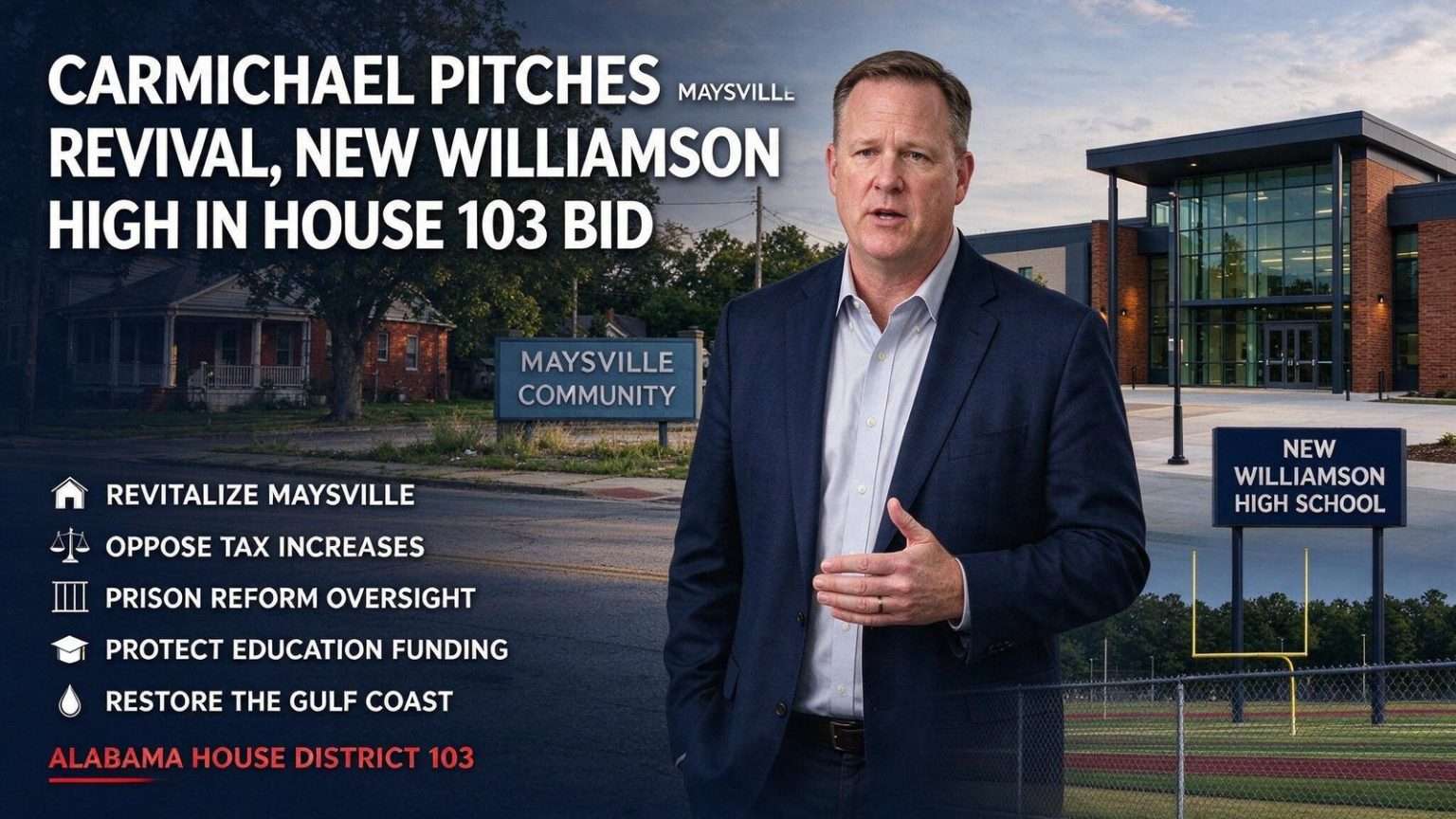
Alabama House District 103, which stretches through parts of Mobile and runs south along Dauphin Island Parkway, drew an unusual rematch this fall as Republican Ralph Carmichael, fresh off an unsuccessful bid for a neighboring seat a year earlier, squared off against Democrat Barbara Drummond, a longtime aide to former Mobile Mayor Sam Jones. The seat opened up after incumbent Democrat Joseph Mitchell chose not to seek re-election.
Carmichael’s path to the race was itself unusual. After his elderly mother suffered a fall, he notified the state Republican Party he intended to withdraw from the ballot, but a clerical error kept his name in place. When his mother’s health improved, he decided to stay in the race after all. A former Ford Motor Co. and Quality Management Solutions employee who spent a dozen years as a minister and now runs a day care center, Carmichael described his background as an asset that lets him relate to a wide range of constituents.
His top priority, he said, is building a new Williamson High School and pairing it with a broader revitalization effort in the surrounding Maysville community, where he said enrollment at the current school has been declining for years even though it hasn’t been officially labeled a failing campus by the state. He envisions the rebuilt school including an on-campus football stadium, and he wants to pair that project with a public-private fund that would help residents winterize and modernize older homes, clear overgrown lots, and eventually convert acquired properties into homes sold to new owners. He was careful to frame the effort as requiring “sweat equity” from participants rather than a giveaway.
On the state’s prison system, Carmichael opposed a tax increase to fund reforms but said the state should immediately ensure only female correctional officers supervise the Tutwiler Prison for Women in Wetumpka, a facility that a U.S. Department of Justice report earlier in the year had linked to allegations of sexual assault of inmates by staff. He said the longer-term answer is preventing crime through job creation, including helping former inmates get bonded and insured so employers will hire them after release.
Like most legislative candidates on the ballot that cycle, Carmichael ruled out raising taxes to close a looming shortfall in the state’s General Fund, saying he’d rather study the budget for savings and make Alabama more business-friendly so companies don’t leave the state. He also opposed a suggestion from Gov. Robert Bentley to tap an Education Trust Fund reserve account for business incentives, saying education dollars should stay focused on K-12 classrooms. On spending from Alabama’s share of RESTORE Act oil-spill settlement money, Carmichael floated using some of the funds for a wildlife preserve near the industrial corridor along Dauphin Island Parkway, arguing environmental restoration opportunities won’t come around twice.
Drummond, who did not attend the sit-down with reporters and editors due to a family matter, had previously said her priorities included education, workforce development, restoring voting rights to former offenders who have completed their sentences, and expanding drug courts and addiction treatment as alternatives to incarceration.
Alabama is a state in the southeastern United States bordered by Tennessee, Georgia, Florida, the Gulf of Mexico, and Mississippi. Often called the Heart of Dixie, it spans Appalachian foothills in the north and flat coastal plains in the south. Its largest cities include Birmingham, Montgomery, Huntsville, and Mobile.
Alabama’s history encompasses Indigenous roots, Spanish and French colonial settlement, a cotton-plantation economy, the Civil War and Reconstruction, and the Civil Rights Movement of the 1950s and 1960s, followed by a shift toward manufacturing, aerospace, and technology. Local news across the state frequently reflects this mix of tradition and change.
Mobile is the county seat of Mobile County in southwest Alabama and the state’s only saltwater port. Situated where the Mobile River meets Mobile Bay near the northern Gulf of Mexico, the city has long served as a commercial and cultural gateway between Alabama and the wider Gulf Coast. Founded in 1702 as Fort Louis de la Louisiane and ruled in turn by France, Britain, and Spain before joining the United States in 1813, Mobile carries a layered heritage distinct from the rest of the state.
Today Mobile anchors a metropolitan area spanning Mobile County and neighboring Baldwin County, and it remains a center for shipping, aerospace, healthcare, and higher education in the region. Its downtown and waterfront have seen sustained revitalization, while historic neighborhoods preserve architecture from its colonial and antebellum past. The city’s identity is shaped as much by its working port and industrial base as by its festivals and food culture, making it a frequent focal point for news about growth and change in southern Alabama.
The Gulf of Mexico borders Alabama’s southern edge and defines much of the state’s coastal identity. Alabama’s Gulf coastline, centered on Dauphin Island, Gulf Shores, and Orange Beach, supports a tourism industry built around beaches, charter fishing, and marine recreation, while offshore waters host shipping lanes and energy interests.
The Gulf’s warm, shallow shelf and exposure to hurricanes make weather and disaster preparedness recurring concerns for communities from Mobile to Baldwin County. The marine environment also underpins commercial seafood harvests that have sustained Gulf Coast families for generations, tying the region’s economy and culture closely to the water.
The economy of the Mobile region is diversified across shipping and logistics, aerospace and shipbuilding, healthcare, tourism, and manufacturing. The Port of Mobile is one of the nation’s busiest seaports and a cornerstone of the local and state economy.
Major employers in aviation and defense contribute to a skilled workforce, while economic-development organizations aim to attract investment and jobs through incentives and infrastructure improvements. Small businesses, from restaurants to professional services, form the backbone of neighborhood commerce.
The health of the regional economy is a frequent subject of public discussion and reporting. Workforce development, recruitment of industry, and the fortunes of local retailers all feed into a broader picture of how the Gulf Coast competes and adapts in a changing national economy.
Education in South Alabama spans public school systems in Mobile and Baldwin counties, a network of private and parochial schools, and institutions of higher learning including the University of South Alabama, Spring Hill College, and community colleges. Public-school governance rests with locally elected boards.
Boards oversee budgets, curricula, and facilities, often amid debates over funding equity and student achievement. The region’s colleges contribute not only to the workforce pipeline but also to healthcare, research, and cultural life, and education policy set in Montgomery frequently shapes what local districts can do.
Schools are also central to community stability. Enrollment trends, facility conditions, and graduation outcomes are watched closely by families and employers alike, making education a persistent focus of public attention and news coverage across the Gulf Coast.
Local government in the Mobile area operates through a combination of mayor-council or commission structures at the municipal level and a county commission in Mobile County, with elected officials handling budgets, public safety, infrastructure, and zoning. Baldwin County has its own commission and a collection of incorporated municipalities.
Decisions made in council chambers and commission meetings affect roads, school funding, economic development, and quality of life, which is why coverage of local government is a staple of regional journalism. The interplay between city, county, and state authorities often determines how effectively the area can address shared challenges.
Because many services residents rely on are delivered at the local level, the choices of elected officials have direct, everyday consequences. Budget priorities, in particular, reveal a community’s values and shape the trajectory of growth and public welfare for years to come.
The natural environment is central to life on the Gulf Coast, where barrier islands, bays, rivers, and wetlands support fisheries, recreation, and storm protection. Coastal Alabama faces challenges common to low-lying regions, including hurricane exposure, erosion, and the management of fragile ecosystems.
The Mobile-Tensaw Delta, one of the largest river deltas in the country, is a particularly significant natural asset. Conservation efforts, fisheries regulation, and shoreline restoration are frequent points of collaboration among state agencies, federal bodies like the Army Corps of Engineers, and environmental groups.
How the region plans for growth while protecting its natural assets is a recurring theme in local reporting. The tension between development pressure and ecological stewardship plays out in zoning fights, infrastructure projects, and disaster-recovery decisions that shape the coast for generations.
Local journalism serves as the connective tissue of communities like those across South Alabama, informing residents about government, schools, public safety, and the events that shape daily life. Outlets covering Mobile and Baldwin County help hold institutions accountable and give voice to neighborhood concerns larger media may overlook.
In an era of shifting advertising revenue and the rise of digital platforms, community news organizations have had to adapt how they gather and deliver information. The persistence of regional reporting remains important for civic engagement, particularly on issues such as coastal development, education, and local governance that directly affect residents.
The relationship between a local newsroom and its community is reciprocal: readers supply tips, context, and a sense of what matters, while the reporting provides a shared record of decisions and events. That loop is essential to a well-informed public.