Historical artifacts and paintings on display at a Mobile art museumA new exhibit at the History Museum of Mobile showcases rare works by artist Roderick MacKenzie.

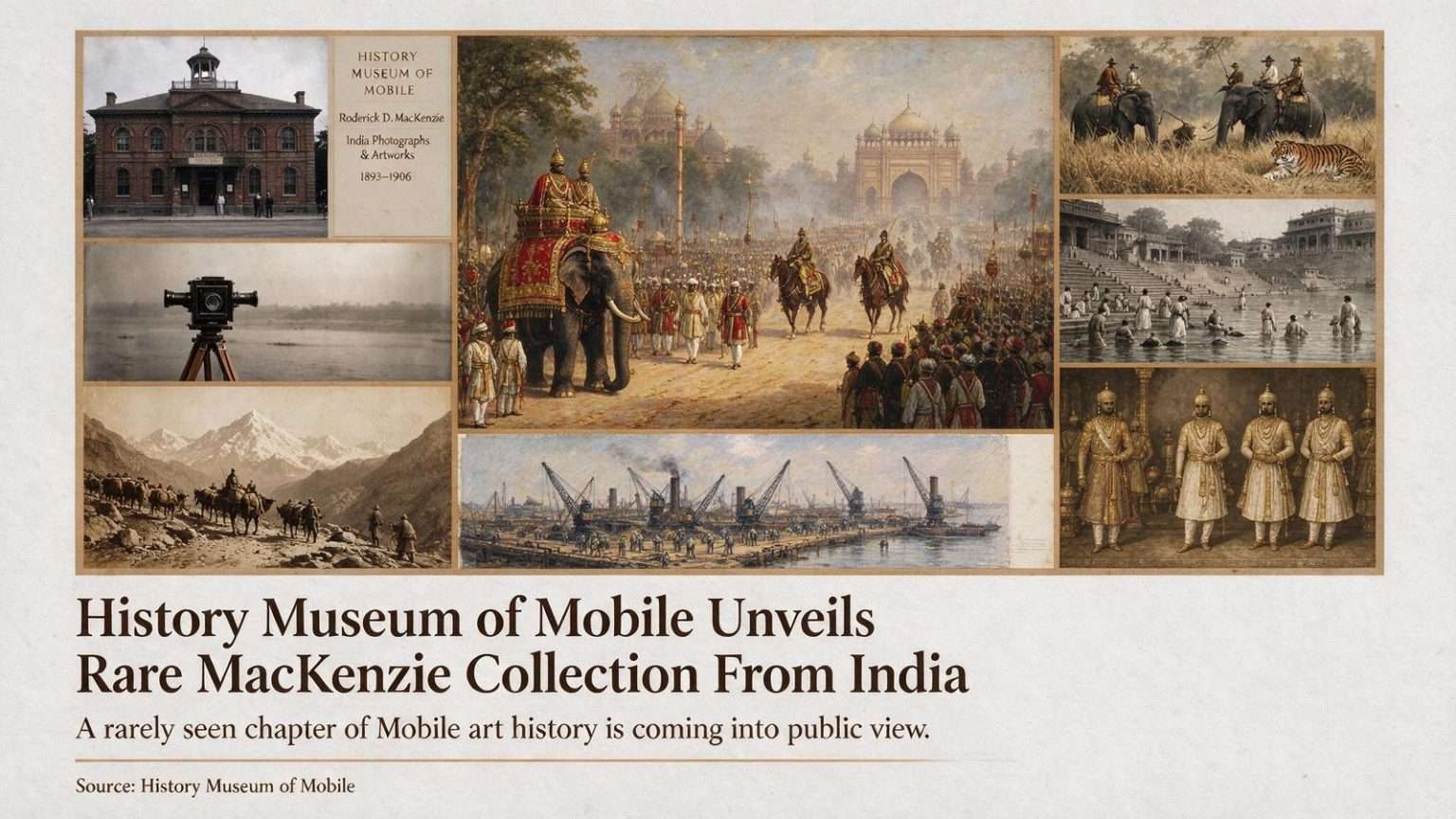
A rarely seen chapter of Mobile art history is coming into public view this month as the History Museum of Mobile prepares to open its largest internally produced exhibit in the institution’s 50-year history. The show centers on more than 100 artifacts and images created and collected by Roderick D. MacKenzie, a Mobile-born painter and photographer who traveled through South Asia at the turn of the twentieth century and later gained international recognition for his work.

MacKenzie grew up in Mobile in the 1870s before spending more than a decade, from 1893 to 1906, traveling across India. During that time he documented everything from tiger hunts and mountain expeditions along the country’s northern border to swims in the Ganges River, capturing both the wealth of Indian royalty and the hardships of laborers he encountered along the way.

Museum staff say the idea for the exhibit took shape roughly five years ago, when curators cataloging the museum’s holdings recognized the significance of hundreds of glass-plate photography slides MacKenzie had brought back from his travels. The artist used a small glass-plate camera to produce four-inch slides, then created finished images through a contact-printing process that exposed photographic paper directly to the slide. Many of those images have never before been displayed publicly, having remained in storage since MacKenzie returned to Mobile just before the outbreak of World War I.

According to museum records, the slides eventually made their way into the History Museum’s collection through the family of a fellow Mobile artist, who is believed to have preserved them after MacKenzie’s death in 1941. Nearly all of the artifacts featured in the exhibit are already part of the museum’s permanent holdings.

The centerpiece of the show is a full-scale reproduction of MacKenzie’s monumental painting depicting a ceremonial procession marking the crowning of a British monarch as Emperor of India in the early 1900s — a work originally commissioned by the era’s British colonial administration and now housed overseas. Museum staff worked with local printers to enlarge and reproduce the image on canvas specifically for the Mobile display, marking what curators describe as the first time area residents will be able to see the piece.

Beyond the India material, the exhibit also includes MacKenzie works closer to home, including pastel studies of the construction of the Bankhead Tunnel and what is believed to be his final, unfinished painting of the Alabama Drydock and Shipbuilding Company on Pinto Island, along with a series depicting Alabama’s steel industry.

See also  Man Shot Multiple Times After Being Boxed Into Clinton Avenue Driveway

Museum leaders say they plan to send the exhibit on a statewide tour after its run in Mobile closes next fall, and a companion book about MacKenzie’s life and travels is available for purchase at the museum gift shop. A public lecture on MacKenzie’s time in India is also planned later in the month. The History Museum of Mobile, located downtown on South Royal Street, offers free admission and is open Tuesday through Sunday.

Mobile is the county seat of Mobile County in southwest Alabama and the state’s only saltwater port. Situated where the Mobile River meets Mobile Bay near the northern Gulf of Mexico, the city has long served as a commercial and cultural gateway between Alabama and the wider Gulf Coast. Founded in 1702 as Fort Louis de la Louisiane and ruled in turn by France, Britain, and Spain before joining the United States in 1813, Mobile carries a layered heritage distinct from the rest of the state.

Today Mobile anchors a metropolitan area spanning Mobile County and neighboring Baldwin County, and it remains a center for shipping, aerospace, healthcare, and higher education in the region. Its downtown and waterfront have seen sustained revitalization, while historic neighborhoods preserve architecture from its colonial and antebellum past. The city’s identity is shaped as much by its working port and industrial base as by its festivals and food culture, making it a frequent focal point for news about growth and change in southern Alabama.

Alabama is a state in the southeastern United States bordered by Tennessee, Georgia, Florida, the Gulf of Mexico, and Mississippi. Often called the Heart of Dixie, it spans Appalachian foothills in the north and flat coastal plains in the south. Its largest cities include Birmingham, Montgomery, Huntsville, and Mobile.

Alabama’s history encompasses Indigenous roots, Spanish and French colonial settlement, a cotton-plantation economy, the Civil War and Reconstruction, and the Civil Rights Movement of the 1950s and 1960s, followed by a shift toward manufacturing, aerospace, and technology. Local news across the state frequently reflects this mix of tradition and change.

The history of South Alabama is shaped by its position at the crossroads of cultures and waters. Indigenous peoples, including the Muscogee (Creek) and Choctaw, lived in the region for centuries before European colonization by French, British, and Spanish powers.

See also  Citronelle Firefighters Battle Early-Morning Mobile Home Fire; Everyone Escapes Safely

The cotton economy and the Civil War left deep imprints, as did the Civil Rights Movement, in which Alabama played a defining role. Understanding present-day debates in the region often requires appreciating this layered past, in which port commerce, racial history, and coastal geography have long intertwined.

That inheritance is visible in the architecture, street names, and institutions of the area. Public memory of the past informs contemporary conversations about growth, equity, and identity, and it frequently surfaces in coverage of local events and policy.

Behavioral-health care on the Gulf Coast is provided by a mix of community mental-health organizations, hospital systems, and private practitioners. Community centers play an especially important role in serving patients who might otherwise lack access to care, often coordinating with courts, jails, and social services.

Demand for these services has grown alongside heightened public awareness of mental illness and the lasting effects of disasters such as hurricanes. Workforce shortages of psychiatrists and other clinicians are a persistent challenge nationwide, and they shape how providers allocate limited staff time between direct patient care and the administrative and legal obligations that accompany treatment.

The intersection of mental health and the justice system is a national concern as well as a local one. Communities across the country have debated how best to divert people in crisis away from jails and toward treatment, a conversation that informs how courts, clinicians, and advocates approach commitment hearings and related proceedings.

Local government in the Mobile area operates through a combination of mayor-council or commission structures at the municipal level and a county commission in Mobile County, with elected officials handling budgets, public safety, infrastructure, and zoning. Baldwin County has its own commission and a collection of incorporated municipalities.

Decisions made in council chambers and commission meetings affect roads, school funding, economic development, and quality of life, which is why coverage of local government is a staple of regional journalism. The interplay between city, county, and state authorities often determines how effectively the area can address shared challenges.

Because many services residents rely on are delivered at the local level, the choices of elected officials have direct, everyday consequences. Budget priorities, in particular, reveal a community’s values and shape the trajectory of growth and public welfare for years to come.

The economy of the Mobile region is diversified across shipping and logistics, aerospace and shipbuilding, healthcare, tourism, and manufacturing. The Port of Mobile is one of the nation’s busiest seaports and a cornerstone of the local and state economy.

See also  From Spring Hill to Kilimanjaro: Rep. Jamie Ison Trains for Africa's Highest Peak

Major employers in aviation and defense contribute to a skilled workforce, while economic-development organizations aim to attract investment and jobs through incentives and infrastructure improvements. Small businesses, from restaurants to professional services, form the backbone of neighborhood commerce.

The health of the regional economy is a frequent subject of public discussion and reporting. Workforce development, recruitment of industry, and the fortunes of local retailers all feed into a broader picture of how the Gulf Coast competes and adapts in a changing national economy.

Baldwin County sits directly east of Mobile County across Mobile Bay and is the largest county in Alabama by land area. It encompasses the Eastern Shore communities of Daphne, Fairhope, Spanish Fort, and Foley and stretches south to the beaches of Gulf Shores and Orange Beach along the Gulf of Mexico.

Long among the fastest-growing counties in the state, Baldwin blends suburban development near the bay with tourism-driven coastal economies. Its proximity to Mobile and its position on the Eastern Shore make it a recurring subject of regional news covering growth, infrastructure, schools, and the balance between development and coastal preservation.

Mobile Bay is a shallow estuary in southern Alabama where freshwater from the Mobile, Tensaw, and other rivers mixes with saltwater from the Gulf of Mexico. It is among the largest estuarine systems in the United States and supports commercial and recreational fishing, shipping through the Port of Mobile, and wetlands that buffer the coastline from storms.

The bay’s Eastern Shore, in Baldwin County, includes Daphne, Fairhope, and Spanish Fort, while the Western Shore lies in Mobile County. Its ecology and economy have guided settlement for centuries, and the bay figures in regional debates over development, navigation, and conservation. Events on either shore are routinely covered as part of the interconnected life of the Mobile metro area.