Satsuma Is Done Handing Out Warnings: Parents Can Now Get the Ticket When a Kid Rides an ATV Down the Street
After months of warnings, Satsuma Police say they will begin issuing municipal ordinance tickets to juveniles riding off-road vehicles on public streets — and in many cases, the parent or guardian will be the one who gets it.
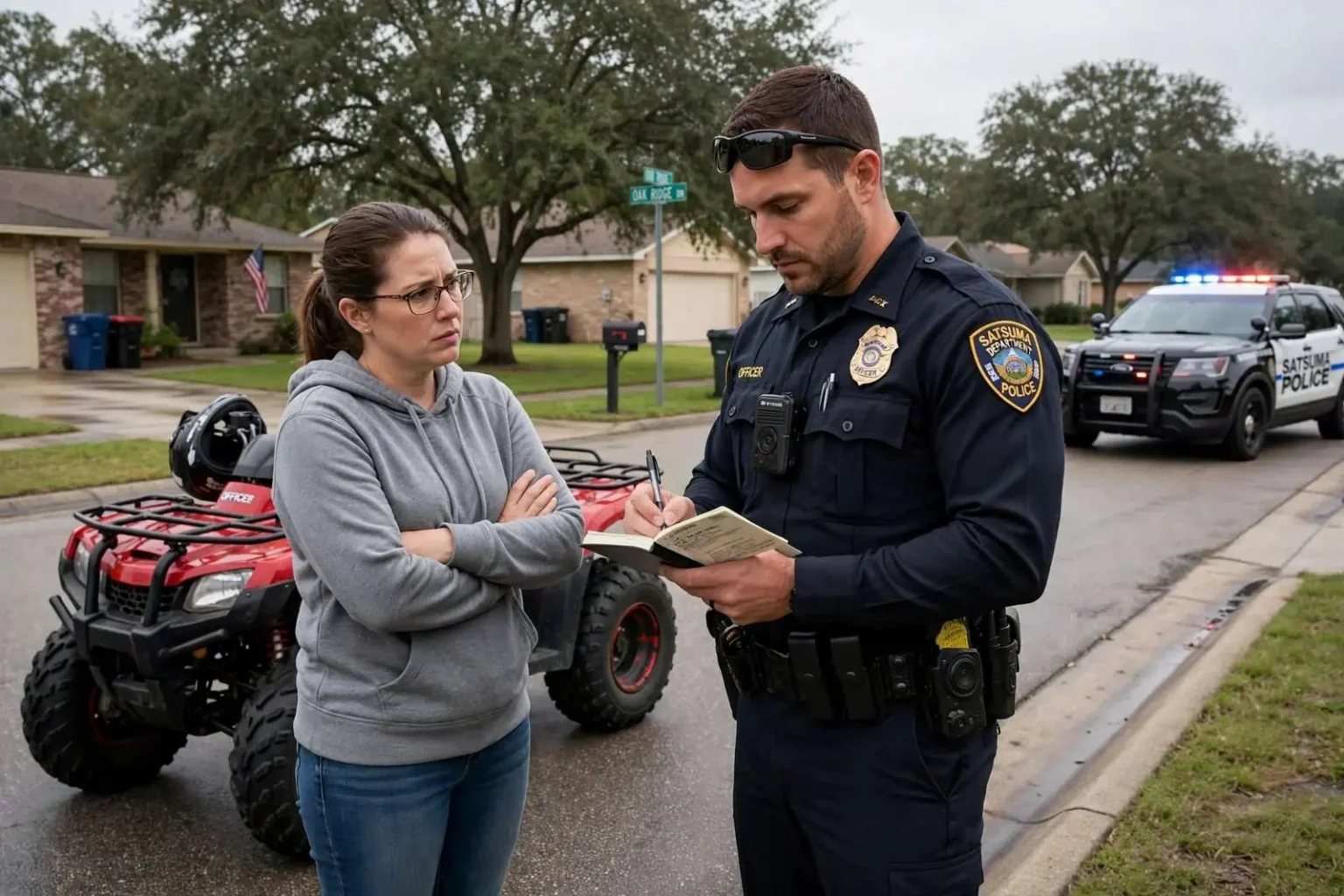
For the last several months, teenagers riding golf carts and dirt bikes through Satsuma’s neighborhoods have been getting a warning. That is over. The Satsuma Police Department has announced it will now issue municipal ordinance tickets to juveniles caught operating off-road vehicles on public roads inside the city limits — and in many cases, the citation will go to the parent or guardian rather than the child.
The shift ends a grace period that officers extended deliberately. Police said they had spent months educating families about the rules before moving to formal enforcement, giving parents time to adjust to requirements that many residents did not realize applied to golf carts and dirt bikes ridden close to home. Now, the department says, the warnings phase has run its course.
What Is Covered
According to the department, officers will write tickets when they see a juvenile operating any of the following on public streets, public property, or public rights-of-way within Satsuma: golf carts, ATVs, dirt bikes, go-carts and other off-road vehicles. The list covers the machines most commonly seen in the city’s residential areas, from the golf carts that families use for short trips down the street to the dirt bikes and four-wheelers that turn quiet subdivisions into informal motocross courses.
The scope matters because many families assume that a slow-moving vehicle is automatically street legal. In Satsuma, as in municipalities across Alabama, the question is not how fast a vehicle travels but whether it is built and equipped for road use at all. A golf cart crossing a public right-of-way, a four-wheeler idling down a city street and a dirt bike jumping curbs all fall under the same ordinance, regardless of how short the trip may be.
The Ticket May Land With the Parents
Police were direct about who ends up paying. In cases involving juveniles, the parents or guardians might be the ones issued the citation.
“These tickets can become expensive, and we want parents and guardians to be aware before they become the first to receive one.”
That structure is common in Alabama municipal enforcement. When a child is too young to be cited as an adult under local ordinance, responsibility shifts to the adults responsible for the child’s supervision, meaning a parent can face the fine for a ride they never saw and never approved. The department is using that reality as its central message: if a juvenile is going to ride, the decision belongs to the parent long before the flashing lights appear at the end of the street.
The department framed the announcement as a heads-up rather than a crackdown, noting that the change follows months of officers issuing warnings instead of citations. Families who have already received a warning should understand that the second encounter is unlikely to end the same way.
The Reason Is Injuries, Not Revenue
Satsuma police said the purpose of the shift is to prevent serious injuries and to make sure parents understand the rules before enforcement begins in earnest.
“The goal of this notice is not to issue tickets. The goal is to prevent injuries and make sure parents understand the rules before enforcement action is taken. Please help us keep Satsuma’s children, streets, neighborhoods, parks, and public areas safe.”
The safety argument rests on the fundamental mismatch between off-road machines and public streets. Off-road vehicles are built for terrain, not traffic. They generally lack the lighting, turn signals, mirrors, seat belts and crash protection that street-legal vehicles are required to have, which is the core of why municipalities across Mobile County restrict them from public roadways.
That equipment gap translates directly into crash outcomes. A driver approaching a golf cart at dusk may never see it, because the cart carries no headlights or reflectors visible at road distance. An ATV rider struck by a car has no seat belt, no airbag and no frame around them, so the rider’s body absorbs the entire impact. Emergency physicians treat these machines with the same caution they apply to motorcycles, and pediatric trauma cases involving ATVs are among the most serious that rural and suburban emergency departments see.
There is also the issue of braking and handling. Off-road vehicles are tuned for loose surfaces, with tires and suspensions designed for dirt rather than asphalt, and they behave unpredictably on pavement — particularly at the intersections and corners where a municipal street network concentrates its conflicts. A machine that feels stable in a field can slide, tip or refuse to stop in time on a crowned residential road.
A Note on E-Bikes
Police also used the announcement to clarify where electric bicycles stand. Under Alabama traffic law, e-bikes are generally treated like bicycles. However, officers noted that riders may still be ticketed if modifications have been made to the bike that push it outside that legal definition — for example, alterations that significantly increase its speed or motor output.
The distinction matters as powered two-wheelers multiply in garages across the region. A standard e-bike, with pedals and a motor that assists within legal limits, occupies the same regulatory space as a child’s bicycle, and the same rules of the road apply. But the internet is full of conversion kits and unlocked controllers that push ordinary bikes far past those limits, turning what looks like a bicycle into something closer to an unlicensed motor vehicle. Satsuma officers say that line — the modification line — is where a legal ride can become a citable one.
Families shopping for e-bikes are advised to keep the original specifications, know the machine’s assisted top speed, and avoid aftermarket modifications that a police officer cannot quickly verify. The safest position is simple: if a machine looks and performs like a bicycle, it will be treated like one, and if it has been altered to perform like a motorcycle, the rider should expect it to be regulated like one.
What Satsuma Families Should Do
Parents with children who ride off-road vehicles are encouraged to keep the riding on private property with permission, or at designated off-road areas. North Mobile County offers more legal options than many families realize, including private land arrangements with landowners and off-road parks within driving distance of the city where ATVs and dirt bikes are the entire point of the property.
Families who are unsure whether a particular vehicle or e-bike is street legal within the city can contact the Satsuma Police Department directly for clarification before a first citation arrives in the mail. Officers would rather answer the question at the front counter than document it in a ticket book, and the department’s message makes clear that the enforcement phase is aimed at households that have already been informed.
The department’s bottom line is that the rule change is not a surprise tax on family fun but a response to what officers have been watching happen on Satsuma’s streets for months. The warnings were the courtesy. The tickets, and the injuries the tickets are meant to prevent, are what the city is now working to avoid — and the responsibility for both rests where the department has always said it does, with the adults at home.
Why Cities Like Satsuma Write Their Own Rules
Alabama leaves substantial authority over local streets to municipalities, and cities across Mobile County have used it to restrict off-road vehicles in the same way Satsuma now enforces. The logic is consistent from city to city: public roads are engineered and insured for licensed vehicles, and anything else introduces risks and costs that the road system was never designed to carry. What varies is enforcement, which is why a warning period like Satsuma’s has been the standard approach for departments introducing a rule that many families had never thought about.
Municipal ordinances also close a gap in state law. State traffic statutes focus on motor vehicles operated by licensed drivers, which leaves young riders on golf carts and ATVs largely outside the state’s framework. Without a local ordinance, officers often have few tools beyond a verbal warning when a 12-year-old rides a four-wheeler down the shoulder of a city street. Satsuma’s ordinance gives officers a documented, escalating response, and gives parents a clear written line they can be held to.
The Enforcement Question
Departments that move from warnings to citations typically see a familiar pattern. Initial enforcement generates complaints, then compliance improves quickly, and within a season the sight of a golf cart parked legally in a driveway becomes the norm rather than the exception. Satsuma’s decision to target citations at parents rather than children is designed to accelerate that adjustment, because a fine that lands on an adult gets discussed at the dinner table in a way a warning to a child never does.
Officers will still retain discretion, as they do with any ordinance. The department’s announcement emphasizes visibility rather than quotas — the goal is for every family in the city to know the rule before an officer has a reason to apply it. Residents with questions about specific streets, shared-use paths or neighborhoods where riding may be tolerated are encouraged to ask before assuming anything.
The Larger Safety Picture
The announcement fits into a broader pattern of small-city Alabama police departments taking on quality-of-life and child-safety issues that fall between the cracks of state law. Off-road vehicle crashes involving juveniles are a recurring summertime problem across the Gulf Coast, and departments have found that the most effective intervention is rarely the crash investigation — it is the ordinary traffic stop that happens before the crash ever occurs.
For Satsuma families, the practical checklist is short. Keep off-road machines on private property with the owner’s permission, or take them to a designated off-road area. Treat any modified e-bike as the motor vehicle it may have become. Ask the police department when a vehicle’s status is unclear. And expect that the era of the warning, which the department says is now over, will not return.
The department closed its notice by returning to the point it considers most important: the goal is not tickets, and it never was. The goal is children who arrive home safely at the end of every ride, streets and parks that remain safe for everyone who uses them, and parents who understand the rules before — rather than after — the citation is written.