70-Year-Old Mobile Man Faces Sentencing in Cottage Hill Road Bank Robbery
A 70-year-old Mobile man who pleaded guilty to robbing a bank while wearing a mask and carrying a fake gun faces federal sentencing.
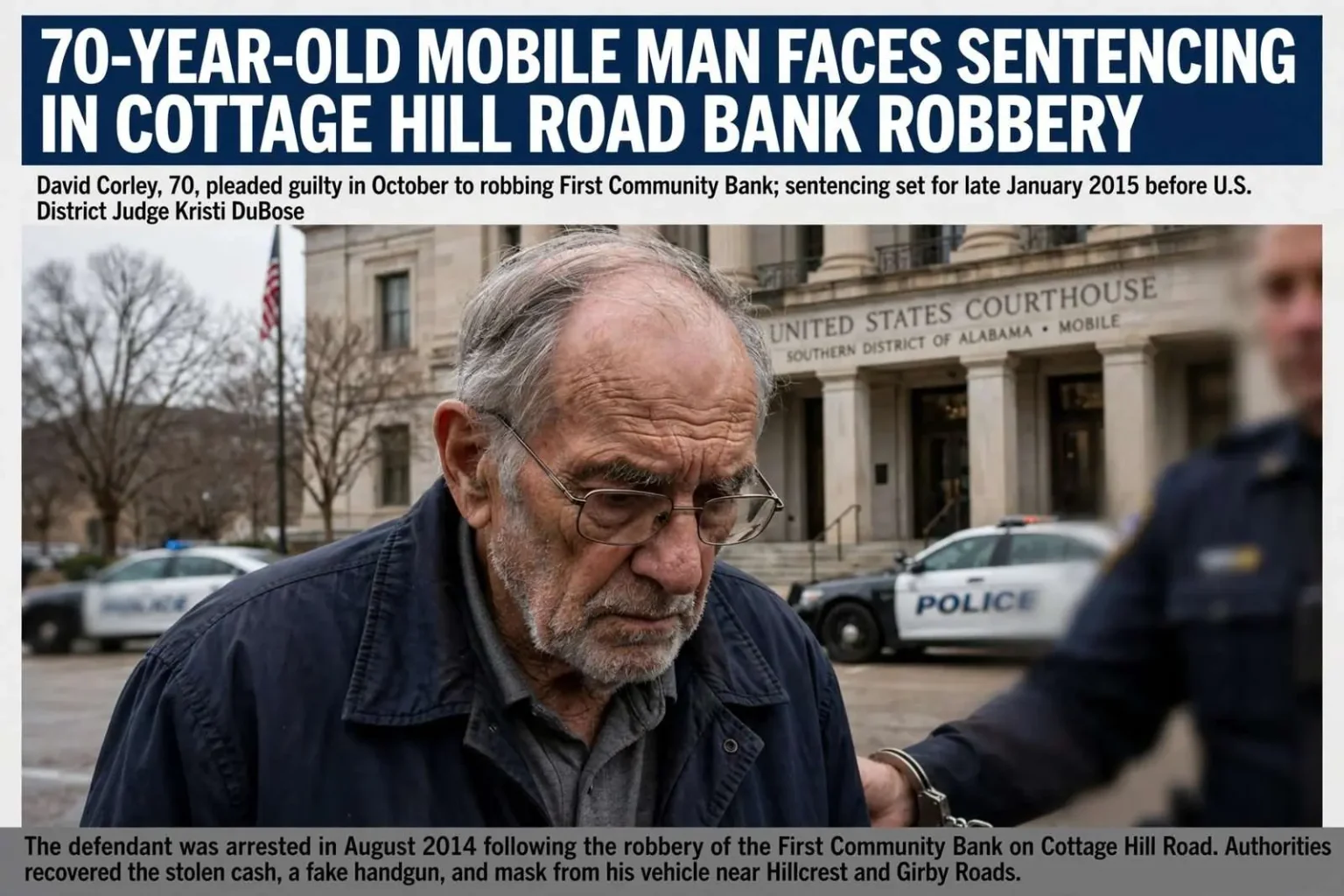
A 70-year-old Mobile man who admitted to robbing a bank of more than $7,400 was scheduled for sentencing in federal court in late January 2015, months after his arrest and guilty plea in the case. David Corley was taken into custody in August 2014 in connection with a holdup at First Community Bank on Cottage Hill Road in Mobile, and his case has moved through the federal system with unusual speed for a bank robbery prosecution.
He later pleaded guilty in October to a federal bank robbery charge at the federal courthouse in Mobile. U.S. District Court Judge Kristi DuBose was set to determine his sentence, with federal law allowing for a maximum punishment of up to 20 years in prison for the offense.
According to a statement of facts filed with the court, Corley entered the bank wearing a mask and carrying a fake handgun, demanding that a teller fill a bag with cash. The teller complied, placing a mix of marked and unmarked bills into a plastic bag before Corley fled the scene.
The choice to include marked bills in the bag proved consequential. Banks across the country routinely stock their teller drawers with bait money — currency whose serial numbers are recorded so that it can be traced if a robbery occurs — and the presence of both marked and unmarked bills gave investigators a way to connect the money found in Corley’s vehicle directly to the Cottage Hill Road branch.
Mobile police stopped Corley a short time later as he drove near the intersection of Hillcrest Road and Girby Road, in the same general area of west Mobile as the bank. Court records state that when officers asked him why he was being pulled over, Corley told them directly that he had just robbed a bank.
Officers recovered the stolen cash, the fake weapon and the mask from the vehicle. After being read his Miranda rights, Corley confessed in detail to the robbery, according to federal court records, providing investigators with an account that matched the evidence recovered at the scene and in his car.
Under federal law, the offense Corley was charged with carries the same elements whether the weapon is real or an imitation, though the distinction matters at sentencing. The fake handgun recovered from his vehicle, along with the mask, formed the physical core of the government’s case alongside the marked and unmarked bills taken from the bank.
A case that moved quickly
The case moved through the federal court system over several months, from Corley’s arrest in August through his guilty plea in October and on to sentencing proceedings in January. That pace reflects how bank robbery cases proceed once the evidence is strong: with a stop made minutes after the crime, the proceeds and the weapon in hand, and a confession on the record, there was little for prosecutors and defense attorneys to contest, and a plea agreement followed rather than a trial.
The quick resolution also reflects coordination between local and federal authorities. Mobile patrol officers made the traffic stop and recovered the evidence, and the case then crossed into the federal system, where prosecutors took over the charging decision and court proceedings. This division of labor is standard in bank robbery cases, but the speed with which Corley’s case moved from stop to plea shows how smoothly it can work when the underlying facts are not in dispute.
Bank robbery cases in the Southern District of Alabama are prosecuted federally because banks are insured by the Federal Deposit Insurance Corporation, giving federal authorities jurisdiction regardless of the amount taken. The FDIC connection means that even a small credit union branch or community bank on a Mobile side street is, in the eyes of federal law, a federally insured financial institution, and a holdup there is a federal crime from the moment it occurs.
That jurisdictional rule explains why residents so often see bank robbery defendants appear before federal judges like DuBose rather than in state court, even when the crime is investigated by city police. The federal government’s interest in bank robbery is longstanding, and the Southern District of Alabama handles a steady share of such cases drawn from Mobile and the surrounding counties.
How federal sentencing works in robbery cases
Sentencing outcomes in federal bank robbery cases can vary widely based on a defendant’s criminal history, the use of a weapon (real or simulated), and whether the defendant accepts responsibility early in the process, as Corley did with his guilty plea months before sentencing. Federal judges weigh those factors under the advisory sentencing guidelines, which assign offense levels based on the conduct involved and adjust upward or downward for aggravating and mitigating circumstances.
In Corley’s case, several details stand out. The weapon was fake, not functional, which typically matters in how the conduct is scored under the guidelines. His age — 70 — may also factor into the court’s assessment, as may his decision to confess to officers at the scene and to plead guilty well before trial. On the other side of the ledger, the robbery involved a masked entrance into a working bank with employees and customers present, the kind of circumstance courts treat as frightening and destabilizing for the people inside.
The maximum sentence available to Judge DuBose is 20 years in prison, though the actual sentence in any given case can fall well below the statutory cap depending on the guideline calculation and the judge’s assessment of the defendant’s history and circumstances. At sentencing, prosecutors and the defense will each have the opportunity to argue for the sentence they believe appropriate, and Corley’s attorneys may present information about his background and health before the court decides.
Federal sentences also typically include a period of supervised release to follow any prison term, along with an order of restitution requiring the defendant to repay the bank for the money taken. In a case where the cash was recovered at the scene, restitution questions are simpler than in most robberies, but the court retains the authority to order repayment of any loss the institution suffered.
The Cottage Hill Road holdup
The bank Corley is accused of robbing sits on Cottage Hill Road, a busy east-west corridor in west Mobile lined with shopping centers, restaurants, and neighborhood businesses. Branch banks along commercial corridors like this one handle steady daily traffic, and a robbery in the middle of a business day puts tellers, other staff, and customers through an experience that many bank employees describe as the most frightening of their working lives. Banks typically retrain staff on robbery procedures after such incidents and rely on quiet alarms, surveillance cameras, and bait currency to protect both people and money.
The teller’s decision to comply with the demand — handing over the cash rather than resisting — is exactly what bank security training instructs, and it is one reason no one was physically harmed during the holdup. Money is insured and replaceable; the priority in every robbery protocol is the safety of the people inside the building.
Once the alarm was raised, the response moved fast. A description of the suspect and his vehicle, relayed to patrol officers in the area, put Mobile police units on the lookout in the streets around the bank — and the stop near Hillcrest and Girby came a short time later. Cases like Corley’s underscore how quickly local law enforcement and federal investigators can move once a robbery suspect flees a scene, particularly when a description and vehicle information are relayed to patrol officers in the area.
The swift stop near Hillcrest and Girby roads, combined with recovered evidence and a voluntary confession, left little room for dispute once the case reached federal prosecutors. Defense counsel had little to work with in challenging the facts, and the plea in October locked in the reality that the January hearing would be about punishment, not guilt or innocence.
What happens at sentencing
At the January hearing, the court will review the presentence investigation report — a document prepared by federal probation officers that details the offense, the defendant’s criminal and personal history, and the guideline calculation. Both sides may object to the report, and the judge will resolve any disputes before announcing the sentence.
Victim impact is also part of the record in bank robbery cases. While no one was injured in the Cottage Hill Road holdup, the employees who faced a masked robber demanding cash are considered victims of the offense, and their accounts can inform the court’s view of the crime’s seriousness.
When Judge DuBose announces the sentence, it will close out a case that began on an ordinary business day at a west Mobile bank and ended, within roughly half a year, with a guilty plea and a confession on the record. For the bank’s staff and the residents of the neighborhoods around Cottage Hill Road, the resolution brings the incident one step closer to being fully behind them.