Orange Beach School Split Campaigns Show Wide Fundraising Gap Ahead of Vote
Campaign finance records show a $50,000 fundraising gap between Orange Beach groups on opposite sides of a school-split referendum ahead of the vote.
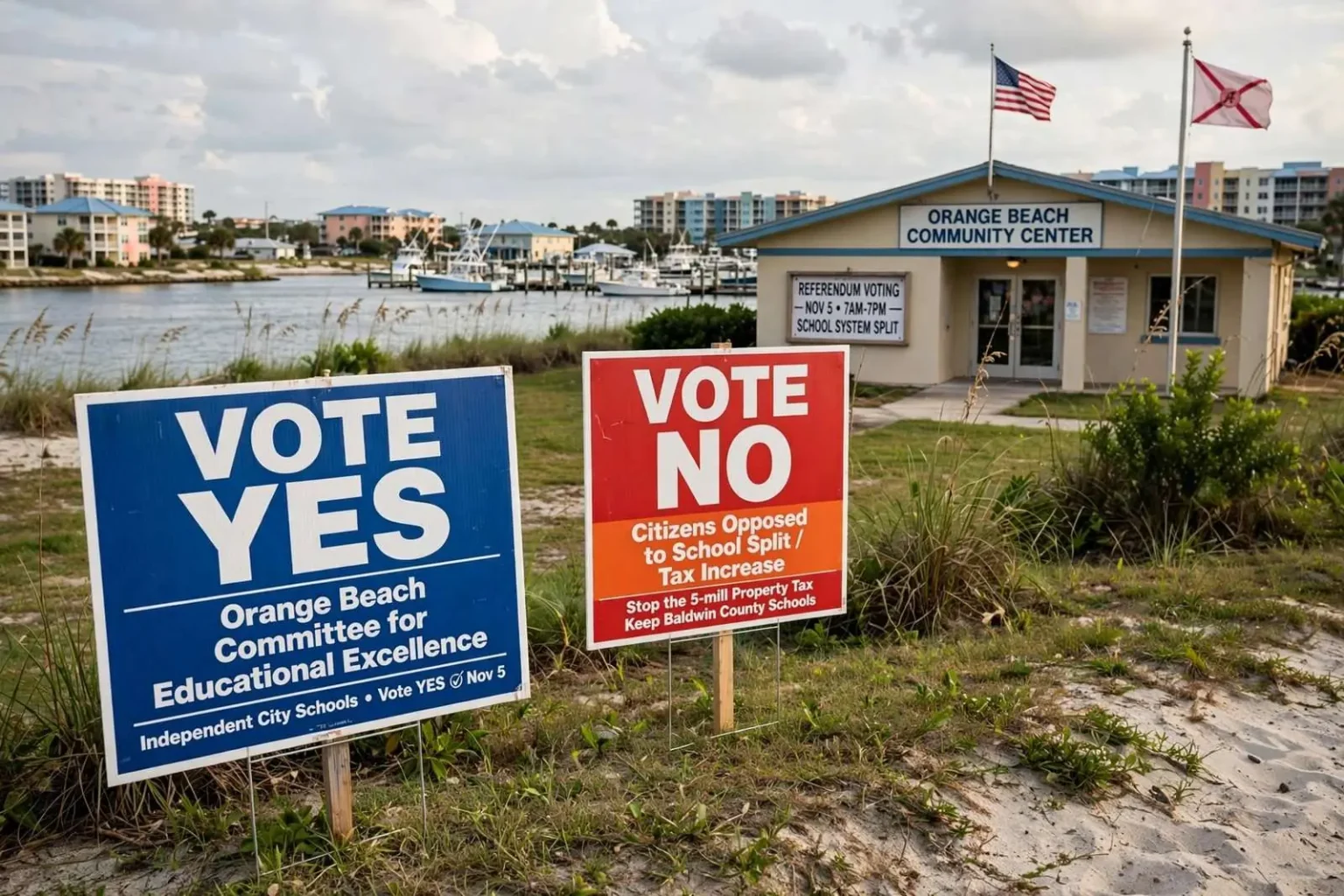
With Orange Beach residents just days from deciding whether to break away from the Baldwin County school system, campaign finance filings reveal a lopsided money race between the two sides pushing their case to voters.
Records filed with the Baldwin County Probate Court show a fundraising gap of more than $50,000 between the political action committees supporting and opposing the split.
The Orange Beach Committee for Educational Excellence, the group pushing for an independent city school system, reported raising $45,360 in cash donations plus another $10,762 in in-kind services since forming in mid-July. The opposing group, Citizens Opposed to School Split/Tax Increase, had raised just $3,725 since organizing in early August.
The discrepancy means the pro-split committee outraised its opposition on paper by more than twelve to one in cash alone, and by an even wider margin once the in-kind contributions — typically donated advertising, printing, or professional services — are counted. In a referendum with an electorate of a few thousand voters, that advantage translates into saturation: billboards, yard signs, direct mail, and radio spots across a city small enough that a modest budget can reach nearly every household repeatedly.
What voters are deciding
The referendum asks the city’s more than 5,500 registered voters to decide on a 5-mill property tax increase that would fund the creation of an independent Orange Beach school system, breaking away from the countywide Baldwin County system. Voting was set to take place at the Orange Beach Community Center.
A 5-mill levy means five dollars of tax for every $1,000 of assessed property value — and in a city whose property base is dominated by waterfront homes, condominium towers, and resort development, assessed values run far higher than in typical Alabama municipalities. That is precisely the arithmetic that split supporters leaned on: a city with some of the highest property values in the state can fund a school system with a tax rate that would produce far less elsewhere, while opponents pointed out that the same taxable base carries the full weight of the increase for homeowners and landlords alike.
The vote itself was the culmination of a process that began with a petition drive and a feasibility study — the standard sequence under Alabama law, in which a city must demonstrate that it can support a school system before a referendum goes to the voters. State officials then certify the election, and if the measure passes, the city moves to a transition period: hiring a superintendent and board, purchasing or leasing facilities from the county system, and setting an opening date.
Who is funding the pro-split campaign
Financial disclosures show the pro-split committee drew support from a broad mix of volunteers, business owners, city councilmen and real estate developers. Its two largest donors each contributed $10,000, with additional five-figure support coming from a handful of local businesses and construction firms. Several sitting city councilmen also contributed personally to the effort.
The donor mix told its own story about who expected to benefit from an independent system. Real estate interests and developers have historically been among the strongest supporters of new city school systems across Alabama, on the theory that high-performing city schools raise property values and accelerate sales of new homes and condominiums. Local businesses, meanwhile, pitched in on the argument that a city-run system keeps tax money and decision-making inside the municipality, and that good schools are central to recruiting families to a resort economy that needs year-round workers.
The participation of sitting councilmen — personal donations, disclosed in the filings — signaled that the city’s elected leadership was not merely neutral on the question but invested in it, even though the referendum was technically a decision for voters rather than the council. Under Alabama’s campaign finance rules, local candidates and officials may contribute to political action committees as individuals, and the disclosures listed them alongside the business contributions rather than separately.
The bulk of the committee’s roughly $17,000 in spending went toward signage and advertising, along with several thousand dollars paid to an out-of-state consultant for polling and campaign strategy work. Hiring outside consultants is common in Alabama school-split campaigns, where the messaging questions — how to frame the tax, how to answer the county system’s counterarguments, and which precincts to target — have been tested in similar votes across the state.
The opposition’s lean operation
The opposition group, by contrast, relied almost entirely on smaller individual contributions, mostly in the range of $50 to $100 from its own members, with one larger donation of $720 from a pair of local residents.
Its spending, totaling roughly $1,400, went toward yard signs, printed flyers and local radio advertising — a grassroots footprint that reflected both the group’s resources and its argument. Opponents cast the campaign as an effort by wealthy interests to push a tax and a government split onto ordinary residents, and their thin budget became, in a sense, part of the message: this is a fight between checkbooks and neighborhoods.
Campaign finance in Alabama municipal referendums is governed by disclosure requirements that funnel through the Probate Court, the same county office that administers the election itself. Committees must file their contribution and expenditure reports on schedule in the weeks before a vote, and it is those filings — not the campaigns’ own claims — that produced the $50,000 gap figure. The documents are public records, and in a race this small they function as the de facto voter guide: every business, councilman, and household that wrote a check is listed by name, occupation, and amount.
The filings also illustrate how differently the two sides structure a campaign. The pro-split committee operated like a small political firm — a treasurer, an outside consultant, bought media, and a message disciplined by polling. The opposition operated like a neighborhood association with a checking account, its money arriving in envelopes of $50 and $100 from people who lived with the tax — and its reach limited accordingly to the yards, flyers, and radio minutes it could afford.
Why Orange Beach wants out
The split argument in Orange Beach followed a familiar script in Baldwin County. The county school system is one of the largest and fastest-growing in Alabama, stretching from the Fairhope and Daphne communities on Mobile Bay down across Weeks Bay to the coastal cities of Gulf Shores and Orange Beach. County officials have spent years playing catch-up on classroom capacity — rezoning fights, portable classrooms, and school construction debates have been recurring features of Baldwin County politics for two decades as the county’s population boomed.
For Orange Beach, the core grievance was the same one neighboring Gulf Shores had pressed: a coastal city whose residents and businesses generate substantial property tax revenue believes those dollars, sent to the county system, return to the coast in classroom space and programs that don’t match what the city itself could fund. City-specific systems — already operating in Fairhope’s orbit through historic city systems elsewhere in the county’s borders, and in dozens of Alabama cities from Arab to Muscle Shoals — offer local control of curriculum, hiring, calendars, and, most visibly, athletic and extracurricular identity under the city’s own banner.
Supporters framed the split as a chance to build a school system tailored to Orange Beach’s needs, with smaller class sizes, coastal-focused programs, and a district whose boundaries match the city’s. Opponents warned of higher property taxes without a clear guarantee of improved outcomes — and pointed to the costs that a startup district must absorb in its first years, from transportation to special education compliance, that a feasibility study’s projections can understate.
What the vote means either way
Whichever way the vote went, the outcome stood to reshape how thousands of Baldwin County families would send their children to school for years to come.
A yes vote would make Orange Beach one of a small number of Alabama cities to have carved a new district out of a county system in recent decades, and would nearly complete the coast’s separation from the county district, following Gulf Shores’ own pursuit of an independent system. The county system, meanwhile, would absorb the loss of some of the wealthiest taxable property in its borders — a fact county officials weighed as the campaign progressed.
A no vote would leave the city inside the county system but would not necessarily end the movement; school-split efforts across Alabama have often returned to the ballot after a defeat, refreshed with new feasibility figures or a new city administration. The Probate Court filings that revealed the $50,000 gap will remain part of the public record either way, a durable account of which interests — and how many of them — stood behind each side of the most consequential local vote in the city’s recent history.
For the residents of a city of roughly 6,000 that swells to many times that number in summer, the election at the Community Center was a rare moment when the town’s permanent population alone would decide something that its seasonal millions never could: what the schools — and the tax bills — will look like long after the last summer visitor has gone home.