University of South Alabama Bay Minette
Summerdale Father Indicted on Five Charges in the Bathtub Death of His 11-Month-Old Son
A Baldwin County grand jury indicted a Summerdale father on five counts, including reckless manslaughter and criminally negligent homicide, in the May 2014 bathtub death of his infant son.
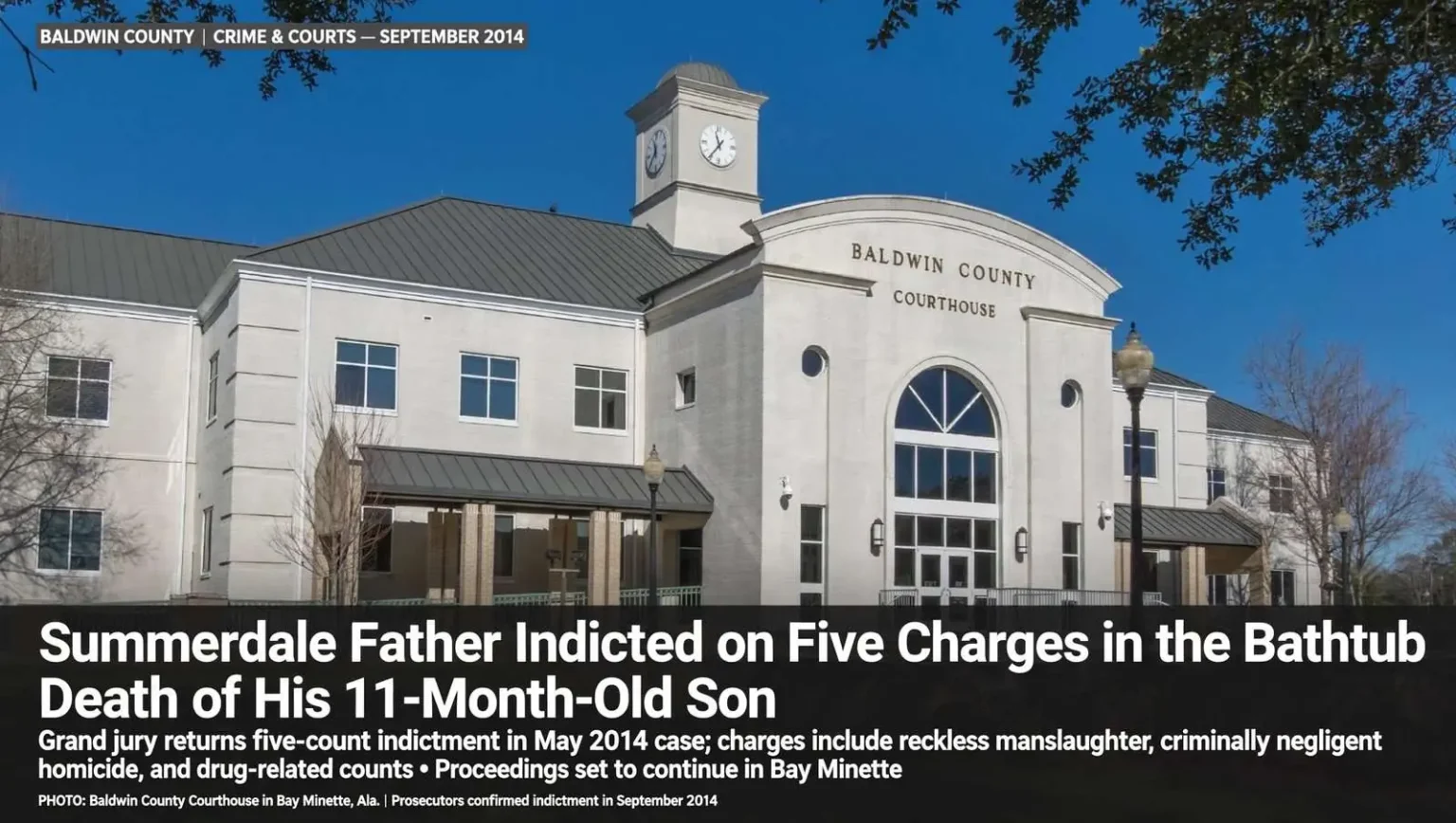
A Baldwin County grand jury returned a five-count indictment against a Summerdale father in connection with the May 2014 drowning death of his 11-month-old son, prosecutors confirmed in September of that year. John Albert McCord III, 37, of Cape Fear Loop, was charged with reckless manslaughter and criminally negligent homicide in the death of his infant son, John Henry Watson McCord. Three additional counts were drug-related: chemical endangerment of a child, possession of a controlled substance and use or possession of drug paraphernalia.
The indictment was handed up as the case moved from Summerdale into the Baldwin County court system, with proceedings centered in Bay Minette, the county seat where Baldwin County’s criminal dockets are heard. The structure of the charges — two homicide theories layered over three drug counts — signaled that prosecutors intended to present the jury with the full range of conduct alleged that day, from the moments in the bathroom to the substance found a few feet away.
What investigators described
According to the Summerdale Police Department, McCord left the 11-month-old and his young stepson alone in a bathtub at the family’s Cape Fear Loop home on May 12, 2014. The tub held roughly eight to 10 inches of water when the infant slipped and fell. A substance believed to be methamphetamine was reported found on the master bedroom floor near the bathroom. The child was pronounced dead May 13 at the University of South Alabama Women’s and Children’s Hospital in Mobile, the regional pediatric hospital to which critically injured Baldwin County children are routinely transported. Police arrested the boy’s father on May 24.
A police officer testified at a July hearing that McCord’s stepson, who was 4 years old at the time, called out to McCord three or four times after his stepbrother fell in the bathtub, but that McCord did not respond. The boy said he then went to find his stepfather in the living area of the home. That testimony, delivered by a child too young for the kinds of statements adults give, became the timeline around which the rest of the case would be built.
Two homicide charges, one difficult question for a jury
The indictment placed two different homicide theories before a potential jury. Baldwin County Assistant District Attorney ChaLea Tisdale explained the legal distinction between the two counts. Reckless manslaughter, she said, occurs when a person who is aware of the risks of their conduct consciously disregards those risks and causes another person’s death. Criminally negligent homicide, by contrast, applies when a person is not aware of the risks, or fails to perceive them, and causes a death through criminal negligence.
The difference between the two turns entirely on the defendant’s state of mind — what he knew, or should have perceived, in the moments before the child fell. Alabama law separates the two offenses precisely so that juries can distinguish between a person who saw a danger and ignored it and a person whose failure to perceive the danger was itself a gross deviation from reasonable care. Manslaughter carries the heavier penalty of the two, which is why prosecutors routinely charge both when the evidence supports either reading of the defendant’s awareness.
“At this point, he has been indicted for both,” Tisdale said. “Therefore, we would expect both to be presented to the jury along with the explanations as to what both charges are. And the jury would then determine what charges to convict or not to convict on.”
Charging both counts in the alternative is a common prosecutorial strategy in cases where the line between recklessness and negligence is the central factual dispute. It preserves the state’s ability to obtain a conviction even if the jury rejects the harsher theory, while leaving the defense free to argue that neither standard was met.
The defense response
McCord’s attorney, Patrick Prendergast, argued that his client could not be found guilty of both reckless manslaughter and criminally negligent homicide, saying a jury would have the option of convicting on one of the charges or acquitting on both. “We will try it as it’s indicted and let the jury hear all the facts,” Prendergast said. “It’s our position he’s not guilty of either one.”
Prendergast’s legal point reflects how the two counts are structured: because they rest on different mental states, they are treated in practice as alternatives rather than a stack. A jury weighing the evidence cannot return convictions on both theories for the same death, so the defense’s task is to knock out the state’s mental-state proof — to show either that McCord did not consciously disregard a known risk, or that whatever failure occurred did not rise to criminal negligence at all.
Chemical endangerment and the drug counts
The three drug-related counts added a separate layer to the case. Chemical endangerment of a child, the charge most often discussed in Alabama courtrooms in that era, applies when a person exposes a child to an environment in which controlled substances are present or consumed. The statute has been among the most aggressively enforced of its kind in the country since its enactment, and its use in cases involving the presence of methamphetamine around children has been upheld repeatedly by Alabama appellate courts.
Paired with simple possession and paraphernalia counts, the chemical endangerment charge allowed prosecutors to address the reported discovery of suspected methamphetamine near the bathroom independently of the homicide counts. Even if a jury acquitted on the death itself, the drug charges would remain for it to decide, a structure that gives juries a way to weigh each element of the day’s events on its own terms.
For the grand jury, the combination was evidently compelling enough to send all five counts forward. Alabama grand jurors hear only the state’s presentation — defense counsel are not part of the proceeding — and their decision to indict on every count submitted suggested prosecutors presented a coherent account across both the death investigation and the drug evidence.
A community and a court system watching
The indictment marked a significant step in a case that had drawn attention across south Baldwin County since the spring. Summerdale, a small town in the county’s lower tier between Foley and the interstate, rarely sees cases of this gravity, and the months between the child’s death and the grand jury’s action were filled with the slow, procedural work that such investigations require: forensic results, child interviews, hospital records and the coordination between a small municipal police department and the district attorney’s office.
That coordination is itself a study in how Alabama’s court systems function. A municipal arrest in Summerdale begins a case in municipal court, but felony charges are bound over to the county system, where a grand jury reviews the evidence before any trial can be scheduled. From Bay Minette, the case would move through arraignment, motions and hearings in the circuit court of the 28th Judicial Circuit, which serves Baldwin County entirely.
Child welfare agencies also run parallel to such prosecutions, a fact often invisible in the public record. When a child dies in a home where other children live, the state’s child protective apparatus becomes involved immediately, and the surviving 4-year-old’s welfare — custody, counseling, the eventual question of what he might be asked to testify to — proceeds on a separate track from the criminal case, even though his account sits near the center of it.
With the grand jury’s action, the matter was set to proceed toward trial in Bay Minette, where the competing homicide counts and the accompanying drug charges would ultimately be weighed by a jury. Whatever the outcome, the case joined the roster of Baldwin County prosecutions that shape how local courts, and local parents, think about the responsibilities that come with leaving children in anyone’s care — and the distance between a tragedy and a crime, which is the ground this trial was destined to explore.
The timeline investigators assembled
The dates in the case moved quickly and then slowly at once. The child died on May 13, 2014, the day after he was found; his father was arrested 11 days later; a preliminary hearing followed in July; and the grand jury’s indictment arrived in September. Each step marked a different phase of the process — arrest based on probable cause, a hearing to test the state’s evidence in open court, and finally the grand jury’s independent review — and each phase generated its own public record in a case that south Baldwin County residents followed closely.
Between the hearing and the indictment, prosecutors weighed the charges with care. The decision to seek both manslaughter and criminally negligent homicide, rather than a single murder or capital theory, indicated how the state read its own evidence: the case was framed as one of catastrophic neglect, not an intentional act. That framing matters at trial, because it defines what the jury will be asked to picture — a father who failed to watch his children in a dangerous moment, compounded by drugs found within reach of the bathroom where the infant was left.
The medical evidence, while never the public centerpiece of the case, forms the backbone of any drowning prosecution. Hospital records, the timing of the child’s decline and the resuscitation efforts at USA Women’s and Children’s Hospital all bear on the critical question of when the child was found and how quickly help arrived — details that will be contested or confirmed when witnesses take the stand in Bay Minette.