
Grand Jury Declines to Indict Spanish Fort Man in Fatal Orange Beach Crash
A Baldwin County grand jury declined to indict a Spanish Fort man in the death of a pedestrian struck while crossing Perdido Beach Boulevard.
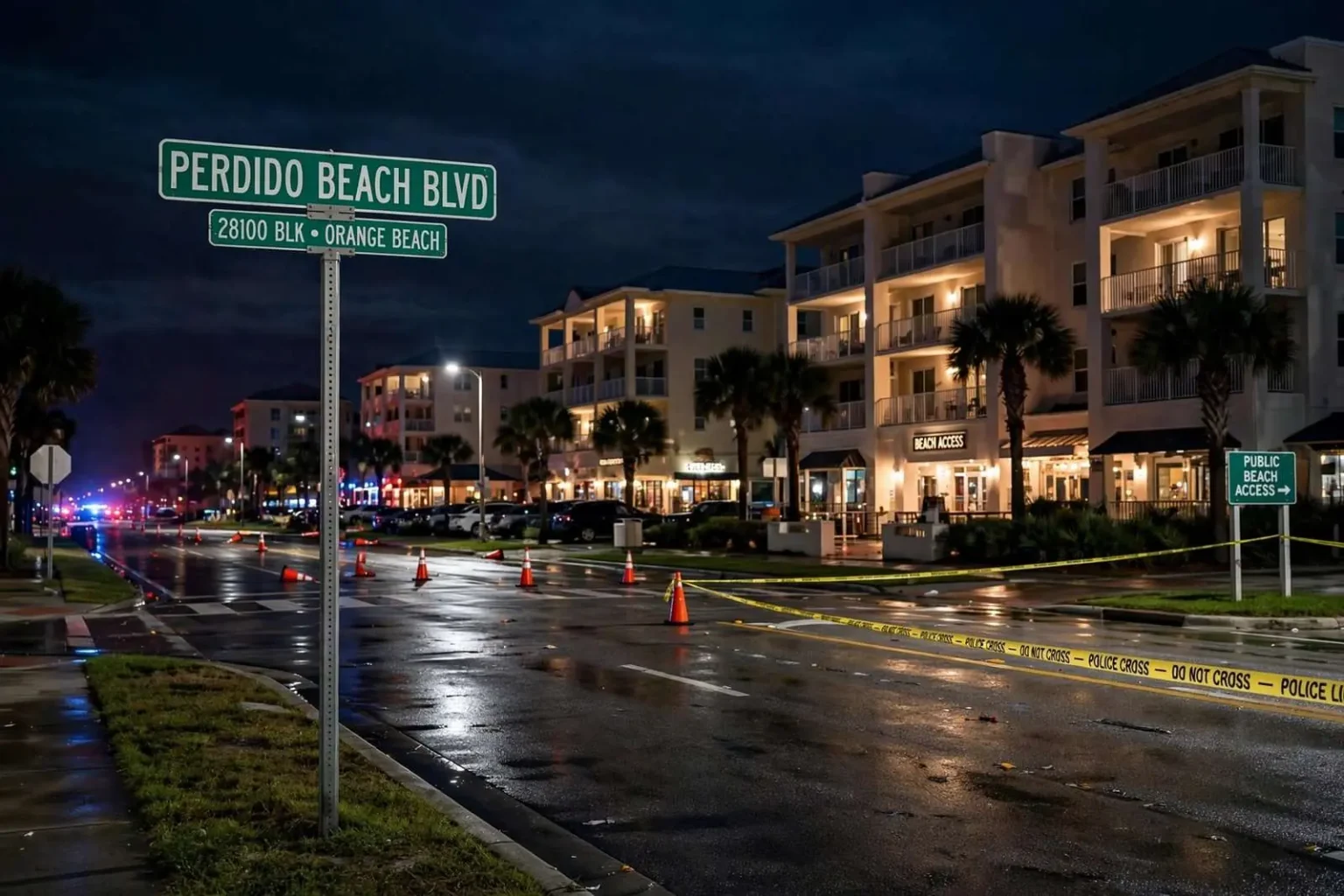
A Spanish Fort man will not face a criminal charge in connection with a fatal pedestrian crash on Perdido Beach Boulevard in Orange Beach earlier this year, after a Baldwin County grand jury declined to indict him. The decision brings the criminal phase of a case that drew attention across the Baldwin County beach communities to a close, though it leaves open the separate question of the driver’s civil liability.
The 57-year-old driver had been facing a possible criminally negligent homicide charge tied to the late-March crash that killed a 44-year-old Tennessee man who was vacationing in the area. Prosecutors presented the case to the grand jury in August, and jurors ultimately chose not to move forward with an indictment, according to court records. The grand jury’s role in such cases is narrow but consequential: it decides only whether probable cause exists to believe a crime was committed, not guilt or innocence, and its refusal to indict means the criminal case ends without a trial unless new evidence or charges emerge.
A Baldwin County assistant district attorney said the panel appeared to view the crash as a tragic accident rather than a criminal act, pointing to eyewitness testimony that the driver had not been speeding or driving on the wrong side of the road. That testimony, prosecutors said, played a significant role in the grand jury’s decision. The distinction matters in Alabama law: criminally negligent homicide requires that a driver’s failure to perceive a substantial and unjustifiable risk amounts to more than ordinary carelessness, and evidence that a driver was traveling lawfully in his own lane at a lawful speed has historically been the kind of case that grand juries decline to criminalize.
How the crash happened
The crash happened shortly after 10 p.m. in late March in the 28100 block of Perdido Beach Boulevard, the beach road that carries locals and visitors past the condos, shops and gulf-front rentals of Orange Beach’s shoreline. According to police, the pedestrian had been crossing the road on foot and made it partway across before stopping in a turn lane to let a vehicle pass in the inside lane. When he stepped out of the turn lane, he was struck by a pickup truck traveling in the outside lane. The sequence — a mid-road pause in a center turn lane, then a step into the path of a vehicle in the outer lane after dark — placed the fatal moment at the edge of the truck’s own travel lane rather than in a crosswalk or along the roadway’s shoulder.
An Orange Beach police officer testified at an earlier preliminary hearing that the driver had not appeared to be driving erratically before the crash, though he did fail three field sobriety tests administered at the scene. The officer’s account left the grand jury weighing two threads that pointed in different directions: behavior behind the wheel that witnesses and the responding officer described as unremarkable, and a driver who could not pass the standard roadside tests once police arrived. The failed field sobriety tests were the basis for the possible charge’s consideration, but the grand jury evidently gave greater weight to the evidence about how the vehicle was being driven at the moment of the crash.
Field sobriety testing is not the same as a blood-alcohol measurement, and the distinction shaped the case. The roadside exams — balance and coordination exercises administered on the shoulder of a dark beach road — are subjective and can be affected by fatigue, injury, age and nervousness, which is why prosecutors generally pair them with chemical tests when they proceed to trial. In this case, the physical evidence and eyewitness accounts placed the pedestrian in the truck’s path, and the grand jury concluded the total picture did not establish criminal negligence.
What may still come
Prosecutors said this week that they could not comment on whether any additional charges might still be considered in connection with the case, leaving open at least the possibility of further legal action even though the original homicide charge has been dropped. Under Alabama practice, a grand jury’s refusal to indict does not bar prosecutors from presenting the case again if new evidence surfaces, though that step is rare.
Separately, the victim’s widow and brother filed a wrongful death civil lawsuit against the driver in the months following the crash. That lawsuit remains active in civil court, meaning the driver could still face financial liability even after the criminal case ended. The two tracks operate under different standards and different burdens of proof: the criminal system required probable cause and then proof beyond a reasonable doubt, while the civil system asks only whether a preponderance of the evidence shows the driver’s negligence caused the death. Wrongful death suits filed along Baldwin County’s beach road routinely turn on questions of lighting, crosswalks, visibility and each party’s movements in the moments before impact — questions that will now be litigated through depositions and expert testimony rather than decided by a grand jury.
The context: a dangerous stretch of beach road
The case is part of a long-running safety conversation about Perdido Beach Boulevard, the four-lane beach road that runs the length of Orange Beach and connects the town’s condos, restaurants and public beach accesses. Pedestrians cross it constantly — from vacation rentals to the sand, from parking lots to restaurants — and after dark, in a resort town where visitors may be unfamiliar with traffic patterns or walking back from evening outings, the road has produced serious and sometimes fatal crashes over the years. State and local officials have responded over time with crosswalk improvements, lighting upgrades and enforcement campaigns aimed at both speed and impairment, but the fundamental geometry of a busy beach road lined with gulf-front destinations keeps pedestrians and vehicles in close contact.
The grand jury’s decision does not close that conversation. For residents and visitors alike, the case is a reminder of the rules that govern the beach road’s intersections and crossings: pedestrians make their way across where they can, drivers travel a corridor with no barrier between lanes and destinations, and the margin for error on both sides is thin, especially at night in March when spring-break and vacation traffic begins building.
Where the case stands
For now, the criminal chapter is closed. No indictment was returned, no charge will be tried, and the driver will not face a jury on the homicide allegation. The civil lawsuit filed by the victim’s family proceeds on its own schedule, as wrongful death cases in Baldwin County generally do — through months of discovery and expert reports before any trial date. The victim, a 44-year-old Tennessean who came to the Gulf Coast on vacation, died on a stretch of road he had every reason to believe was safe to cross, in a case that prosecutors and grand jurors agreed was a tragedy without a crime.
The outcome illustrates the boundary between fault and criminality in Alabama’s legal system. A family has lost a husband and brother; a driver remains saddled with a civil suit and the knowledge of a fatal night; and the law, having weighed the evidence, found the crash heartbreak rather than homicide. The courts will now settle what remains to be settled in the civil forum, where the standard is lower and the question is not whether someone committed a crime but who bears the cost of the loss.
The timeline of the case ran through the standard stages of an Alabama criminal prosecution before ending at the grand jury. Orange Beach police investigated the March crash and forwarded the case to the district attorney’s office, which presented the evidence to a Baldwin County grand jury in August. Along the way came the preliminary hearing, where the police officer’s testimony about the driver’s behavior — unremarkable behind the wheel, but failing the roadside tests — became the public outline of the evidence. Preliminary hearings exist to establish probable cause and bind a case over to the grand jury, and the testimony given there often shapes how prosecutors frame the case when they present it to the sixteen or so jurors who decide whether an indictment issues.
Criminally negligent homicide, the charge prosecutors were weighing, occupies the lower end of Alabama’s homicide ladder. Unlike manslaughter or murder, it does not require intent or even recklessness in the everyday sense — only that a person’s failure to perceive a substantial and unjustifiable risk deviates grossly from what a reasonable person would do. That definition is precisely why ordinary traffic accidents, even fatal ones, rarely survive grand jury review: driving lawfully within one’s own lane at a lawful speed, as witnesses described here, is not the kind of risk-creating conduct the statute was written to punish, however terrible the outcome.
For the victim’s family, the decision means the answers they seek will have to come from the civil courtroom instead. Wrongful death actions under Alabama law are brought for the benefit of the statutory beneficiaries and serve, in part, to assign financial accountability when negligence causes a death — a standard the family’s lawyers will argue the evidence meets, and which the driver’s defense will contest on the same facts the grand jury weighed. Civil discovery may also surface details the criminal process never tested, from vehicle data to additional witnesses, and its outcome will be the final word the courts have on the crash.