Search Continues for Missing Boaters After Deadly Dauphin Island Regatta
Coast Guard and state crews searched through the night for boaters missing after a violent storm capsized vessels during the Dauphin Island Regatta.
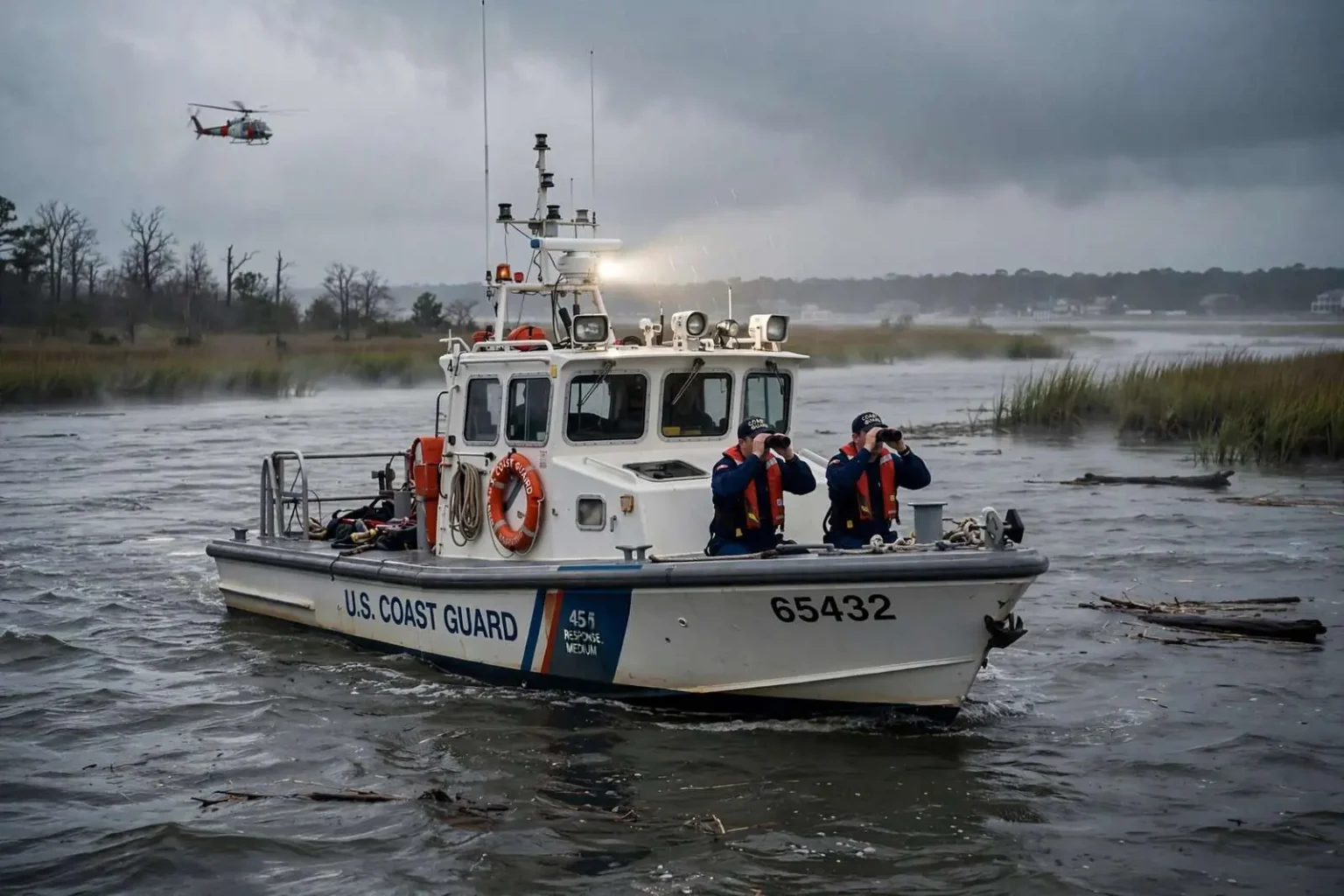
Search and rescue crews worked through the night and into a second full day looking for boaters still missing after a violent storm capsized vessels taking part in the Dauphin Island Regatta over the weekend, officials said. The regatta, a beloved tradition on Mobile Bay, had drawn hundreds of sailors for a race that in most years is a celebration of the bay’s sailing culture — and that in a single storm system became the scene of one of the worst maritime disasters in the region’s memory. What began as an afternoon of competitive sailing ended with capsized hulls, rescues in churned water, and families gathering on the island waiting for word.
U.S. Coast Guard spokesman Seth Johnson said crews would continue searching overnight and into the following day, with rescuers focused on finding survivors. By Sunday morning, one additional body had been recovered, bringing the confirmed death toll to two. Five people remained unaccounted for. The arithmetic was grim and unstable — the numbers could still change in either direction, and officials declined to predict which way — as boats, aircraft and shore teams covered the bay’s wind-scoured surface and its marshy edges looking for anyone the storm had left behind.
The Briefing on Dauphin Island
Captain Duke Walker, commander of Coast Guard Sector Mobile, said during a Sunday morning briefing on Dauphin Island that the missing and deceased include not just regatta participants but other boaters who happened to be on Mobile Bay when the storm hit. Officials said they had also received at least one report of a missing person unconnected to the race. The clarification mattered: the disaster’s true footprint was wider than the regatta’s fleet, because the storm caught every vessel on the water, not just those racing. A Sunday bay — normally dotted with fishing boats, pleasure cruisers and sailboats making ordinary weekend passages — became, in minutes, a search area.
Walker said the Coast Guard knows the identities of the five missing individuals but was not releasing their names, pending notification of families. The discipline of that refusal is standard practice in mass-casualty maritime operations: names are confirmed against manifests and witness accounts, families are informed first, and the public account follows the private notifications. On an island where everyone knows everyone, the anonymity was more formality than protection — the community knew who was out on the water, and it knew who had not come back.
According to Walker, at least 10 vessels capsized or were disabled during the storm, three of which were competing in the regatta. The count itself was provisional; vessels scattered by wind and current were still being located, and some disabled boats were found aground or drifting with no one aboard. A previously scheduled Sunday evening press conference was postponed to Monday morning after officials said there were no major new developments to report — a delay that reflected the slow, methodical nature of the work underway rather than any reduction in effort.
The Storm That Caught the Fleet
Summer storms on the Gulf Coast build with infamous speed. A line of weather that looks manageable at midday can mature into a squall with 60-knot gusts by mid-afternoon, and Mobile Bay — wide, shallow at its edges, and open to the south — offers little shelter once wind and wave combine. Sailors in the regatta described conditions that turned from race-typical chop to survival sailing in minutes: masts pinned to the water, cockpits awash, crews clinging to hulls that had turtled. Boats that capsize in open bay water separate swimmers from their vessels quickly, and visibility in driving rain falls to yards.
Those physics define the search. A person in the water drifts with current and wind; a capsized hull drifts differently. Rescuers therefore work patterns rather than points, sweeping sectors repeated through the night because drift models change with the wind. Night operations add their own difficulty — flares, floodlights and thermal cameras extend vision, but a head in dark chop is a small target — which is why the decision to search through the first full night, and to commit to a second day, signaled how seriously Sector Mobile was treating the casualty count.
The Race and Its Host
The Fairhope Yacht Club hosted this year’s race, which rotates annually among four yacht clubs on Mobile Bay. Club commodore Gary Garner said members were devastated by what happened and were cooperating fully with search and rescue efforts, though organizers declined to discuss whether the race should have been scheduled differently given the weather. That refusal to second-guess in public, while the search was still live, was characteristic of a club in crisis: the questions about forecasting, start timing and race management would be asked — they always are after a regatta disaster — but not while boats were still unaccounted for and families were still waiting.
The regatta itself is one of the bay’s great sailing traditions, drawing sailors of every skill level for a course that in ordinary years is a festival as much as a race — boats rafted together afterward, results argued over on the seawall, and a junior-sailing contingent that makes the event a multigenerational affair. The rotation among four yacht clubs spreads the honor around the bay’s sailing communities, and it means the disaster touched not one club’s membership but the whole region’s. Fairhope, on the bay’s eastern shore, is a town whose identity is braided with the water, and the regatta was among its signature days.
A Multi-Agency Search
Multiple agencies joined the search, including Coast Guard aircraft and small boats, Alabama Law Enforcement Agency marine patrol and air units, and Mobile County Sheriff’s Office vessels. The layering of capabilities reflects the scale of the task. Coast Guard helicopters cover great distances quickly and carry rescue swimmers who can be deployed into the water; fixed-wing aircraft sweep wide sectors and spot debris fields; small boats work close to shore and among the marsh islands at the bay’s edges, where a person in the water or a capsized hull might come to rest. Local sheriff’s vessels bring knowledge of the bay’s shallows and channels that no outside agency can match.
Coordination among that many organizations is itself a technical achievement. Sector Mobile stands up a unified command, assigns search sectors to each unit, and reconciles what each crew sees — a spotter’s report of an orange life jacket, a fisherman’s call about a hull on a sandbar — into a single operational picture. ALEA Marine Patrol Chief Steve Thompson said he had briefed ALEA Secretary Spencer Collier and Governor Robert Bentley on the situation, keeping the state’s executive level informed as the death toll climbed and the search continued. That chain of briefing matters: a disaster of this scale can require state resources, from additional patrol units to emergency management support for the families gathered on the island.
The involvement of so many agencies also told residents something about the scope. When a search is handled by one station’s boats, it is an incident; when helicopters, fixed-wing aircraft, state marine patrols and sheriff’s vessels are all on the water through a second night, it is a regional emergency, and everyone on the Eastern Shore and the island could see it from their own waterfronts.
The Island’s Longest Weekend
Despite the tragedy, organizers said a previously scheduled concert series on Dauphin Island would continue Sunday evening, though the mood on the island remained somber as families waited for word on their loved ones. The decision to proceed was not made lightly. Small communities argue over such choices in real time — some saw continuing as a necessary normalcy, a way to keep people together rather than alone with their phones; others felt the music conflicted with the waiting. In the end, the island did what island communities do: it gathered, it fed the families of the missing, and it kept its lights on toward the water.
Dauphin Island occupies a peculiar and exposed place on the Gulf — a barrier island at the mouth of Mobile Bay, connected to the mainland by a long bridge, oriented toward the water in every direction. Its residents are experienced with the sea’s capacity for sudden harm, and regatta disasters are part of the bay’s collective memory. The weekend’s events added a heavy chapter to that memory, one measured not in property but in the two confirmed dead, the five still missing, and the households on the island and around the bay whose Sunday waiting would continue into Monday and beyond.
What Happens When the Search Ends
Maritime search operations follow a hard and well-understood logic. Every sector is searched, re-searched as drift models update, and finally closed on the basis of probability — the calculated chance that a person in the water could still be alive in the conditions. Those decisions are among the most difficult in the Coast Guard’s work, and they are made with families present, briefed on the same modeling the rescue crews use. When active search ends, recovery operations typically continue, and the investigation into what happened — a formal Coast Guard marine casualty investigation in cases like this — begins in parallel.
That investigation will reconstruct the storm’s timeline against the fleet’s: when warnings were issued, when the squall hit the racing area, which vessels reported distress and when, and how the response unfolded. Regatta disasters elsewhere have produced lasting changes in race management — mandatory distress-carry requirements, revised starting procedures, real-time weather monitoring on the race committee signal boat — and the questions raised on Mobile Bay will be examined with the same seriousness, in part because the bay’s sailing calendar will continue, and the community that lost sailors this weekend will race again.
Mobile Bay’s Sailing Culture
To understand the weight of the weekend, it helps to understand how deeply sailing is woven into Mobile Bay life. The bay is wide enough for serious racing, shallow enough to demand local knowledge, and ringed by communities — Fairhope, Point Clear, Mobile, Dauphin Island — that have supported yacht clubs for generations. Junior programs teach children to sail in the same waters their parents race; the annual regatta rotation ties the clubs together in friendly rivalry; and the seafood houses and marinas along the shore measure their seasons partly by the boating calendar. A storm that kills sailors on this bay does not strike a community that uses the water. It strikes a community that is the water.
That is why the response reached so far beyond official channels. Commercial fishermen altered their routes to look for debris and people, and recreational boaters who knew the missing offered their vessels. Churches on both shores opened their doors for the families, and the island’s small restaurants fed rescue crews alongside the waiting relatives. None of that appears in the casualty counts, but all of it is part of how a bay community absorbs a disaster.
Holding the Numbers Lightly
In the days that followed the Sunday briefing, the figures officials gave — two confirmed dead, five missing, ten or more vessels capsized or disabled, three of them racers — remained the working numbers of an ongoing operation. Search operations of this kind revise their counts as vessels are located, as hospitals reconcile their intake, and as reports of unconnected missing boaters are resolved one way or the other. The Coast Guard’s refusal to release names, the postponement of the Sunday evening press conference, and the emphasis at every briefing on continuing the search all pointed to the same posture: nothing was being declared finished while anything remained findable.
For the families at the center of it, the operational language mattered less than the search’s persistence. Rescuers worked through the first night in bad conditions, committed to a second full day, and continued to put aircraft and vessels on the water after the casualty count had risen — a demonstration that the effort would not be measured by odds but by the possibility, however small, of bringing someone home. On Dauphin Island, where the fairway bells and the harbor lights face the same bay that took the regatta fleet, that persistence was the only comfort the week offered, and the community held to it while it lasted.