Qualifying Underway for Mayor and City Council Races Across Baldwin County
Candidates for mayor and city council across Baldwin County can qualify through June 24 ahead of the Aug. 26 municipal elections. Here's what to file.
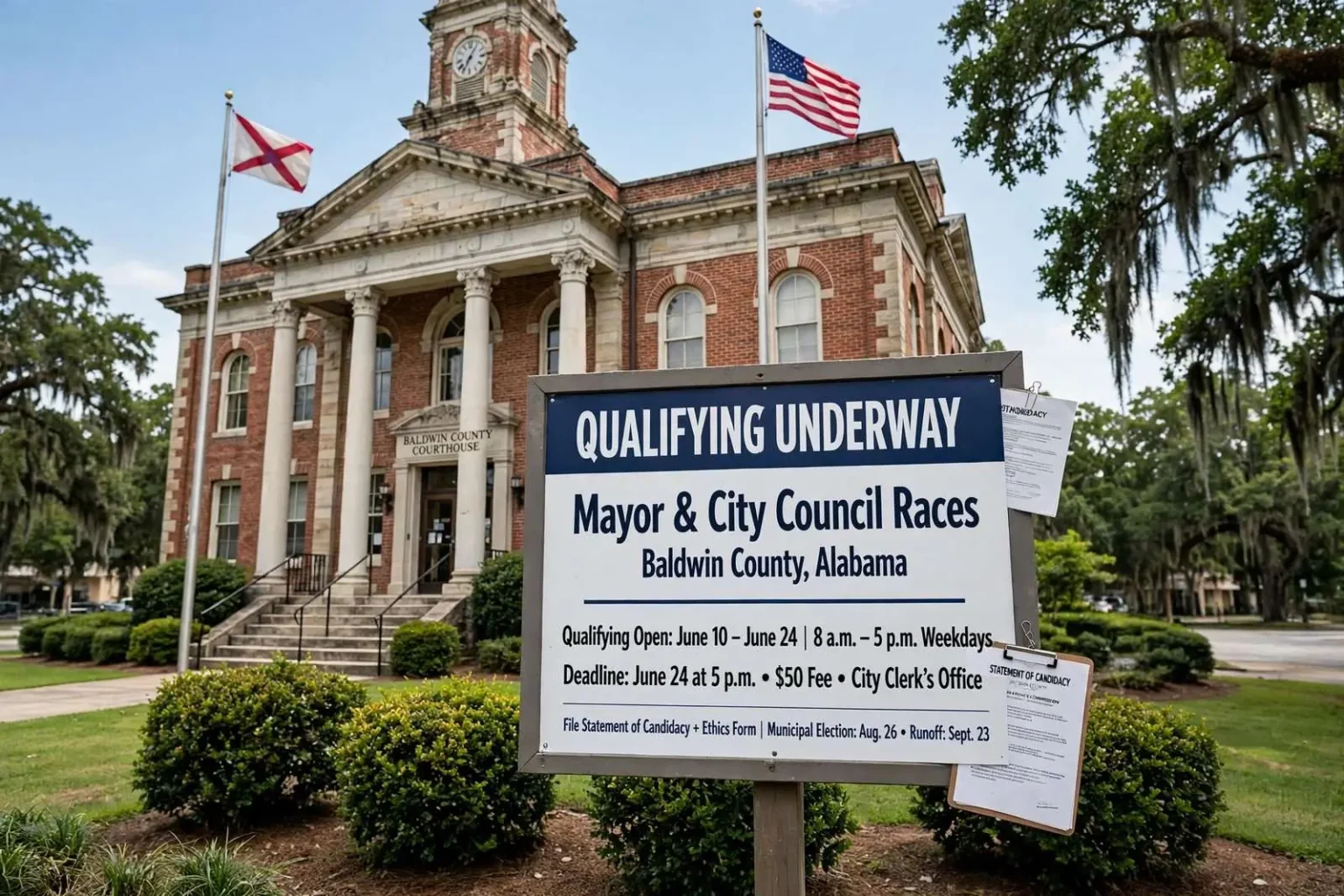
BALDWIN COUNTY, Ala. — Residents across Baldwin County who want their name on the ballot this summer can now formally qualify for their city’s municipal elections, with the qualifying window running through June 24. From Bay Minette to Foley, the paperwork phase of the county’s city races is officially open.
Qualifying opened June 10 and closes at 5 p.m. on June 24. Candidates sign up through the city clerk’s office in the city they hope to serve, with offices open from 8 a.m. to 5 p.m. weekdays during the period. The qualification fee is $50 — a modest bar to entry that has historically kept Baldwin County’s municipal ballots open to first-time candidates as well as incumbents.
Elections shifted off the presidential calendar
Baldwin County’s municipal elections are scheduled for Aug. 26, with a runoff set for Sept. 23 if needed. The contests were postponed a year by state lawmakers, who voted in 2021 to extend the terms of officials elected in 2020 so that city races would no longer share a ballot with presidential elections. The one-year extension moved every municipal election in the state onto its own cycle, decoupling city hall contests from the national stage.
Officials cited poll worker fatigue, voter confusion over polling locations and equipment shortages in making the change. Presidential elections strain county election machinery to its limits — enormous turnout, long ballots and a statewide scramble for workers — and municipal races at the bottom of those ballots often bore the consequences. Alabama now joins the majority of states that hold municipal elections in non-presidential years, when city races can command the attention they deserve.
For candidates, the shift changes the texture of campaigning. A municipal race on its own ballot cannot ride a presidential contest’s turnout, so candidates must build their own lists of supporters and drive their own voters to the polls. In Baldwin County’s fast-growing cities, where thousands of new residents arrive between elections, that ground game matters more than ever.
What candidates must file
To appear on the ballot, candidates must file a Statement of Candidacy form with their city clerk and submit a Statement of Economic Interests form with the Alabama Ethics Commission. Election officials recommend filing both at the same time; anyone who has already filed an economic interests statement should bring proof of that filing when they qualify.
The ethics form can be completed online through the commission’s website, and paper forms will also be available at city clerk offices during qualifying. The two-document requirement is designed to establish both the candidate’s intent and their financial disclosures before the campaign begins.
Mayoral and council hopefuls must be at least 18 years old, a U.S. citizen, a registered voter of the municipality at the time of qualifying, and a resident of the city or district they seek to represent for 90 consecutive days before the election. The requirements apply uniformly across the county’s municipalities, from its largest cities to its smallest towns.
A county of city halls
Baldwin County is Alabama’s largest county by area, and its municipal map has grown crowded with growth. Cities such as Daphne, Fairhope, Foley, Gulf Shores, Orange Beach, Spanish Fort, Robertsdale, Loxley and Bay Minette each elect their own mayor and council, and each of those races now sits on the same summer ballot. In recent years the county’s cities have ranked among the fastest-growing in the state, which means many of the voters deciding these races were not living in the municipality during the last cycle.
That growth shapes the issues candidates will run on. Baldwin’s coastal cities face the pressures of tourism, short-term rentals and beach management; the Eastern Shore communities of Daphne, Fairhope and Spanish Fort grapple with traffic, school growth and annexation; the inland cities along the U.S. 31 and Alabama 59 corridors balance industrial recruitment with the infrastructure demands of subdivision development. Municipal office in Baldwin County carries real authority over police, planning, utilities and parks — the day-to-day machinery residents notice most.
How the municipal ballot works
Alabama municipal elections are officially nonpartisan: candidates qualify without party labels, and the Aug. 26 ballot lists names and offices alone. If no candidate for an office receives a majority of the votes cast, the top two finishers advance to the Sept. 23 runoff. Winners take office in the fall, beginning the four-year terms created by the state’s 2021 calendar shift.
The runoff structure matters in Baldwin’s multi-candidate races, where crowded fields for council seats and open mayor’s offices are common. A candidate who can consolidate a plurality in August may still face a head-to-head contest in September, and campaigns plan their budgets accordingly — holding resources for a second push if the first round lands them short of a majority.
The qualifying window’s practical details
The two-week window between June 10 and June 24 compresses a significant amount of paperwork into a short period, and city clerks’ offices become the busiest rooms in city hall during it. Candidates are advised to arrive with identification, the $50 fee and — if already completed — proof of their economic interests filing, since qualifying is not complete until all required documents are on file.
For residents considering a first run for office, the requirements are intentionally reachable: state adulthood, citizenship, registration and a 90-day residency stake in the city. The design of the process reflects an old idea of municipal government — that city council seats belong to neighbors willing to serve, not to a professional political class. Baldwin County’s summer ballot will show how many neighbors answered the call this year.
Advice for first-time candidates
Experienced municipal candidates and election officials tend to repeat a short list of advice during qualifying season. First, file everything early: the June 24 deadline is a hard 5 p.m. cutoff, and a missing signature or unfiled ethics form discovered at 4 p.m. on the final day ends a campaign before it starts. Second, keep proof of every filing — the Statement of Candidacy receipt from the city clerk and the confirmation from the Alabama Ethics Commission are the documents that protect a candidacy if questions arise later.
Third, understand the residency clock. The 90-day requirement means a candidate must have lived in the city or district for 90 consecutive days before the election itself, not merely before qualifying. Newcomers who moved to a Baldwin city this year need to confirm their timeline qualifies before investing in a campaign.
Finally, candidates should study the office they seek. A council seat in a Baldwin municipality means votes on budgets that fund police and fire protection, on zoning maps that shape where the county’s next decade of growth lands, and on utility and infrastructure decisions that take years to undo. The $50 fee and two forms put a name on the ballot; the campaign is where a candidate demonstrates readiness for the rest.
What to watch this summer
Between the June 24 qualifying deadline and the Aug. 26 election, Baldwin County’s municipal campaigns will unfold at street level — yard signs along the county’s arterial roads, forums hosted by civic clubs and chambers of commerce, and door-to-door canvassing through neighborhoods that keep multiplying. The runoff on Sept. 23 will settle any race where August produces no majority.
The calendar shift that moved these races off the presidential ballot was intended to give municipal government its own moment, and this summer is the first full test of that design in Baldwin County. Turnout will be smaller than a November presidential cycle, but the voters who show up will be the ones paying closest attention to city hall — arguably the ideal electorate for choosing mayors and councils. For the county’s cities, from the beaches to the northern farmland, the qualifying window now open is the first formal step toward that conversation.
The June qualifying window also sets the table for the behind-the-scenes machinery of a municipal election. City clerks certify the qualifying list once the window closes, ballot ordering is set, and campaign finance obligations attach to every candidate from the moment the Statement of Candidacy is filed. Candidates who raised money before formally qualifying should understand that the filing itself triggers the reporting requirements that govern municipal races in Alabama.
For voters, the period offers a first look at the field. The list of qualifiers published by each clerk’s office after June 24 will show which mayor’s offices drew challengers, which council seats are contested, and where incumbents will run without opposition — the full map of the summer’s races across the county.
Incumbency, as always, will shape the ballot. Municipal officeholders in Baldwin’s growing cities have presided over years of rapid change, and challengers this cycle have made growth management the natural axis of the campaigns. Whether voters reward continuity or demand new direction will be decided on Aug. 26 — and, in any race that reaches a runoff, again on Sept. 23.