South Alabama Lawmaker Pushes Bill to Make Running From Police a Felony
House Bill 337 would make attempting to elude police a felony in Alabama, after deadly Mobile County chases spurred lawmakers to act.
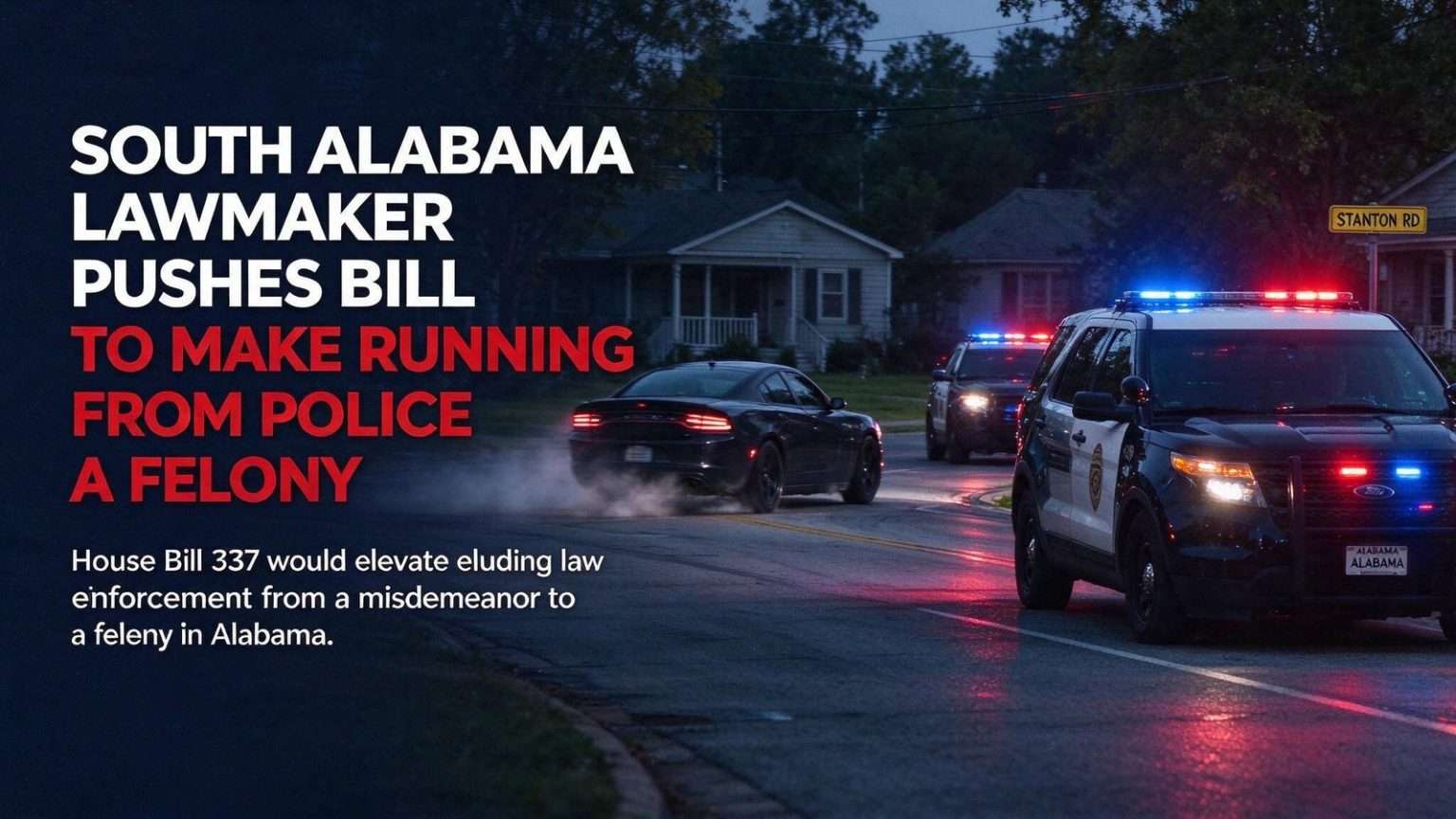
A string of dangerous police chases across Mobile County — including a deadly crash into a home on Stanton Road — has renewed a legislative push to impose stiffer penalties on drivers who try to flee law enforcement.
House Bill 337, sponsored in part by State Rep. Ginny Shaver of District 39, would elevate attempting to elude law enforcement from a misdemeanor to a felony in Alabama. The change would mark one of the most significant increases in penalties for flight from police that the state has considered in recent sessions.
Under the measure, fleeing would carry up to 10 years in prison and a $10,000 fine as a Class C felony, while a flight that seriously injures someone would become a Class B felony punishable by up to 20 years and a $30,000 fine. The escalation matters because felony sentences are served in state prison rather than county jail, and felony convictions carry consequences that follow defendants long after release.
Why sponsors say the change is needed
Shaver said eluding has become a serious problem statewide, particularly along border counties where suspects can slip across state lines. Because the current offense is only a misdemeanor, she explained, it is not extraditable — meaning suspects who flee into another state often are not brought back to face Alabama charges.
That gap in the law has real consequences for the counties that sit along Alabama’s boundaries. A driver who flees a traffic stop near the state line and crosses into Mississippi or Florida before officers can stop them currently faces little practical risk of prosecution back in Alabama, and officers who know the pursuit will end at the border face difficult decisions about how long to chase.
A felony classification would change that calculus. Extradition for felony charges is a routine process between states, and the threat of being brought back to face Alabama justice would follow suspects who flee across state lines, removing the escape valve that current law leaves open.
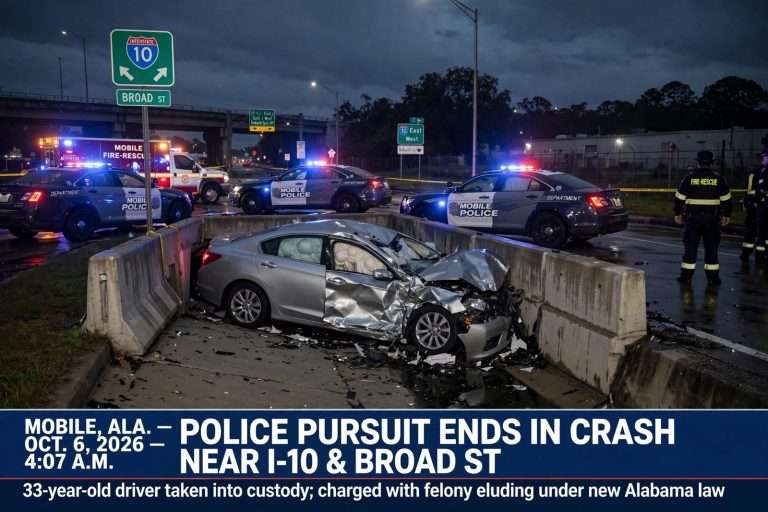
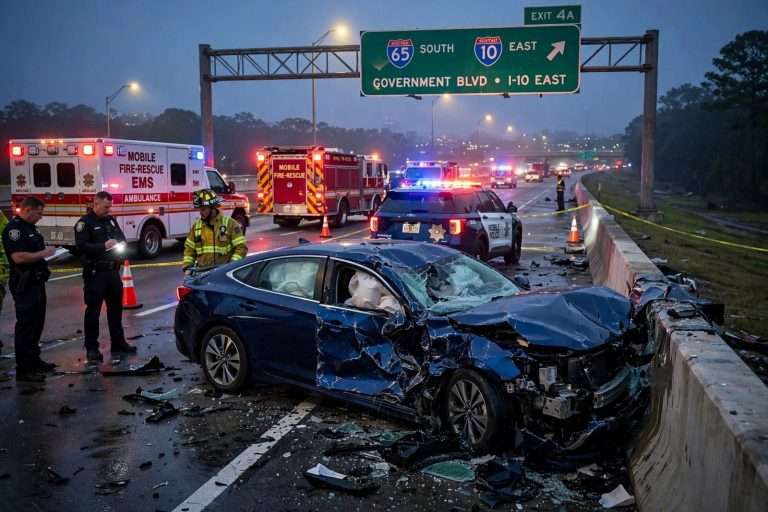
Mobile County has seen its share of consequences. In one recent chase, a speeding driver lost control and crashed into a home on Stanton Road, killing the driver. In another off Carol Plantation Road, a suspect driving a stolen vehicle struck another car while trying to get away.
Those incidents, and others like them across the county, illustrate the chain of danger that flight creates. A driver fleeing police travels at speeds the roadway was never meant to carry, runs intersections at full speed and frequently ends the chase in a collision that injures someone who never participated in the original offense, whether a passing motorist, a pedestrian or a family inside their own home.
Law enforcement officers also bear the risk. Every pursuit puts officers in vehicles at high speed, often through neighborhoods, and departments train heavily on when to begin and when to break off chases. Stiffer penalties for the person who chooses to flee, sponsors argue, change the incentive structure before an officer ever turns on the lights.
Previous attempts fell short
Shaver said this is not her first attempt at the legislation. The bill has twice cleared the Alabama House but ran out of time before receiving a Senate vote, though it made it out of committee and onto the floor calendar.
Running out of time is a familiar fate for legislation in Alabama’s sessions, where the calendar compresses as the session winds down and bills that lack the support of leadership can stall despite clearing early hurdles. Making it out of committee and onto the Senate floor calendar twice, however, indicates the bill has maintained genuine support rather than fading after introduction.
She hoped the session beginning March 7 would finally carry it across the finish line. The third attempt comes with a stronger record of county-level incidents to point to, and with supporters in Mobile County watching a case that crystallized the stakes.
The view from Stanton Road
Residents who have lived through the aftermath of high-speed pursuits support the change. Myra Edwards, whose Stanton Road neighborhood was hit by a deadly chase, said the problem repeats itself far too often.
“It happens time and time again,” Edwards said. “This is nothing new, where we have a high-speed chase and someone done lost their life.”
Edwards and her neighbors lived with the aftermath of the Stanton Road crash, which killed the driver and damaged a home in the middle of a residential block. Incidents like it leave neighborhoods asking why the consequences for starting such a chase are so light, and supporters of the bill say that question is exactly the point of raising the penalty.
Public safety advocates have long argued that flight-from-police offenses are underweighted in state law, given that the behavior virtually guarantees a high-speed drive through populated areas. A driver who flees is not merely refusing a traffic stop; in practice, the choice subjects everyone along the route to danger that compounds with every block.
The bill’s core principle
For Shaver, the bill comes down to a basic function of government.
“It’s a public safety issue,” she said. “If we’re not safe in public, our other rights suffer.”
That framing reflects a legislative philosophy that treats the protection of the public as the precondition for everything else state government does. In her telling, the debate over House Bill 337 is not primarily about punishment but about the signal the state sends: that fleeing police is not a minor infraction with a fine, but a felony-level threat to the community.
The penalty structure of the bill mirrors that philosophy. The base offense of eluding becomes a Class C felony, punishable by up to 10 years and a $10,000 fine, while the injury provision rises to a Class B felony with up to 20 years and a $30,000 fine when a flight seriously injures someone. The tiering ensures the law’s harshest consequences land on the outcomes everyone fears most.
What happens next in the Legislature
If the bill clears the Senate this session, it would move to the governor for signature before taking effect, likely with an implementation date tied to the next annual cycle of the state’s criminal code updates. Prosecutors across the state, including in Mobile County, would then have the option of filing felony eluding charges in appropriate cases.
Supporters in law enforcement have generally welcomed tougher penalties for flight, arguing that the current misdemeanor structure undervalues the danger pursuits create. District attorneys have also pointed to the extradition problem as a practical enforcement failure that only a legislative fix can address, since prosecutors cannot charge across state lines on their own.
The session beginning March 7 will determine whether the third attempt succeeds. Bills that have twice reached the Senate floor calendar often pass once their sponsors build enough momentum, and the repeated Mobile County incidents have given the argument for passage a concrete local face.
For the neighborhoods that have absorbed the consequences, from Stanton Road to the roads off Carol Plantation Road, the legislation represents accountability in the most direct sense: a driver who makes the choice to flee would face prison time rather than a misdemeanor fine, and a suspect who crosses a state line would no longer escape Alabama’s courts by crossing a bridge.
Shaver’s office is expected to push the bill early in the session, and supporters of the measure say the time lost in previous years only sharpened the case. With deaths on the record and a district attorney community asking for the tool, House Bill 337 enters the session as one of the clearer public safety measures on the Legislature’s calendar.
Residents affected by chases, including those in the Stanton Road area, have said they intend to follow the bill’s progress, and some have expressed willingness to travel to Montgomery to testify if committee hearings are held. Their stories, in the view of the bill’s sponsors, are the strongest argument the legislation has.
The outcome will be watched closely in Mobile County, where the consequences of flight from police have already been measured in lives.
The extradition issue deserves particular attention because it determines whether any penalty can be enforced at all. Under current law, a misdemeanor eluding suspect across the state line is effectively beyond reach, since other states are not obligated to return misdemeanor fugitives. The felony reclassification closes that loophole by making the charge serious enough that neighboring states will cooperate in returning suspects to Alabama custody.
County sheriffs and municipal police departments along the state’s borders have reported the problem for years, watching suspects deliberately choose flight when they are close to a boundary. The behavior is predictable once drivers learn the system, and officers say word of the loophole spreads quickly among those with reason to know it.
The cost of a chase
Beyond the human toll, pursuits carry costs that land on the public: damaged patrol vehicles, injured officers, destroyed property and the emergency response that follows every crash. Insurers, courts and county budgets all absorb pieces of the bill, and the deadliest costs fall on the uninvolved, as the Stanton Road crash showed.
Supporters of House Bill 337 argue that a stiffer penalty is the legislature’s most direct tool for reducing the number of chases in the first place. If the driver behind the wheel knows that flight means a felony record and up to a decade in prison, the calculus at the moment the lights come on changes, and more suspects choose to stop.
That deterrent effect is the heart of the argument the bill’s sponsors will make in Montgomery. The legislation cannot undo the crashes that have already happened, but it can change the choices that lead to the next one, and in the view of its supporters, that is precisely what the Legislature owes the communities that have buried the consequences.
The session’s progress on the bill will be followed closely, with updates as House Bill 337 moves through committee and, supporters hope, to a full Senate vote for the first time.