USA Statistics Professor Alan Chow Wins Readers’ Vote for Best Local College Professor
University of South Alabama statistics professor Dr. Alan Chow was voted Best Local College Professor in this year's readers' poll, earning praise for turning a famously tough subject into a manageable one for students.
A statistics class is not usually where students expect to find their favorite professor, but for many at the University of South Alabama, Dr. Alan Chow has become exactly that.
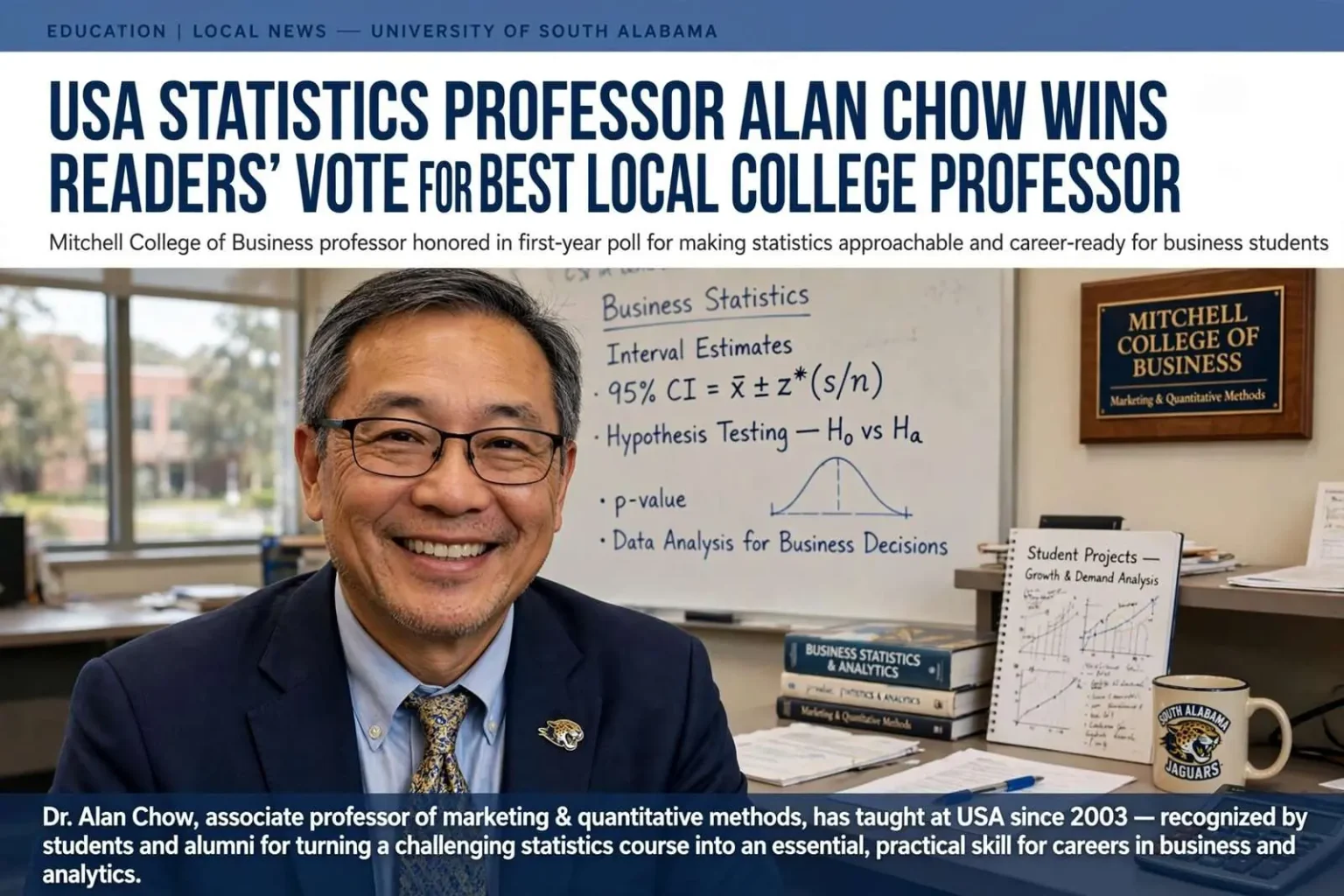
Chow, an associate professor of marketing and quantitative methods in the Mitchell College of Business, was recently voted Best Local College Professor in a readers’ poll, the first year the category has been included. The recognition caught the attention of alumni, current students and fellow educators, many of whom pointed to Chow’s ability to make a subject widely regarded as one of the most difficult parts of a business degree feel approachable.
Business statistics, the course Chow teaches most often, moves well beyond the basics of mean, median and mode into territory like interval estimates, hypothesis testing and integration analysis, concepts that trip up even strong students. It is the class business majors schedule last and dread most, the quantitative hurdle between them and the degree.
Chow said he has learned to expect resistance to the material and tries to meet it with humor and perspective rather than more formulas. He tells students to think of the coursework as applied mathematics rather than abstract math, a mental shift that he said helps many business majors who assume going in that numbers are not their strength.
“I try to take a topic that’s not most people’s favorite and make it, maybe not enjoyable, but at least endurable,” Chow said. “A lot of students ask, ‘When will I ever use this?’ And my answer is, ‘I teach this material because, at some point in your career, you’re going to need maybe 10 percent of it, but you won’t know which 10 percent until you actually get there.'”
The road to the classroom
Chow holds four academic degrees and has published research on topics including volatility measures in equity returns and alternative methods of statistical comparison — work that sits at the intersection of finance and statistics, the quantitative territory where markets meet measurement. He came to academia after a career in industry, joining the University of South Alabama faculty in 2003, where he has taught statistics and analytics courses for more than fifteen years.
That industry background shapes his teaching. A professor who has applied statistical methods to real business problems can answer the skeptic’s question — when will I use this? — from experience rather than from the syllabus, and Chow’s classrooms lean on that credibility. The material is not presented as mathematics for its own sake but as the toolkit that separates managers who guess from managers who know.
Teaching runs in the family. Chow is a second-generation professor who followed his father into teaching statistics; his father taught at what is now the University of Louisiana at Lafayette. Chow said that background shaped his approach early on, teaching him that building relationships with students and understanding what each one actually needs matters as much as the material itself.
“You really have to be thinking about the students and their success, and success in my classes doesn’t always mean making an ‘A,'” Chow said. “For some people it’s making a ‘C’ and continuing on. It’s important to realize that everybody is trying to make it through this. As long as they’re doing their share, I’m willing to do mine and work with them any way I can.”
The family also has long-standing ties to Louisiana State University, where Chow earned two of his four degrees, and he grew up cheering for the LSU Tigers. When South Alabama meets LSU in baseball or basketball, people ask him which side he is pulling for. “I always tell them: ‘South Alabama gives me a check every month, and every year LSU asks me for one,'” he said. “That will square your allegiance up quickly.” These days, he said, his loyalty is squarely with the Jaguars, whoever the opponent.
What the poll says about teaching
The readers’ poll category was new this year, and its first winner being a statistics professor says something about what local readers — many of them former students — remember decades later. Professors of drama or marketing or management win popularity contests; professors of statistics win gratitude, usually deferred, from the students whose careers later ran headlong into a spreadsheet they needed to understand.
Chow’s approach — meet resistance with humor, reframe the math as applied, promise that ten percent will someday matter — is the methodology of a teacher who has made peace with the subject’s reputation rather than denying it. Students respond to the honesty. The course remains hard; the difference is that the professor admits it and teaches accordingly.
The Mitchell College of Business
Chow’s home department, marketing and quantitative methods, sits at the center of the Mitchell College of Business, the University of South Alabama’s business school. The college serves thousands of undergraduates and MBA candidates, and quantitative methods is the department every one of them passes through — the courses that supply the analytical backbone of a business degree.
The University of South Alabama, founded in 1963, has grown into one of the Gulf Coast’s major universities, and its business college’s graduates staff the banks, hospitals, shipyards and aerospace suppliers of the Mobile region. For those graduates, statistics is not an abstraction: it is the tool behind quality control at an aircraft supplier, demand forecasting at a hospital system, risk analysis at a bank. Chow’s argument that ten percent of the course will someday matter is, in Mobile’s economy, a conservative estimate.
Faculty members in quantitative fields carry a particular burden at regional universities. Their students arrive with wide ranges of preparation, and the teaching that works requires meeting each cohort where it stands — which is why the professors who succeed in these courses, as Chow has, tend to become the departments’ indispensable figures. The poll recognition reflects years of that daily work rather than a single viral moment.
Statistics and the modern business degree
The concepts in Chow’s syllabus — interval estimates, hypothesis testing, integration analysis — form the core of what modern business analytics builds on. Interval estimates teach managers to state what they know with a defined confidence rather than a false certainty. Hypothesis testing instills the discipline of asking whether a difference is real or noise. Integration analysis, in its business applications, measures how quantities accumulate over time — revenue, cost, adoption — the mathematics underneath every growth curve a company charts.
The rise of business analytics as its own field has only raised the stakes for professors like Chow. A generation of students trained on dashboards and automated reports now needs to understand what the dashboard is actually computing, and the statistics course — once the hurdle to clear — has become the foundation everything else rests on. Faculty who teach it well are, in effect, the quality control for the region’s future analysts.
Chow’s research track reflects the same orientation toward applied rigor. Studying volatility measures in equity returns ties classroom statistics to the questions financial professionals actually face — how to characterize the movement of markets, and how to compare methods of measuring it. Research of that kind feeds directly into teaching: the professor who tests statistical methods against market data brings examples into the room that no textbook exercise can match.
Why the recognition matters
For the university, a first-year category won by a quantitative faculty member is a piece of institutional marketing money cannot buy. Prospective students and parents visiting the Mitchell College of Business hear many claims about teaching quality; a community-voted award for a statistics professor is the kind of credential that survives skepticism.
For Chow, the prize validates an approach built over fifteen years: expect the resistance, use humor, reframe the math, and answer honestly when students ask what the point is. The answer — you won’t know which ten percent until you get there — has evidently done its work, one endureable lecture at a time, in classrooms full of students who arrived certain they were not math people and left with the tools to prove themselves wrong.
Inside the classroom
Students in Chow’s courses describe a familiar arc: dread in the first week, cautious comfort by midterm and something like confidence by the final. The progression is engineered. Early sessions confront the fear directly, establishing that the course expects work but not genius, and that questions asked in class are the intended mode of participation rather than an admission of failure.
The humor he deploys serves a technical purpose as well. Statistics education research has long documented that math anxiety measurably depresses performance — anxious students misread problems, skip steps and freeze on exams. A teacher who can lower the emotional temperature at the front of the room is not merely entertaining; he is removing a documented obstacle to learning the material itself.
The applied framing does the rest. A problem about confidence intervals becomes a question about how long a delivery route will take; a hypothesis test becomes a decision about whether a marketing campaign actually moved sales. By the time students meet the formal machinery, they have already used its logic in disguise, which is precisely how the mental shift from abstract to applied mathematics is supposed to work.
The regional demand for analytics
The Mobile area’s economy gives Chow’s teaching an audience with immediate uses for it. The region’s employers — the port and its logistics network, the aerospace and shipbuilding industries, the healthcare systems that anchor both sides of the bay, and the banks and insurers that finance them — all run on quantitative analysis, and all complain in hiring season about the shortage of graduates who can actually interpret data rather than merely collect it.
The University of South Alabama’s business college sits at the center of that pipeline. Its graduates take positions across the Gulf Coast, and the quantitative methods courses every one of them passes through function as the region’s analytics filter — the place where a business major either acquires the ability to reason with data or graduates without it.
Faculty awards like the readers’ poll recognition thus carry economic weight beyond the honor. A region competing for industrial investment sells, among other assets, the quality of its workforce and the institutions that train it. A business school whose statistics teaching wins community recognition is a small but real piece of that pitch — evidence that the local pipeline produces graduates employers can use.
A career measured in students
More than fifteen years after joining the faculty in 2003, Chow has taught long enough that former students now manage the departments he once lectured toward, hire the analysts he trained and sit on the boards that fund the university’s programs. The ten percent he promised them has, for many, arrived in stages — a budget hearing here, a forecast there, a market report that makes sense because someone once insisted the material was endurable.
That is the legacy the poll measures, imperfectly but genuinely. Professors of spectacle collect applause in the moment; professors of statistics collect it decades later, in the thank-you notes that arrive when a former student finally sees which ten percent she needed — and discovers she has it.