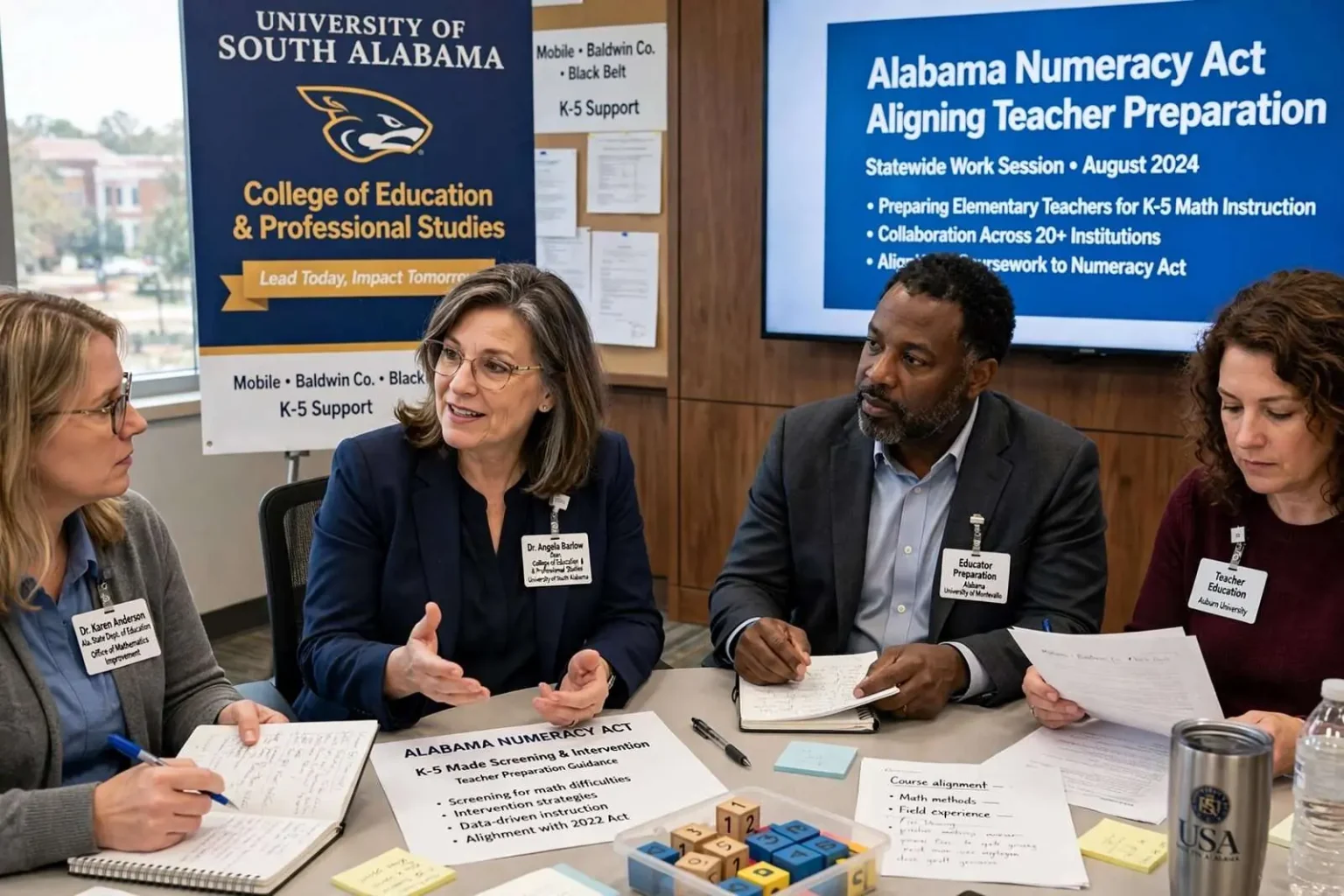
The University of South Alabama brought more than 20 professors and administrators from colleges and universities across the state to its Mobile campus this week for a work session focused on preparing future elementary school teachers to meet the requirements of the Alabama Numeracy Act. The gathering, hosted by the university’s College of Education and Professional Studies, put representatives of educator preparation programs from across Alabama in the same room to compare notes on how their institutions will retrain the way elementary teachers are taught to teach math.
The 2022 law was passed by state lawmakers in response to years of stagnant and declining math scores among Alabama’s youngest students. It sets new expectations for how kindergarten through fifth grade students are taught math and how struggling students are identified and supported, and it also reaches back into the state’s teacher preparation programs, requiring that college students studying to become elementary educators receive stronger grounding in how to teach math concepts. The legislation followed years of national assessment data showing Alabama students trailing most of their peers nationwide in mathematics, a gap officials describe as both an economic problem and a classroom instruction problem.
Under the law, local school systems are expected to screen young students for math difficulties in much the same way the state’s 2019 literacy act requires reading assessments, then provide targeted intervention for children who fall behind. That structure places new demands not only on elementary classrooms but on the colleges and universities that supply those classrooms with new teachers. If graduates are to identify and address math struggles in six-year-olds, the argument goes, their own training has to change first.
That requirement is what brought educator preparation providers from across Alabama to the University of South Alabama’s College of Education and Professional Studies. Dr. Angela Barlow, dean of the college, organized the gathering to walk fellow administrators through what the law expects of their programs and to build working relationships that can continue after the session ends. Participants came from public and private institutions across the state, reflecting the wide reach of the mandate: every program in Alabama that certifies elementary teachers must eventually align its coursework with the numeracy act’s expectations.
“Our goal today is to make sure that we’re all on the same page in terms of understanding the expectations of the numeracy act, and then to build some relationships so that we can walk away and continue collaborating to meet those expectations,” Barlow said.
Putting a Motto Into Practice
Barlow said the college has long operated under the motto “lead today, impact tomorrow,” and framed the work session as a chance to put that philosophy into action on a statewide scale. Rather than treating the new law as a compliance exercise confined to USA’s own programs, she said the college saw an opportunity to convene its peers and help shape how the entire state responds.
“I, as dean of the College of Education Professional Studies here at the University of South Alabama, always want to lead today and impact tomorrow. That is our motto. So, this is a chance for us to lead in this endeavor and make a difference in our state,” she said.
The framing matters for Mobile’s place in the state’s education landscape. The University of South Alabama is one of the largest educator preparation providers in south Alabama, and a substantial share of the teachers working in Mobile County, Baldwin County and the surrounding rural counties passed through its college of education. Decisions made in Mobile about how to train math teachers ripple outward through hiring pipelines that stretch from the Gulf Coast to the Black Belt.
State Agencies at the Table
Representatives from the Alabama State Department of Education’s Office of Mathematics Improvement and the Alabama Commission on Higher Education also took part in the session, giving the group a direct line to the state agencies responsible for enforcing and overseeing the law’s rollout in classrooms and on college campuses. Their presence underscored the two-track nature of the numeracy act: one track governs what happens in elementary schools, the other governs how universities prepare the people who will staff them, and neither can succeed without the other.
Dr. Karen Anderson, director of the Office of Mathematics Improvement, praised the University of South Alabama for taking a lead role in helping other institutions adapt.
“I will just say that Dean Barlow has really taken the lead across the state. She has really looked at the assets that her college has and is applying those to the expectations of the law,” Anderson said.
Anderson said the Numeracy Act was needed in part because many undergraduate students preparing to become teachers were not previously getting coursework that translated directly into what they would need once they had their own classrooms. A future teacher might complete a math content course, she suggested, without ever learning how to translate that content into a lesson a first grader can absorb.
“What I need is, how do I unpack those standards? What does that first grade standard really mean? How do I teach that standard in such a way that a first grader, a six-year-old, is able to understand,” she said, describing the kind of practical training the law now demands of teacher preparation programs.
The distinction Anderson drew is a familiar one in teacher education circles: knowing mathematics and knowing how to teach mathematics are different skills, and the second does not follow automatically from the first. The numeracy act pushes preparation programs to build that instructional bridge deliberately, ensuring that candidates leave their programs fluent in both the math itself and the methods for teaching it to young children.
Screening and Support in the Early Grades
The Alabama Numeracy Act requires local school systems to screen students in kindergarten through fifth grade for math difficulties and to provide additional, targeted instruction to those who are falling behind, modeled closely on the state’s earlier literacy law aimed at reading proficiency. Its central provisions, phased in over several years, include elementary math coaches deployed to schools across the state, additional training and support for K-5 teachers, structured assessments to identify struggling students, and intervention time built into the school day for the children who need it most. For colleges and universities that train future teachers, the law means updating coursework so graduates arrive in classrooms already equipped with research-based strategies for teaching early math skills.
That screening mandate has real consequences for south Alabama classrooms. Teachers in Mobile County, Baldwin County and neighboring systems will be expected to spot math struggles early — before they compound into years of frustration — and to document and respond to those struggles with specific interventions rather than general review. The approach mirrors the intervention framework schools adopted under the literacy act, which statewide officials have credited with measurable gains in early reading; the numeracy act applies the same logic to number sense, computation and problem solving in the earliest grades.
For the young students themselves, the law’s early-grade focus reflects a widely held finding in education research: children who fall behind in math in the earliest grades rarely catch up on their own, and the gap tends to widen each year. Early identification is therefore treated as the state’s best chance to change long-term outcomes, including students’ readiness for algebra and later coursework that employers across Alabama consistently cite as a hiring prerequisite.
A Working Session, Not a One-Time Meeting
Participants spent the session working through what the law expects of preparation programs and comparing how their institutions currently structure math methods courses, field experiences and faculty expertise. With more than 20 institutions represented, the discussion ranged from curriculum redesign to the practical questions of faculty development — how to prepare the college instructors themselves to teach the new expectations to teacher candidates.
Organizers said Monday’s session is intended to be the start of ongoing collaboration among Alabama’s educator preparation programs, rather than a single one-time meeting, as institutions work through the coming years to align their coursework with the law’s requirements. The relationships built in Mobile are expected to continue through follow-up communication and future convenings as the state agencies phase in compliance timelines.
For the University of South Alabama, the session reinforces its self-image as a convener for the region’s education community. College leaders have argued that south Alabama benefits when its largest university takes an active role in state education policy, because local districts then gain graduates trained to the newest standards without a lag behind their peers in Huntsville, Birmingham or Montgomery.
The stakes extend well beyond campus. Alabama’s effort to rebuild its elementary math instruction comes as the state courts industries that increasingly screen job applicants for computational skills, and as school systems across Mobile and Baldwin counties compete for a limited pool of qualified elementary teachers. Every institution in the room is part of that supply chain, and the numeracy act effectively asks all of them to raise the floor at the same time so no district’s new hires arrive unprepared.
What Changes for Teacher Candidates
For college students currently studying to become elementary educators, the practical effect of the law and sessions like this one will show up in their coursework. Candidates can expect stronger emphasis on how children develop number sense, how to diagnose where a struggling student’s understanding breaks down, and how to use screening data to adjust instruction — the same competencies the state will expect them to demonstrate once they hold a certificate.
The law also ties the work of the universities to the work underway in local schools. Districts are building their own math intervention structures under the act, hiring and training coaches and configuring schedules to provide extra support to flagged students. When a newly graduated teacher arrives already fluent in those practices, the district’s job becomes reinforcement rather than remediation, which educators say is the difference between a policy that changes classrooms and one that changes paperwork.
Anderson’s office, created under the numeracy act to drive its implementation, has been charged with overseeing the instructional side of the rollout, including the development of support for districts as they put screening and intervention in place. Its participation in the Mobile session signaled that the state intends for the university side and the district side of the law to move in step rather than in sequence.
A Region Watching Its Schools
Education policy occupies a prominent place in civic life across south Alabama, where school performance shapes home values, business recruitment and the long-running competition between suburban and city systems for families and teachers. Mobile County Public Schools, the state’s largest system, and the fast-growing Baldwin County system both depend heavily on regional universities for their annual hiring classes, making the alignment of teacher preparation a matter of direct local consequence.
The work session also reflects a broader pattern in Alabama education policy of the past several years: the state legislature passing laws that reach into the details of instruction, from the literacy act’s retention and coaching requirements to the numeracy act’s screening mandates. For the universities, adapting to those mandates has become a recurring institutional project, and the Mobile gathering was framed as a way to share that burden across institutions rather than have each program solve the same problems alone.
As the session closed, the mood among organizers was that the hard work lies ahead — the curriculum revisions, the faculty training, the steady grind of aligning hundreds of course sections across the state with a single set of expectations for early math instruction. But the first step, they said, was simply getting everyone in the same room, reading from the same page, and leaving with names and numbers to call when the questions start. For the future kindergartners and elementary students of Alabama, the results will arrive one classroom at a time.