USA’s Office of Community Engagement Launches Bus Tour to Highlight Local Partner Schools
The University of South Alabama's Office of Community Engagement toured Baldwin Preparatory Academy and Bishop State Community College on a new bus tour meant to strengthen ties with community partner schools.
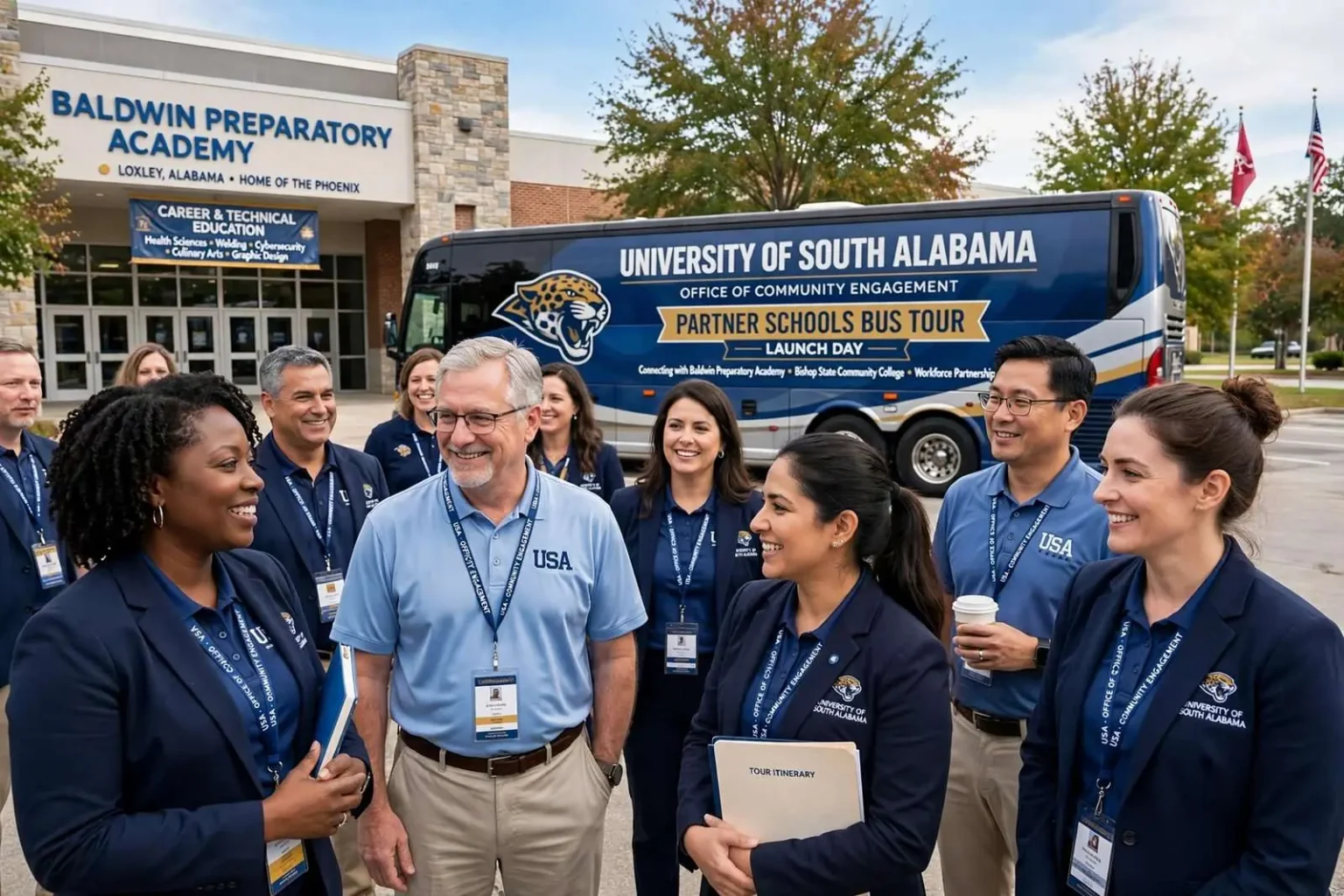
The University of South Alabama’s Office of Community Engagement hosted its first bus tour for faculty and staff, taking them to Baldwin Preparatory Academy in Loxley and Bishop State Community College in Mobile. The tour was designed to strengthen relationships between the university and the community partners it works with on education and workforce initiatives.
Bus tours occupy a special place in university outreach. Meetings and video calls convey information, but a day on the road lets faculty and staff see partner institutions in operation — the pace of a classroom, the equipment in a training lab, the students a partnership actually serves. The Office of Community Engagement’s inaugural tour put that principle into practice, loading South’s people onto a bus and sending them across Mobile Bay to the institutions where the university’s education and workforce commitments take on flesh and blood.
The itinerary was chosen to showcase two very different but complementary partners. Baldwin Preparatory Academy represents the newest model in Alabama’s public education landscape, while Bishop State Community College anchors the two-year college tradition in downtown Mobile. Together they trace the pathway a student might travel from high school career training through a community college credential to a university degree — the full arc that USA’s partnerships are built to support.
Inside Baldwin Preparatory Academy
Baldwin Preparatory Academy is a full-time public high school for students in grades 10 through 12 that emphasizes hands-on career training alongside traditional coursework. Opened in Baldwin County to serve one of the fastest-growing counties in the state, the academy reflects a statewide shift toward career and technical education that prepares students for real employment options at graduation, whether they head to work, to a two-year college, or to a four-year university.
During the visit, USA staff toured collaborative learning spaces and saw 12 career pathway courses of study, including health sciences, cybersecurity, welding, cosmetology and barbering, graphic design and advertising, and culinary arts. The range is deliberate: the pathways span professions that Baldwin County’s economy actually demands, from the healthcare employers clustering along the Eastern Shore to the trades supporting the county’s construction boom, hospitality industry, and digital economy.
Students at the academy wear uniforms tied to their chosen academic focus. The practice is more than cosmetic. Uniforms tied to a pathway reinforce professional identity from the first day of tenth grade, build habits of dress that transfer to workplaces, and signal to visiting employers that the students they meet are training for their industries. For the USA visitors, seeing students move through labs in pathway-specific attire offered a visible answer to the question every university asks about its pipeline partners: what actually happens here each day?
Dr. Joél Lewis Billingsley, USA’s vice president for community engagement, said the tour was meant to build on relationships the university already has with both institutions.
“The purpose of this tour was to create an opportunity to continue building meaningful relationships between South and our community partners,” Billingsley said, adding that the university remains focused on economic and workforce development alongside community engagement.
The emphasis on relationships over transactions reflects how successful university partnerships actually work. Agreements and memoranda create the framework, but the collaborations that endure are sustained by people — a admissions counselor who knows the academy’s counselors by name, an engineering professor who visits a high school lab each semester, a financial aid officer who walks families through the transfer process. Putting faculty and staff on a bus is an investment in that human layer, giving dozens of university employees a firsthand stake in partnerships they might otherwise know only from a directory listing.
It also connects to the university’s broader economic role. As one of the Gulf Coast’s major employers and the region’s principal doctoral university, South graduates much of the professional workforce that staffs Mobile area hospitals, schools, engineering firms, and industries. Aligning its outreach with the school systems and community colleges that feed its enrollment is both a civic mission and a competitive necessity, as demographic trends push every Alabama university to recruit and retain students across a wider geography.
Bishop State and the Transfer Bridge
Bishop State Community College, the tour’s Mobile stop, has served the city for decades as a public two-year institution with deep roots in the community. The college offers academic transfer programs, career and technical education, workforce credentials, and community programming from its campus in downtown Mobile, serving students who range from recent high school graduates to working adults retraining for new careers. Its role in the city’s educational landscape is foundational: for many first-generation college students, Bishop State is the most accessible on-ramp to higher education in the region.
USA maintains a supportive agreement with Baldwin Preparatory Academy and an articulation agreement with Bishop State Community College that allows Bishop State graduates to pursue a bachelor’s degree through Pathway USA. The articulation agreement removes the friction that historically complicated transfer: course equivalencies are mapped in advance, advising is coordinated, and a Bishop State graduate who qualifies arrives on South’s campus with a clear route to the bachelor’s degree, rather than a stack of credits awaiting evaluation.
Pathway USA has become one of the university’s signature transfer pipelines, and agreements like the one with Bishop State put it to work for Mobile’s own students. The economics matter as much as the access: a student who completes two years at community college tuition rates and transfers into a university degree saves substantially on the total cost of a bachelor’s degree, and the coordinated advising reduces the credit losses that often extend transfer students’ time to graduation.
Why Workforce Partnerships Matter on the Gulf Coast
The tour’s two stops sit inside one of Alabama’s most consequential economic corridors. Baldwin County’s population growth has made it one of the fastest-growing counties in the state, driving demand for healthcare workers, skilled tradespeople, hospitality staff, and technology professionals. Mobile’s port, aerospace sector, shipbuilding industry, and expanding healthcare systems face the same challenge: finding trained workers in sufficient numbers to sustain growth. Institutions like Baldwin Prep and Bishop State are the front lines of that effort, and universities that build genuine partnerships with them strengthen the entire regional pipeline.
The career pathways on display at Baldwin Preparatory Academy map directly onto that demand. Health sciences feed the region’s hospitals and clinics; welding supports shipbuilding and industrial construction; cybersecurity serves the defense and technology employers across the Gulf Coast; cosmetology, culinary arts, and graphic design sustain the small-business economy that makes communities livable. When a university’s community engagement office sends its own staff to see those programs firsthand, it builds the institutional knowledge needed to design scholarships, dual-enrollment options, and degree pathways that fit what the schools are actually doing.
For the students, the value compounds across each handoff in the pipeline. A tenth-grader who declares a health sciences pathway at Baldwin Prep can graduate high school with certifications and college credit, continue into Bishop State’s nursing or allied health programs, and complete a bachelor’s degree at South through Pathway USA — each step building on the last, with agreements already in place to smooth every transition. The bus tour’s purpose, in the end, is to make sure the people who run the university’s end of that pipeline know exactly what the earlier steps look like.
A Model for Future Engagement
As a first-of-its-kind effort for the Office of Community Engagement, the tour sets a template that future editions could follow — and the office’s model has obvious applications beyond these two partners. Schools, industries, and nonprofits across the university’s service region would benefit from the same treatment: a day of shared space, direct conversation, and firsthand observation that turns formal partnerships into working relationships.
For the faculty and staff who made the trip, the day offered something meetings rarely do: the chance to watch a welding student find her rhythm, to hear a counselor describe what families ask about college costs, to stand in a learning space designed around collaboration rather than rows. Those impressions travel back to campus in a way no report can, informing everything from admissions visits to curriculum design.
University officials describe community engagement and workforce development as inseparable parts of the same mission, and the bus tour embodied that claim. South’s future depends on the strength of the schools and colleges that prepare its students, and this first tour made those connections literal — a bus, two stops, and a university putting its people where its partnerships are.
The tour also arrives as higher education across Alabama works to rebuild public trust and demonstrate everyday value to the communities that fund it. Painting that picture takes more than press releases; it takes residents who have personally seen a university serving their schools and their neighbors. Each stop on the route gave the university a story its employees can retell in their own neighborhoods, which is how an institution’s reputation is actually built — visit by visit, conversation by conversation, long after the bus returns to campus.