‘Dolly Parton’ Bridge Reopens Early After Quick Repair Job on I-65
Repairs on the I-65 bridge locally known as the 'Dolly Parton' bridge finished ahead of schedule, reopening both northbound lanes early.
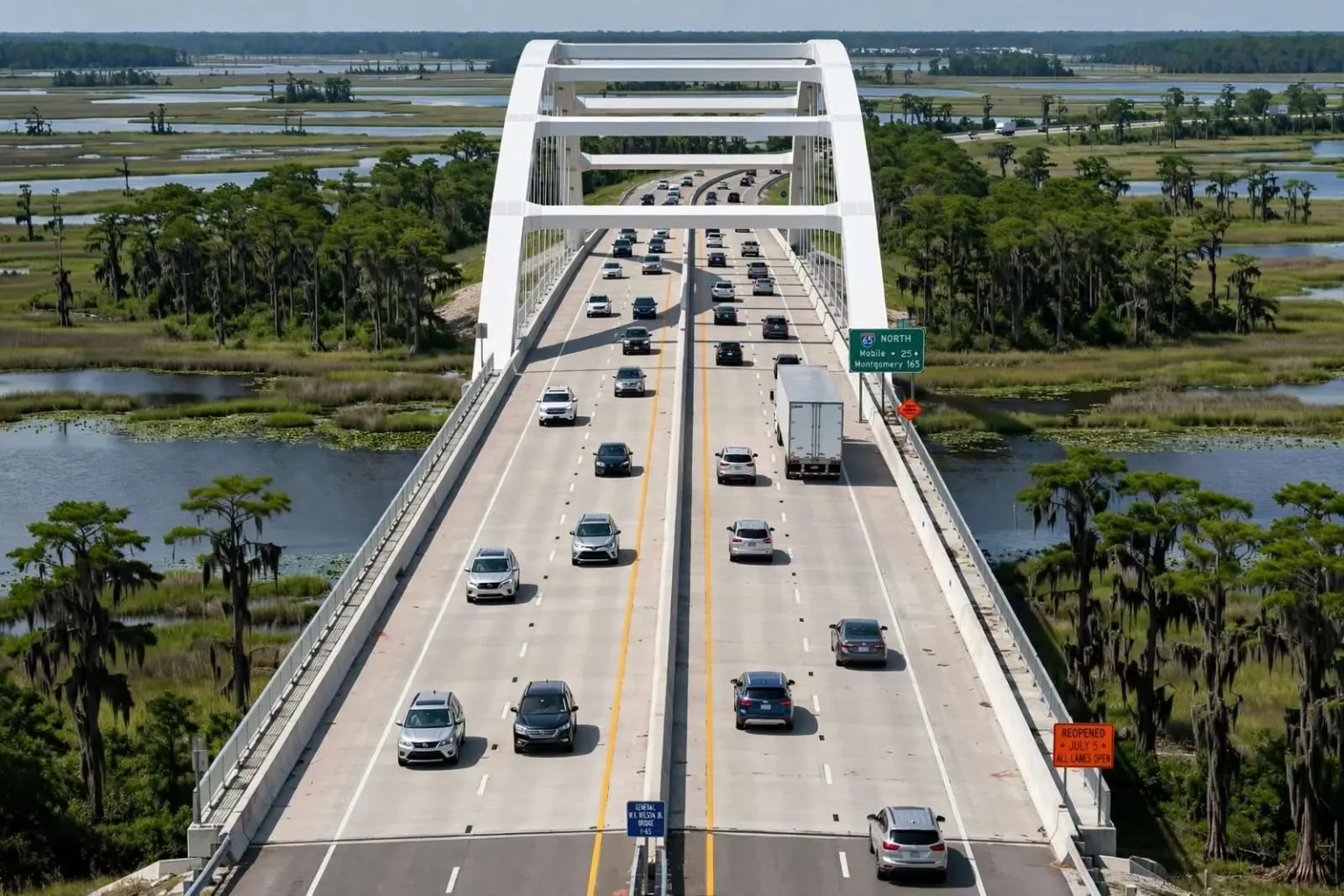
The stretch of Interstate 65 known locally as the ‘Dolly Parton’ bridge is back to full northbound service after a construction crew wrapped up emergency repairs well ahead of its original deadline. The reopening restores one of south Alabama’s most important river crossings to complete capacity just in time for the summer’s heaviest travel weekend.
The bridge, formally the General W.K. Wilson Jr. Bridge, had been reduced to a single lane after a serious wreck damaged the structure earlier in the year. The damaged span carries Interstate 65 across the Mobile-Tensaw Delta north of the city, a wetland crossing where the highway rides high above miles of rivers, bayous and bottomland forest, and where lane closures create bottlenecks that can stretch for miles.
Crews began the repair work on June 21 with a 25-day timeline to complete the job, but a Montgomery-based construction company pushed to finish even faster. Part of the motivation was financial. The repair contract included an incentive clause promising the contractor an extra $50,000 for every day the work finished ahead of schedule — a structure designed to trade bonus payments for reopened lanes, and one that paid off exactly as intended.
With the bridge fully reopened by July 5, the company stood to collect as much as a half-million dollars in bonus payments for beating the deadline by roughly three weeks. The math is straightforward: roughly ten days early at $50,000 per day, the maximum bonus payout approached the kind of sum that makes round-the-clock scheduling worthwhile for a contractor able to staff it.
A Critical Corridor Crossing
The bridge carries an estimated 30,000 vehicles a day, making it one of the busiest crossings in the region and a critical link for commuters and travelers moving along the Interstate 65 corridor. The route connects Mobile to Montgomery and points north, funnels Gulf Coast beach traffic in and out of the region, and carries commercial freight between the Port of Mobile and the rest of the state.
With the Fourth of July holiday traffic bearing down on the area, transportation officials had considered a quick repair essential to avoid major congestion and safety risks on one of south Alabama’s most heavily traveled routes. Holiday weekends routinely push delta-crossing traffic to its limits, and a single-lane configuration on a major interstate bridge multiplies both delay and the risk of secondary crashes in the queue.
The delta crossing’s geography leaves drivers few alternatives. Detouring around the Mobile-Tensaw Delta means long swings onto smaller U.S. highways not built for interstate volumes, so when the bridge narrows, the region’s whole north-south traffic pattern narrows with it.
Racing The Calendar
The accelerated timeline meant round-the-clock work for crews in the weeks leading up to the reopening, with construction teams racing to complete structural repairs, resurfacing and final inspections before reopening the roadway to traffic. Night shifts over a working interstate require intense lighting, staged lane control and inspection protocols that keep workers and drivers separated while the structure itself is under repair.
Structural repairs after a wreck involve more than patching visible damage: engineers assess impact damage to beams, railings and the driving surface before crews cut, replace and reinforce, and final inspections verify the work before traffic is allowed back at full speed and full width. Finishing that sequence roughly three weeks early required overlapping phases that a normal schedule would have run one after another.
The incentive-disincentive clause is a standard tool in transportation contracting, used when the cost of a closed road to the public exceeds the cost of speeding up the work. Each day a major interstate bridge runs short-handed imposes real costs on freight carriers, commuters and emergency response, and the $50,000 daily bonus was calibrated to make reopening early worth more to the contractor than stretching the job out.
Why ‘Dolly Parton’?
The bridge’s nickname, a nod to its distinctive twin-arch silhouette, has made it a familiar landmark for anyone who regularly drives the interstate between Mobile and the rest of the state. Motorists see the twin white arches rising out of the delta wetlands for miles in both directions, a profile so recognizable that the nickname has largely displaced the bridge’s formal name in everyday conversation across the Gulf Coast.
The structure it replaces in the public’s memory — and the delta it spans — give the bridge a place in local identity that ordinary overpasses never earn. Crossing it marks the passage from the coastal plain into the river delta country, and its twin arches have framed the northbound view out of Mobile for generations of travelers.
Traffic Returns To Normal
With both northbound lanes now fully restored, traffic flow across the span has returned to normal, closing out a repair saga that began with a dangerous wreck and ended with a contractor cashing in on an aggressive push to get the job done early. Transportation officials get their full-capacity crossing back before peak summer travel; the contractor collects the bonus; and drivers regain the lane that had been pinching the corridor for weeks.
The episode offers a case study in how incentive clauses can compress repair timelines when the stakes are public. A 25-day job completed in roughly three weeks meant the delta crossing entered the July 4 weekend at full capacity rather than single-lane, sparing holiday travelers the miles-long backups a narrowed bridge would have produced at peak volume.
Southbound traffic had been unaffected in the immediate aftermath of the wreck, but northbound freight and commuter flows bore the brunt of the reduced capacity until the reopening. Commercial traffic between Mobile’s port and the state’s interior had been rerouting around the delays, adding miles and hours to deliveries that the reopening again shortens.
For the crews who worked through the nights to finish early, the reopening marked the end of a compressed, high-pressure construction schedule executed over open water in the middle of hurricane season. For the traveling public, the familiar twin arches on I-65 are back to carrying the full 30,000 vehicles a day that depend on them — with the repair bill for the wreck paid, in part, by the speed of the crew that beat the deadline.
The June wreck that started the saga caused damage serious enough that transportation engineers restricted the span to a single northbound lane rather than risk full traffic on a compromised structure. Interstate bridges are inspected and rated for load, and a wreck that damages structural elements or safety railings triggers an assessment before any decision to restore lanes — the single-lane configuration was the public-safety answer while repairs were planned and bid.
Emergency repair contracts of this kind move fast by design. Once the damage assessment was complete, the state could scope the structural repairs, resurfacing and inspections, set the 25-day baseline schedule, and attach the per-day incentive that gave the Montgomery contractor its reason to compress the work further. From wreck to full reopening, the entire repair cycle was measured in weeks rather than months.
The delta setting added complexity that a city-overpass repair would not face. Crews worked over water and wetland in summer heat and afternoon storms, with equipment access, barge logistics and environmental protections all shaping how fast each phase could proceed. Finishing early under those conditions, over a holiday push, marked an unusually quick turnaround for structural work on a bridge of this size.
Local drivers, meanwhile, had spent weeks adjusting to the narrowed crossing. Regular commuters shifted departure times, freight carriers built delta delays into their schedules, and summer travelers heading to and from the Gulf beaches learned to expect the slowdown that the July 5 reopening erased.
The bridge’s place in the region’s infrastructure is hard to overstate. Interstate 65 is the spine that connects Mobile to Montgomery, and beyond it to Birmingham and the interstate networks of the broader Southeast, so the delta crossing is the single pinch point through which all of that traffic must pass. Hospital transfers, law enforcement movements and hurricane evacuation planning all route over the same twin arches, which is why transportation officials treat any capacity loss there as a regional emergency rather than a local inconvenience.
The Fourth of July timing made the deadline all the more urgent. Beach traffic between Birmingham, Montgomery and the Gulf Coast funnels across the bridge in enormous volumes during the holiday week, and officials had warned that a single-lane span during peak holiday flow would produce the kind of congestion that breeds secondary wrecks and stranded travelers. Reopening on July 5 meant the bridge absorbed the return-travel surge at full width.
Delta crossings also carry a history of careful public investment. The Mobile-Tensaw Delta is one of the South’s largest wetland ecosystems, home to rare species and popular for fishing and boating, and any highway work there operates under environmental constraints designed to protect the waters below. The repair crews’ early finish happened within those same constraints, adding another layer to the accomplishment.
As traffic returns to its normal rhythms across the reopened span, the episode closes with all sides made whole: engineers satisfied the structure is sound, officials saw the corridor restored before the worst of the holiday rush, the traveling public got its second lane back, and the Montgomery contractor earned a bonus measured in half a million dollars for every day it saved the region.