A $17,223 Printing Bill Draws Scrutiny in the Gulf Coast Classic Audit
An audit of the Gulf Coast Classic listed $17,223 in printing costs, far more than the Senior Bowl or BayFest spent. Organizers said the figure covered far more than tickets.
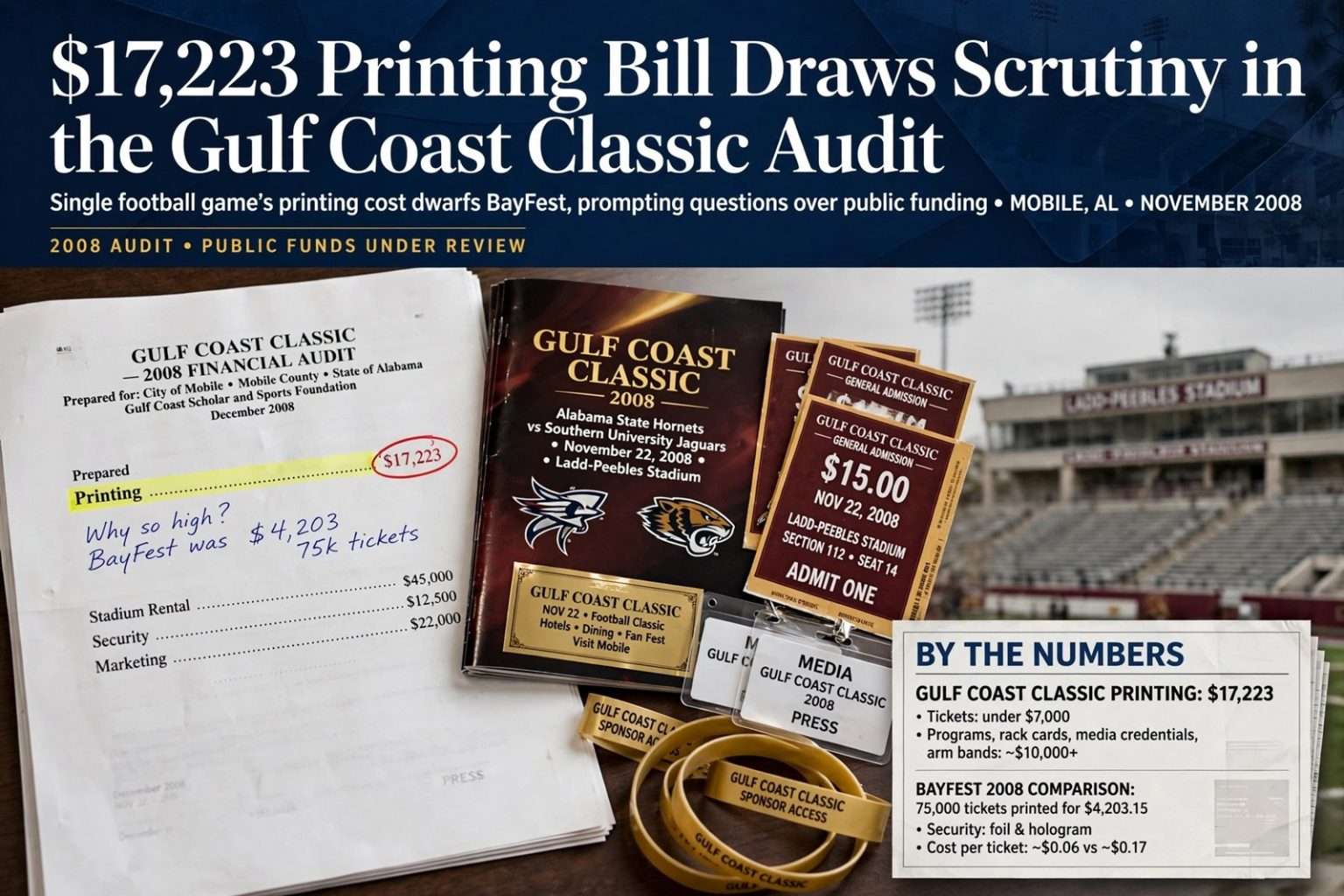
Among the many line items in the audit of the 2008 Gulf Coast Classic, one number kept catching the eye of anyone reading closely: $17,223 for printing. The figure stood out because it dwarfed what comparable events in Mobile spent on the same category. The GMAC Bowl, the Senior Bowl and BayFest all reported considerably less.
For a single football game between Alabama State and Southern at Ladd-Peebles Stadium, the number invited an obvious question, and the question was not a friendly one. An event that had drawn public money from the city, the county and the state was being asked to account for itself, and an expense line nearly four times the size of BayFest’s entire printing bill was exactly the sort of entry that turns a routine audit into a public discussion.
Printing occupies a peculiar place in event accounting. Unlike a stage or a scoreboard, printed material is consumed in an afternoon: tickets are torn, programs are discarded, arm bands end up in trash cans. When an event’s costs are scrutinized, a large printing line looks like money that bought nothing durable — which makes it a natural target for officials trying to understand where a subsidy went, and a natural first item for defenders to explain.
What the money actually bought
Organizers said the impression of extravagance rested on a misunderstanding. Ticket printing alone accounted for less than $7,000, according to Taylor Hodge Jr., president of the Gulf Coast Scholar and Sports Foundation, the nonprofit that took over management of the game.
The remaining $10,000 and more, Hodge said, covered programs, arm bands, media credentials, rack cards and an assortment of other printed materials produced for the weekend. In other words, the audit’s single printing line collapsed a range of expenses into one figure that looked, at a glance, like the cost of tickets.
The distinction was more than bookkeeping. A college football classic produces printed matter the way a theater production does: game programs with rosters and advertisements, credential packages for media working the game, hospitality materials for sponsors, and promotional pieces distributed in advance to build the crowd. Rack cards — the small, rack-displayed promotional pieces used in hotels and visitor centers — pointed to a marketing effort intended to reach the tourists the event had promised to attract. None of that is captured by the word “printing” alone, and Hodge’s explanation amounted to a request that readers not mistake one category label for the whole picture.
Even so, the explanation left the underlying question standing: why did the Classic’s combined printing cost so much more than what other Mobile events reported for the same function? That question could only be answered by comparison, and the most pointed comparison available came from an event many times larger.
The BayFest comparison
The comparison that made the number hardest to defend came from an event several times larger. BayFest, the downtown music festival staged in Mobile each October, printed 75,000 tickets for $4,203.15, according to festival officials. Those were not simple tickets, either. Because BayFest runs outdoors across three days without reserved seating, counterfeiting is a genuine risk, and the festival takes measures accordingly.
BayFest executive director Bobby Bostwick described the precautions: a foil wrap and hologram embossing, both of which raise costs above those of a standard printed ticket. Weekend passes carry three perforations as well. The printing was handled locally, by Printed Impressions.
“I’m pretty sure ours are more sophisticated than a standard ticket to a football game,” Bostwick said, adding that he had not seen a Gulf Coast Classic ticket and that his remarks applied strictly to BayFest.
Bostwick’s careful phrasing acknowledged what any fair reading requires: he had not examined the Classic’s tickets, and security features are only one variable in print pricing. Paper stock, ink coverage, quantity, turnaround time and design complexity all move the number. But his central point survived the caveats — an event that admitted tens of thousands of people to an open downtown festival, using tickets armored against counterfeiting, had managed the job for a fraction of what the Classic’s single line item showed.
The arithmetic was unavoidable. BayFest produced 75,000 high-end, security-featured tickets for roughly $4,200. The Classic’s ticket printing, by its own organizers’ account, ran to something under $7,000 for a stadium that seats about 40,000, and for a game whose attendance has been variously pegged at figures between 10,700 and 26,000.
On a per-ticket basis, the contrast was stark. BayFest’s security-featured tickets cost roughly six cents each; the Classic’s reportedly approached or exceeded seventeen cents apiece for tickets that presumably carried no foil, no hologram and no perforations beyond a stub tear. Organizers could point to design and production choices that a single line item does not reveal, but the gap between the two events’ experience with the same printing category gave the audit’s readers a benchmark no one at the foundation could easily rebut.
The larger accounting
The printing line was a small piece of a much bigger dispute. The 35th annual Gulf Coast Classic, promoted for the first time by the Gulf Coast Scholar and Sports Foundation, received public financing in 2008 totaling at least $355,000. That included $275,000 from the City of Mobile, agreed to in a compromise after an initially proposed $450,000; $50,000 from Mobile County; and $30,000 from a state tourism fund.
The shape of that funding told its own story. The city’s contribution had already been cut from an initial request of $450,000 to $275,000 before the money was committed — a negotiation that signaled municipal skepticism about the event’s business plan even before the game was played. The county and the state tourism fund added smaller amounts, each conditional on the same premise: that the Classic would generate economic activity, tourism and goodwill commensurate with the public investment.
The audit of the game reflected a deficit of more than $188,000 — an amount very close to what the two participating schools were still owed under their contract.
That near-coincidence was the most consequential detail in the entire document. A deficit that almost exactly matches an unpaid contractual obligation to the participating institutions suggests an event that spent what it had and reached the end of the year with its core commitments — the appearance fees, guarantees and expense reimbursements that make a college football game possible — still hanging. Schools do not schedule games on faith alone; they schedule them because contracts guarantee payment. An event that cannot cover its guarantees becomes a risk that athletic directors remember the next time a promoter calls.
City officials were scheduled to meet with foundation representatives on March 18 to review the event’s performance, a session that would inform the budget discussion for 2009-2010. The printing figure was likely to be one of many entries examined line by line.
That meeting was the fork in the road. A city that has subsidized an event at $275,000 and watched it post a six-figure deficit faces a decision every year: renew, renegotiate or withdraw. The March 18 session would produce the data on which that decision rested — attendance figures, revenue breakdowns, expense explanations — and the eventual budget for the following two years would show whether Mobile’s officials believed the Classic’s promise or had decided the promise had not been kept.
Why the detail mattered
Disputes over public money are often settled in exactly this register — not in grand arguments about whether a city should subsidize a football game, but in the granular business of what a receipt says and what it actually represents.
The Classic had been sold to Mobile as an investment: a historically Black college football showcase modeled on the Bayou Classic in New Orleans and the Magic City Classic in Birmingham, capable of filling hotel rooms and restaurants on a mid-November weekend.
Both of those model events are civic institutions with decades of history. The Bayou Classic, played in New Orleans between Grambling State and Southern, draws tens of thousands of visitors and has become a fixture of that city’s fall calendar; the Magic City Classic, matching Alabama State and Alabama A&M in Birmingham, similarly anchors a weekend of events around the game. The Gulf Coast Classic’s pitch to Mobile was that the Port City could capture the same formula — a marquee matchup, a parade, a fan base that travels, and a weekend of spending that reaches well beyond the stadium gates.
Events of that kind are judged against their promises, and the promises were explicit. A mid-November football game at Ladd-Peebles Stadium was supposed to put heads in hotel beds and customers in restaurants during a shoulder season for tourism. When an event making that promise runs a six-figure deficit, every line in its audit acquires a weight it would not otherwise carry.
A $17,223 printing charge, properly explained, may have been entirely defensible. But the explanation had to be asked for, and that in itself said something about how much trust the first year of the new Gulf Coast Classic had managed to build.
That final point is the durable lesson of the episode. A line item is only a number until context is supplied, and the obligation to supply it belongs to the organization that spent the money. In its first year under new management, the Gulf Coast Scholar and Sports Foundation learned that a public subsidy comes with a standing demand for transparency — and that when that demand has to be satisfied after the fact, in response to an audit, the organization has already lost part of the argument. The city’s March meeting would decide whether the Classic got a second chance to make the case on its own terms.