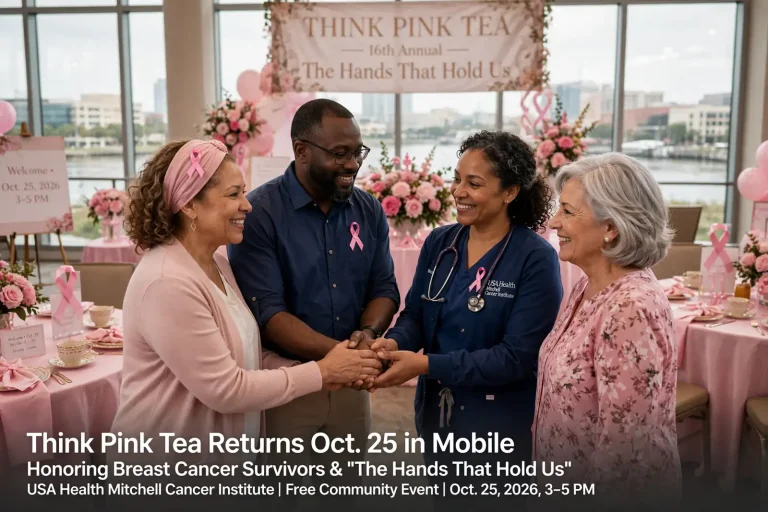
Mobile’s Annual Think Pink Tea Kicks Off Breast Cancer Awareness Month
Mobile's annual Think Pink Tea returns to Geri Moulton Children's Park, opening breast cancer awareness month with a free fashion show honoring survivors.
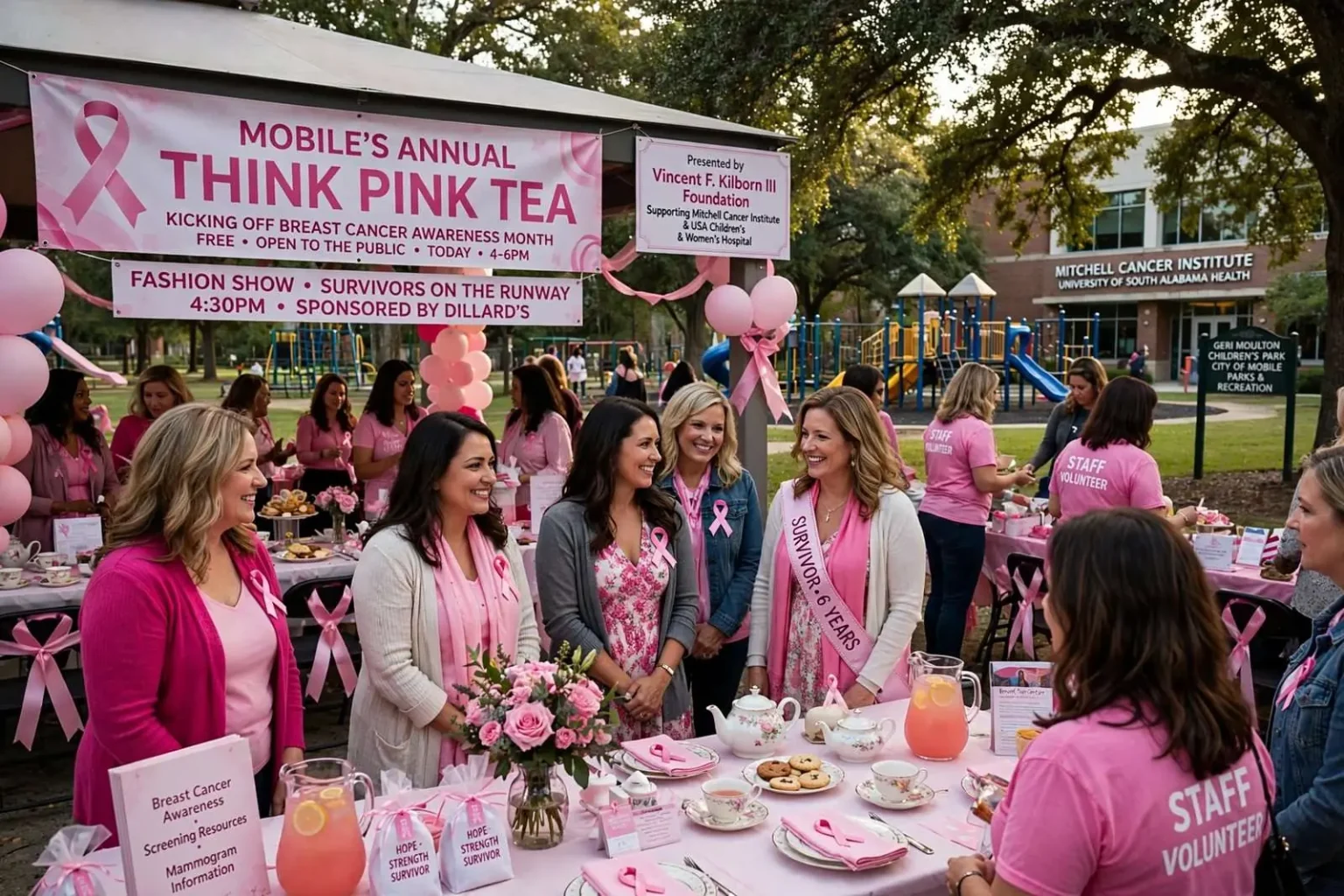
Breast cancer awareness month kicks off in Mobile this week with the return of an annual fundraising tea that has become a fixture on the city’s fall calendar. The event, held at Geri Moulton Children’s Park near the Mitchell Cancer Institute, blends light refreshments with a fashion show and a program aimed at supporting patients and survivors throughout the region.
Organizers say the gathering has grown steadily since it began, with last year’s tea drawing a crowd large enough to fill the Mitchell Cancer Institute’s lobby to capacity. The move to the adjacent children’s park reflects that growth — a venue that can hold the crowd the tea now attracts while keeping the event within steps of the institute it supports.
This year’s program keeps the same free, open-to-the-public format, running from 4 p.m. to 6 p.m., with the fashion show set to begin around 4:30 p.m. The afternoon format makes the event accessible to patients, survivors and families who might not manage an evening function, and organizers have kept the atmosphere celebratory rather than somber.
The timing puts the tea at the front of a national observance. October is Breast Cancer Awareness Month across the country, marked by pink-themed fundraisers, screening drives and awareness campaigns, and Mobile’s tea serves as the local movement’s opening event — the gathering that sets the tone for a month of pink ribbons on downtown storefronts and hospital workers in pink scrubs.
A sponsor with a personal stake
The tea serves as the launch event for a charitable foundation established by Mobile attorney Vincent F. Kilborn III, who has stepped forward as presenting sponsor. Kilborn has said the cause is personal, noting that breast cancer has touched his own family and that events like this one give relatives and survivors alike a chance to support ongoing research and treatment efforts at the Mitchell Cancer Institute and USA Children’s & Women’s Hospital.
The connection between the foundation and the two institutions it supports runs through the heart of Mobile’s medical community. The Mitchell Cancer Institute, part of the University of South Alabama’s health system, is the region’s academic cancer center, combining patient treatment with research into the disease, while USA Children’s & Women’s Hospital serves the families who face a diagnosis alongside pregnancy, motherhood and caregiving. Funding raised through events like the tea flows into that ecosystem — the labs, the clinics and the patient programs that a diagnosis puts a family into overnight.
Kilborn’s involvement has given the tea a durable institutional anchor. Grassroots cancer fundraisers often depend on a handful of volunteers who burn out after a few years; a named foundation with a presenting sponsor can plan further ahead, grow the program each year, and turn a single afternoon into a sustained annual commitment to the cancer center next door.
The setting carries its own meaning. Geri Moulton Children’s Park, with its playground and green space, sits alongside the medical campus, and holding the tea there places an event about survival in a park built for children and families — a reminder of whom a breast cancer diagnosis affects beyond the patient herself.
Survivors on the runway
The fashion show, sponsored by a local Dillard’s store, will feature breast cancer survivors modeling for the crowd. Among them is a Mobile-area mother who was diagnosed with breast cancer while pregnant with her daughter and has since marked six years cancer-free. Her story — a diagnosis arriving at one of life’s most joyful moments, followed by treatment, delivery and years of survivorship — captures the reason the fashion show exists.
Organizers say including survivors as models is meant to put a human face on the disease and celebrate milestones that patients and families fight hard to reach. For the women walking the runway, the show is frequently described as a milestone of its own: a public declaration of survival, applauded by a room that includes women still in treatment.
The audience relationship runs both directions. Newly diagnosed patients attending the tea see women years into survivorship living full lives, and that visibility is part of the event’s quiet therapeutic work. A cancer center’s waiting room is full of fear; a park full of survivors in fall dresses is the counterargument.
Free and open to everyone
No tickets are required and there is no cost to attend, organizers said, a detail they hope will encourage more families and cancer survivors to take part regardless of financial circumstance. The open-door format stands out among charity events, which often gate their most meaningful moments behind table prices. Here, a patient in treatment, a survivor decades past her diagnosis, and a family simply curious about the institute’s work all stand in the same crowd.
The no-cost format also serves the awareness mission. Every attendee who watches survivors model, hears the program and picks up information about screening leaves as a messenger — someone more likely to schedule a mammogram, encourage a sister or friend to do the same, and volunteer at the institute’s other events during the month that follows.
Those wanting to reserve a seat at the fashion show or get more information about the tea can call the Mitchell Cancer Institute’s community outreach line or visit the institute’s breast cancer awareness page online. Seating for the fashion show is the only element that requires a reservation, and organizers encourage early contact as the event’s popularity has grown each year.
Why awareness month matters here
Breast cancer is among the most commonly diagnosed cancers in American women, and the Gulf Coast’s medical community treats patients from across southwest Alabama and the Mississippi coast who come to Mobile’s hospitals for care. Awareness campaigns like October’s exist because early detection changes outcomes dramatically: cancers found at earlier stages are treated more successfully, with less aggressive treatment, than those found late. That is the practical message beneath the pink — mammograms, self-exams and prompt attention to changes save lives.
For the Mitchell Cancer Institute, the tea is both a fundraiser and a public introduction. Academic cancer centers can seem distant to the public — research buildings, clinical trials, technical language — and an afternoon in the park puts the institute’s mission in plain terms: the doctors and researchers who work there are neighbors, and the patients they treat are the women in the audience.
The event also reflects Mobile’s broader fall calendar, when the city’s charity season ramps up alongside the return of cooler weather. Among the galas and golf tournaments, the tea occupies a gentler niche — two hours in the late afternoon, children playing in the park nearby, survivors being applauded rather than solicited.
The month ahead
The tea’s launch role means the foundation and the institute will spend the rest of October building on the gathering — screening reminders, additional fundraisers and awareness programming aimed at the women of southwest Alabama and the families who love them. Organizers have watched the event grow from its beginnings into a capacity crowd, and each year’s attendance becomes the baseline for the next.
For attendees, the afternoon offers something simple: refreshments in a park, a fashion show, and a room full of proof that a diagnosis is not the end of the story. For the institute and the foundation behind it, the tea is the first step of a month — and a mission — that continues long after the pink decorations come down: supporting the research, the treatment and the survivorship that turn patients into the women who walk the runway the following year.
The women behind the event
Behind every capacity crowd is a corps of volunteers who hang the decorations, pour the tea and line up the models, and the tea has drawn that labor from the same community it serves — survivors who return each year to work the event, institute staff who lend their afternoon, and volunteers from the organizations that support the cancer center throughout the year. The event’s growth from its beginnings to a lobby-filling crowd was built on that recurring labor as much as on any sponsor’s check.
The fashion show’s backstage choreography has its own meaning. Survivors get fitted in the dresses Dillard’s provides, and the moments before the runway — women helping each other with earrings, comparing notes on treatment years past — are the part of the afternoon attendees never see but that keeps volunteers coming back.
Screening: the message beneath the celebration
While the tea celebrates survival, its most consequential message is about the screenings that produce survivors in the first place. Medical organizations recommend that women begin regular mammograms at an age their doctors determine based on their individual risk, and the institute uses awareness month to press the point that Mobile-area mammography capacity exists — at the institute, at USA hospitals and at community screening events across the county.
Barriers to screening are well known: cost concerns, scheduling, fear of what a scan might find. Events like the tea chip at all three, by connecting women to the institute’s outreach staff, by publicizing programs that help cover screening costs for the uninsured, and by normalizing the conversation — a park full of women talking about mammograms in the same tone they use discussing school schedules and fall festivals.
Families have a role too. Public health campaigns consistently find that women are most likely to get screened when someone close to them encourages it, and the tea’s audience — husbands, daughters, sisters, friends — leaves with the assignment of making that phone call for the women in their lives who have put it off.
A fall tradition with staying power
Events earn fixture status on a city’s calendar the hard way — by showing up every year, rain or shine, until attendance becomes expectation. The Think Pink Tea has done that in Mobile’s fall lineup, growing from a modest gathering into an event that must leave the lobby it outgrew. The move to Geri Moulton Children’s Park gave it room to keep growing while keeping it anchored to the campus it benefits.
As October begins, the tea opens a month in which Mobile’s medical community asks the city to think pink — and, more to the point, to schedule the screening, support the researcher, and stand with the survivor. The crowd that fills the park this week will hear the stories, applaud the models and, organizers hope, carry the message home: awareness is not a ribbon, it is an appointment kept.