University of South Alabama Mobile
Mobile’s USA Medical Center Says It’s Ready to Isolate, Treat Any Ebola Patient
USA Medical Center staff in Mobile say the hospital already has the equipment and protocols needed to isolate and safely treat any Ebola patient.
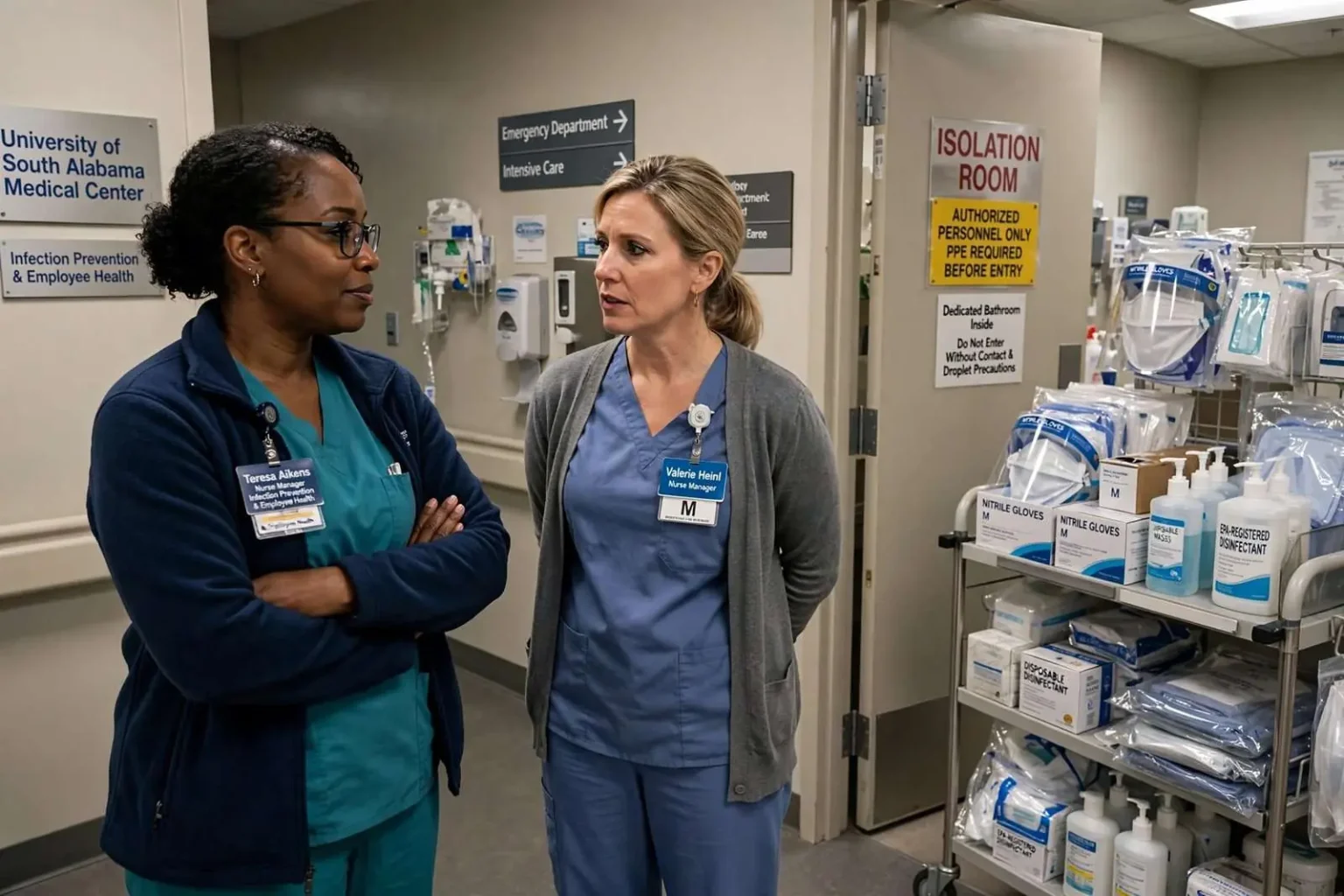
Following news of the first Ebola diagnosis confirmed on U.S. soil, staff at the University of South Alabama Medical Center sought to reassure the public that the hospital is equipped to handle a potential case without risking a broader outbreak like those seen in West Africa.
Any hospital in the country has the basic equipment and training needed to isolate a patient and prevent the virus from spreading, said Teresa Aikens, the medical center’s nurse manager for infection prevention and employee health. Speaking at a media briefing, Aikens compared the level of preparation to what hospitals already do ahead of hurricane season or other regional emergencies.
“People assume and people worry,” Aikens said. “Health care providers are already working on this and getting prepared.”
She said the hospital already has the necessary protective gear and protocols on hand should a patient arrive showing symptoms. All that would be required, she explained, is a private room with its own bathroom, clear signage marking it as an isolation space, and a cart stocked with gloves, face shields and other protective equipment placed just outside the door.
How the Virus Spreads — and How It Doesn’t
Aikens emphasized that Ebola cannot spread through the air. The virus is transmitted only through direct contact with the bodily fluids of someone who is actively showing symptoms, meaning casual contact carries little to no risk.
That distinction drives every layer of the hospital’s response plan. A person infected with Ebola who has not yet developed symptoms is not considered contagious, which is why the screening question that matters most in an emergency department is not simply whether a patient has a fever, but whether the fever is accompanied by recent travel to the outbreak region or contact with a confirmed case. Patients who answer no to both pose no Ebola risk, while those who answer yes are moved immediately into isolation for evaluation.
The virus’s transmission profile also explains why health officials have consistently said a large American outbreak is unlikely. Ebola does not travel through the air, food or water the way influenza or measles can, and it is far less contagious than the diseases that drive seasonal illness. Containing it requires interrupting direct fluid contact — something hospital infection control is specifically designed to do.
Inside the Isolation Protocol
Alongside fellow nurse manager Valerie Heinl, Aikens walked through the standard precautions hospital staff would take with a contagious patient: thorough hand-washing both before entering and after leaving a patient’s room, gloves removed carefully by turning them inside out, and full protective gear consisting of a body-length apron, a paper face mask and a clear shield to protect the eyes.
Each step in the sequence exists for a reason demonstrated by decades of hospital infection control. Hand hygiene before entry protects the patient from whatever the nurse carries in; hand hygiene after exit protects the nurse and the next patient. Removing gloves by peeling them inside out traps the contaminated outer surface inside, so the wearer never touches it with bare skin. The apron, mask and face shield together cover every route by which a symptomatic patient’s fluids could reach a caregiver’s skin, mouth or eyes.
Any waste generated in the course of treating a patient with a serious infectious disease is handled as biohazardous material and disposed of accordingly, Aikens said, to further reduce any risk of exposure to staff or other patients.
The private-room requirement follows the same logic. Isolation rooms with dedicated bathrooms keep the patient’s fluids within a controlled space, and the signage outside the door tells every worker, visitor and transporter what precautions apply before they step inside. The supply cart stationed at the door means no caregiver has to leave the room mid-care because a piece of equipment is missing — one of the classic moments when protective gear gets compromised.
Those measures are not new or Ebola-specific. They are the same precautions hospitals apply every day to tuberculosis, influenza, gastrointestinal illnesses and other infectious conditions, scaled up with additional gear for a virus transmitted through bodily fluids. That familiarity, Aikens suggested, is the public’s best reassurance: the response to a suspected Ebola case would not require inventing a new system, only applying one the hospital already uses.
A Briefing Born of National Anxiety
The briefing came amid heightened national attention to Ebola preparedness following the diagnosis of the first U.S. patient earlier in the week, with hospitals across the country reviewing isolation procedures.
The American diagnosis transformed Ebola from a distant tragedy into a local question. The outbreak in West Africa had already claimed thousands of lives and overwhelmed health systems in Guinea, Liberia and Sierra Leone, but for most Americans the disease remained something happening an ocean away until a traveler arrived in the country carrying it undetected. Emergency departments everywhere suddenly faced the same question: what happens if that patient walks through our doors?
For a Gulf Coast hospital, the question carries regional texture. Mobile’s medical community serves travelers and seafarers through the port, hosts visitors from across the region, and sits within driving distance of a major international airport hub. None of that makes an Ebola case likely, but it makes the screening questions at triage practical rather than theoretical — and it makes a prepared, rehearsed response the difference between a contained case and a public scare.
Hospital leaders also recognized that fear itself is a public health problem. Patients worried about Ebola may delay care for other conditions, and rumors can spread faster than any virus. By walking reporters through the specific steps — the private room, the cart at the door, the sequence of hand-washing and gear removal — the nurses aimed to replace vague alarm with a concrete picture of what a response would actually look like.
Officials at the Mobile hospital said their goal was simply to walk the public through exactly what would happen if a suspected case arrived locally, and to underscore that standard infection-control measures already used for other diseases are sufficient to keep staff, patients and the surrounding community safe.
The message from Aikens and Heinl amounts to this: the skills, equipment and rooms needed to contain Ebola are not exotic imports but everyday hospital practice, refined during hurricane seasons and flu seasons alike. A suspected case in Mobile would trigger a familiar sequence — isolate, protect, evaluate and coordinate with public health authorities — executed by staff who run that sequence routinely, against diseases far more contagious than the one now dominating the headlines.
Infection prevention as a hospital discipline operates far out of public view until a moment like this one arrives. Nurse managers such as Aikens and Heinl spend their routine days auditing hand-hygiene compliance, tracking hospital-acquired infections, training new staff on protective equipment and updating the facility’s response plans as guidance from federal health authorities evolves. When an emerging disease reaches American shores, that machinery is what converts national headlines into a local checklist.
The coordination with public health authorities is another layer the briefing touched only briefly. A suspected Ebola case would not be a hospital event alone: the county health department and state health officers would be notified, laboratory testing would be arranged through the public health system, and any confirmed case would trigger contact tracing to identify everyone who had close contact with the patient. Hospitals practice those notification chains for diseases from meningitis to measles, and Ebola would flow through the same channels.
Employee health — Aikens’ other responsibility — matters just as much. Staff who work an isolation case are monitored for fever or symptoms during the virus’s incubation window, with the hospital tracking who entered the room and when. That surveillance protects the workforce and, by extension, every other patient in the building, since a caregiver who developed symptoms would be removed from duty immediately rather than working through them.
For residents wondering whether to worry, the nurses’ guidance reduces to familiar advice: seek care normally, answer travel and contact questions honestly at triage, and trust that the screening system exists precisely so that a rare case is caught at the front door rather than in a crowded waiting room. The distance between a national headline and a local emergency is bridged by exactly the procedures the medical center demonstrated — nothing more exotic than a private room, a stocked cart and careful hands.
The comparison to hurricane preparation is apt in one further respect: both are about rehearsing before the emergency rather than improvising during it. Gulf Coast hospitals hold drills for mass casualties, storm evacuations and utility failures, and the same drills-and-checklists culture applies to infectious disease. By the time the first U.S. diagnosis made news, the hospital’s answer to a local case was already written, stocked and practiced — which is precisely the point Aikens and Heinl set out to make to a worried public.