Baldwin County Catholic High School Fund Drive Nears $7.5 Million Mark
A campaign to build a new $9.5 million Catholic high school in Baldwin County has drawn 885 donors and $7.5 million in pledges toward its goal.
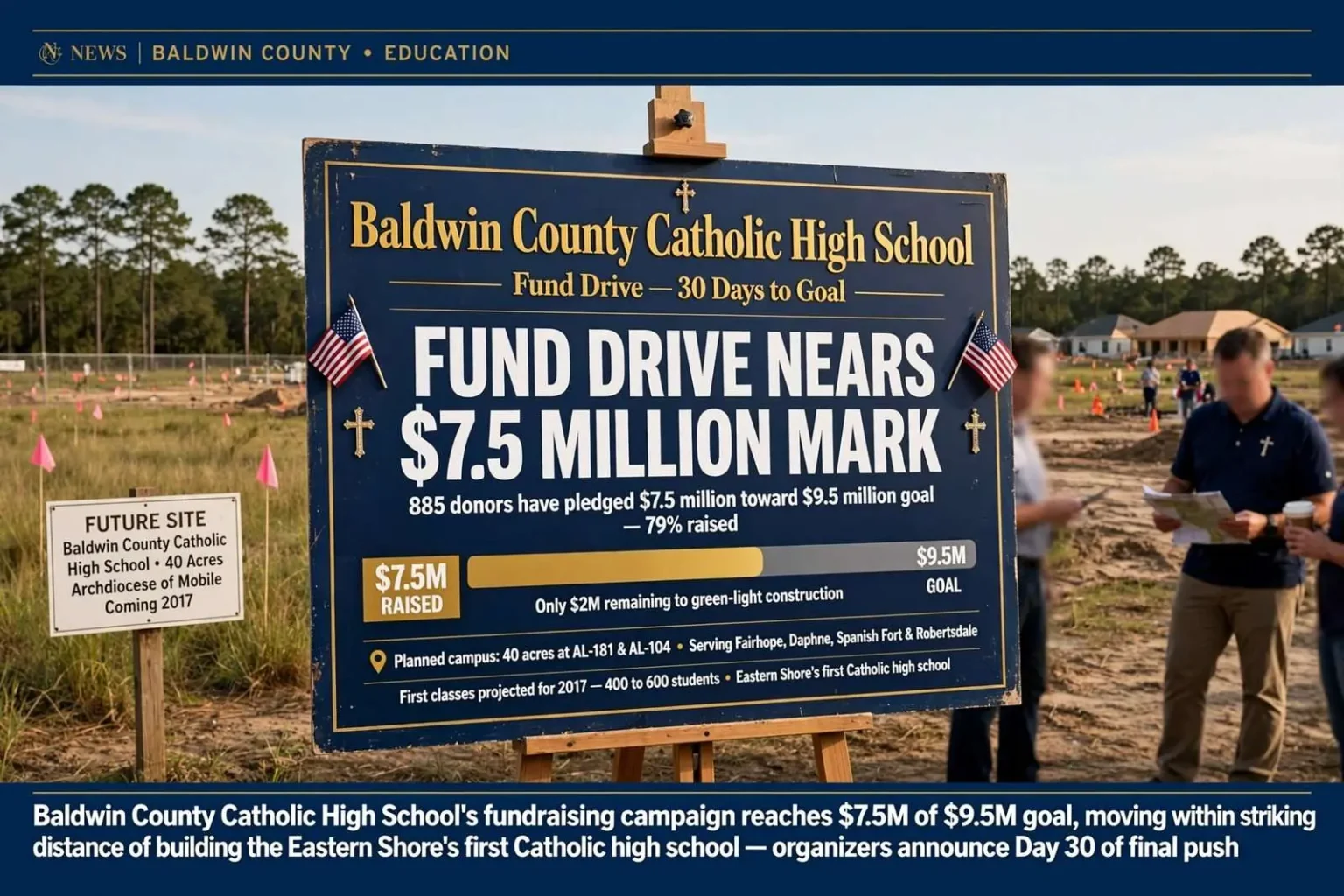
A fundraising campaign aimed at building a new Catholic high school in Baldwin County has pulled in $7.5 million in pledges from 885 donors, pushing organizers within reach of the $9.5 million goal needed to get the project off the ground, according to figures released by the Archdiocese of Mobile. The pace of giving — approaching nine thousand dollars per donor on average from nearly nine hundred families and individuals — reflects the depth of local demand for a Catholic college-preparatory option on the Eastern Shore side of Mobile Bay, where the archdiocese has long served elementary and middle school students without a comparably close high school.
The planned campus would sit on 40 acres near the intersection of Alabama 181 and Alabama 104, a growing corridor of Baldwin County that has seen steady residential development in recent years. The site places the school within a short drive of the Fairhope, Daphne, Spanish Fort and Robertsdale communities where much of the county’s Catholic school population lives, and along a highway network that has carried most of Baldwin County’s recent growth. Forty acres gives the campus room not just for its initial buildings but for the athletic facilities and expansions a full-service high school eventually requires.
The Timeline and the Target
Under the timeline organizers have discussed, the school could open with its first two grades as early as 2017, with plans calling for eventual enrollment of 400 to 600 students. Opening with just the first two grades is a common strategy for new high schools: it lets the school grow with its founding classes, build a culture and identity year by year, and add upperclass programs as the demand and the facilities mature. At full build-out, an enrollment of 400 to 600 would make the school comparable in size to the established Catholic high schools of the archdiocese.
Tuition is expected to run roughly 10 to 20 percent higher than McGill-Toolen Catholic High School in Mobile, the archdiocese’s existing Catholic high school on the south side of Mobile Bay. The premium reflects the realities of launching a new campus — smaller initial classes carrying the fixed costs of a new facility — and organizers have been candid that the early years of any new school operate on thin margins until enrollment approaches its target. For families weighing the cost, the calculation includes not just tuition but the daily commute across the bay that McGill-Toolen requires of Baldwin County students.
Counting Down in Public
Campaign organizers have been tracking the fund drive publicly through a social media countdown, marking the milestone as Day 30 of the final stretch and framing donor participation as a simple yes-or-no question: are you in. The approach treats the campaign less like a capital campaign and more like a community referendum conducted one pledge at a time — each donor added to the count is visible proof of demand, and the public tally builds momentum precisely because everyone can see how close the effort stands to its goal.
The pace of pledges suggests strong buy-in from Baldwin County Catholic families and other supporters who have watched the diocese’s only current Catholic high school, McGill-Toolen, serve a broad regional draw for decades without a comparable option on the Eastern Shore side of the bay. For decades, the geography of Catholic secondary education in the region has been shaped by the water: every Baldwin County teenager seeking a Catholic high school education has had to cross Mobile Bay — by the Bankhead or Wallace tunnels, or around the northern route through the causeway — twice a day, every school day, for four years.
That daily crossing is more than an inconvenience. It shapes which families can realistically choose Catholic education at all, limits participation in after-school activities and athletics, and ties Baldwin County families to a schedule dictated by a single congested crossing. A high school on the Eastern Shore changes the practical calculus for hundreds of families whose children already attend Catholic elementary schools in Fairhope, Daphne and the surrounding communities — students who would otherwise face the choice between the commute and leaving Catholic education after the eighth grade.
The Rally and What Comes Next
A public rally originally planned for late September at the Dick Higbee Road site had to be pushed back because of bad weather. Organizers have since rescheduled the event, where Archbishop Thomas J. Rodi and Catholic schools superintendent Gwen Byrd are expected to walk supporters through a construction timeline and unveil new details about the school, including its official colors. The rally is meant to serve as a public marker of how close the campaign has come to its target after months of private and parish-level solicitation.
That sequence — quiet major-gift solicitation first, parish-level appeals next, a public celebration as the finish line approaches — follows the standard architecture of a successful Catholic capital campaign. The archdiocese’s leadership has been visible throughout, and the decision to have Archbishop Rodi and Superintendent Byrd personally present the timeline signals how central the project is to the archdiocese’s planning for the Eastern Shore. The reveal of the school’s colors, a detail that might seem small, is the kind of symbolic step that turns a fundraising number into a real school community that students can begin to picture themselves joining.
If the campaign clears its remaining $2 million gap, construction crews could begin work on the Baldwin County site in the coming months, setting up what would be the first new Catholic high school to open in the greater Mobile Bay area in years. The remaining gap — about a fifth of the total goal — is a familiar position for campaigns of this kind, where the last dollars typically come from smaller gifts solicited during the public phase. Crossing the $9.5 million threshold is the condition the archdiocese has set for green-lighting construction.
A Long-Discussed Goal Comes Into Focus
For Baldwin County families who have historically had to send children across the bay to McGill-Toolen for a Catholic college-preparatory education, a local option closer to home has been a long-discussed goal within the archdiocese, and the fundraising progress marks the clearest sign yet that the project is moving from concept to construction. The conversation about a Baldwin County Catholic high school has surfaced repeatedly over the years as the county’s population multiplied — and as its Catholic elementary schools filled with students who had no nearby path into Catholic secondary education.
Why Baldwin County, Why Now
Baldwin County’s growth is the backdrop that makes the campaign’s math work. The county has been among the fastest-growing in Alabama for years, drawing new residents along the Interstate 10 and Alabama 181 corridors, and its Catholic parishes and elementary schools have grown with it. A high school placed near the Alabama 181 and Alabama 104 intersection sits in the middle of that growth pattern, close enough to the Eastern Shore’s population centers to draw from all of them while leaving room on its 40 acres for the campus to expand as the county does.
The campaign also arrives at a moment when Baldwin County’s public schools — which enroll tens of thousands of students and grow every year — are themselves planning for new construction and capacity. A new Catholic high school adds a private alternative to that landscape, and its planners have been explicit that the school is meant to serve families who want a Catholic college-preparatory education, not to compete with the public system’s expansion. In a county where school quality drives real estate decisions, a new high school of any kind is a significant community development.
What a New School Means for the Archdiocese
For the Archdiocese of Mobile, which has administered Catholic education across south Alabama for generations, the project represents its most significant expansion of secondary education in the region in decades. The archdiocese’s Catholic schools have long served Baldwin County at the elementary level, and the absence of a high school on the eastern side of the bay has been a structural gap in that system — one that eighth-grade graduations at Baldwin County Catholic elementary schools have underscored every spring as families faced the cross-the-bay decision.
If the timeline holds and the first classes open in 2017, the school would begin its life with the founding-class dynamic that shapes every new institution: small rosters, closely bonded classes, and a community of parents who were donors before they were school families. The 885 donors already pledged — many of them presumably parents of current and future students — form the nucleus of that community. The remaining question, as organizers’ countdown ticks toward the $9.5 million goal, is not whether Baldwin County wants the school but whether the final $2 million arrives in time to hold the schedule that would put freshmen in classrooms on the Alabama 181 site by 2017.