Fort Morgan Residents Weigh Incorporation to Shape the Peninsula’s Future
With a long court fight over annexation settled, the Fort Morgan Civic Association weighed whether to incorporate as a city, seeking local control over development along the narrow Baldwin County peninsula.
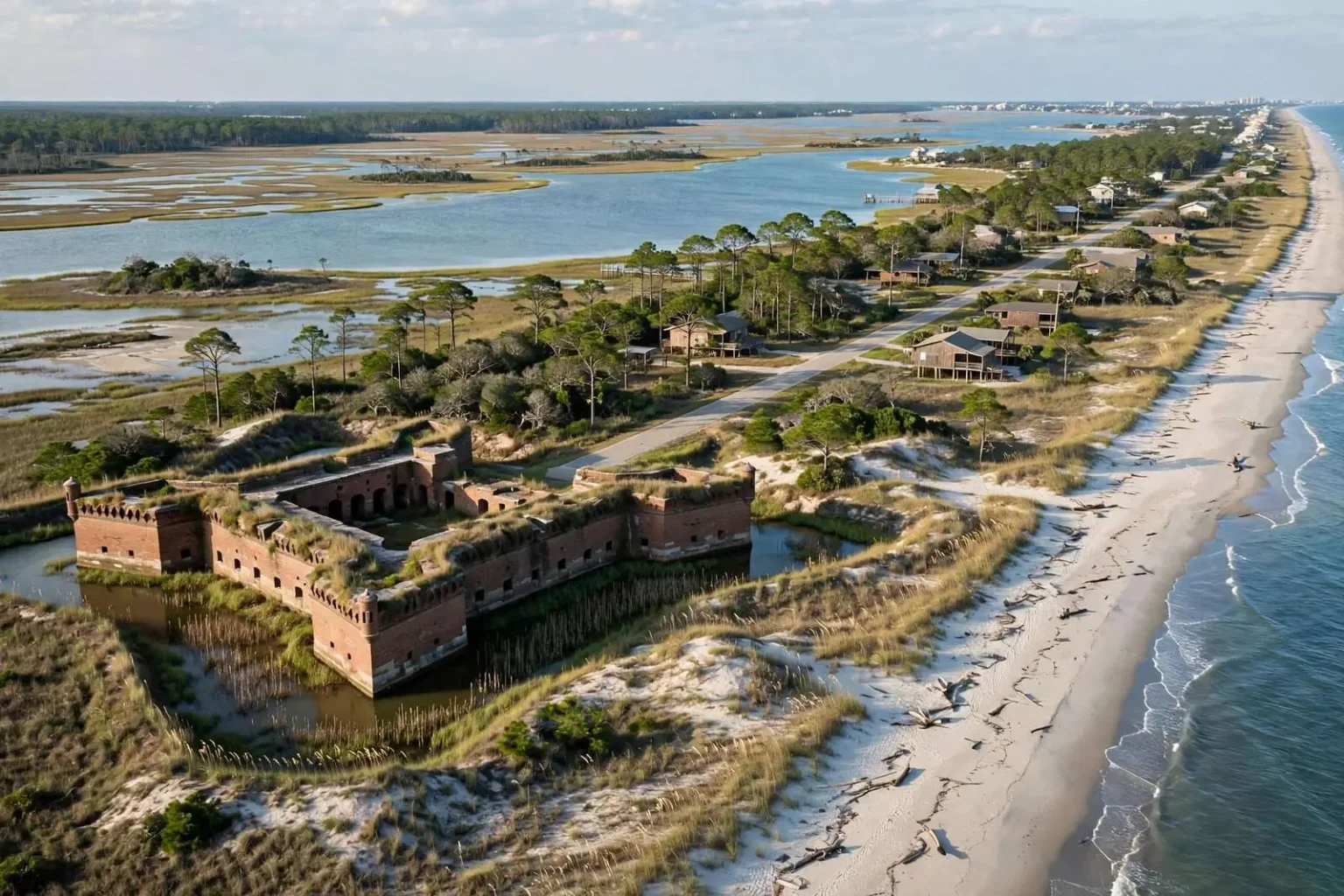
Having prevailed in a long legal fight over annexation by the city of Gulf Shores, residents of the Fort Morgan peninsula turned to a new question: what comes next. The Fort Morgan Civic Association weighed whether to petition to incorporate as a municipality, a step that would give the community its own local government. Bordered by the Gulf of Mexico to the south and Bon Secour Bay to the north, Fort Morgan’s unincorporated area runs from the fort itself on the western tip of the peninsula east until it meets the Gulf Shores city limits.
The legal victory had returned the peninsula to Baldwin County’s unincorporated jurisdiction, ending years in which Gulf Shores claimed and zoned the narrow strip of land that holds some of the most ecologically sensitive shoreline in Alabama. With the annexation undone, the 400-member civic association faced a decision that has divided small coastal communities for generations: accept county governance and its protections, or build a government of their own and answer for everything from garbage routes to zoning appeals.
Control over development
“We need to be in control of protection of our lifestyle, our environment — the wildlife and the environment on the peninsula,” said Sonja Sanders, the association’s news and website editor. “Our main goal is to have control of that, to have some say-so in what kind of development goes on here.”
For the peninsula’s full-time residents, the issue was not abstract. Fort Morgan holds the last significant stretch of Alabama coastline that never filled in with high-rise condominiums — a 19-mile ribbon of sand, maritime forest and low-slung beach houses between the fort’s moat and the Gulf Shores line. Every few years a developer arrives with plans for something taller, denser or louder than what the two-lane road, the sand dunes and the nesting shorebirds can absorb, and each such proposal renews the community’s conviction that whoever controls the zoning controls the peninsula’s future.
The Alabama Supreme Court had ruled in favor of the association in 2012 and denied Gulf Shores’ appeal earlier in the year, closing the legal chapter with unusual finality. The 400-member group said it would not settle on a course of action until its next meeting, scheduled for July 14 — deliberately taking the summer to canvass members before committing to a path with tax, service and legal consequences that would last for decades.
Association leaders emphasized that the fight with Gulf Shores had never been personal, at least as they described it. The city’s interest in the peninsula was a straightforward municipal ambition — annexed tax base and gulf-front control — while the residents’ interest was preservation. The court’s ruling had simply made the residents’ position, for the first time in years, the legally settled one.
Weighing the options
Incorporation was only one possibility on the table. “We have also looked at the options available with the Alabama statutes for either a preservation zone or a historic district,” said association president Paul Barefield. Creating a historic district, like the one established for Stockton in north Baldwin in 2012, could be a viable path, according to Charles “Skip” Gruber, chairman of the Baldwin County Commission and a resident of Elberta.
“It gives them protection from being incorporated or incorporating themselves,” he said, cautioning that becoming a municipality would bring new responsibilities. “If they do that, all the streets become theirs,” he said, noting county-maintained roads would shift to local upkeep. That single observation captured the arithmetic that has defeated most incorporation drives in Alabama: a municipality inherits everything its territory contains, including the bridges, culverts and washouts that a county road department currently fixes at no direct charge to the residents who drive them.
For a peninsula with one road in and one road out, the road question was not a detail. Highway 180 — the two-lane artery that runs the length of Fort Morgan — carries commuter traffic, tourist traffic, and hurricane evacuation traffic, and any municipal government formed along it would become responsible for maintaining the evacuation route that Baldwin County now owns. Association leaders acknowledged they were studying what incorporation would mean for taxes, police service, planning commissions and storm debris, as well as for zoning.
If the association did pursue incorporation, Barefield said, the boundaries would follow Baldwin County’s Planning District 25, running from the Gulf Shores city limits to the tip of the peninsula. The district line had already been drawn by the county’s own planning process, which meant the new municipality would start with a map that planning staff, engineers and emergency managers all recognized — and with a population concentrated along a corridor that has resisted large-scale development precisely because of its isolation.
The Stockton precedent gave the historic-district option a concrete local example. Stockton, a small north Baldwin community with deep roots in the county’s early history, had won state recognition as a historic district in 2012, gaining a measure of protection over its character without taking on the full apparatus of a town government. For Fort Morgan, whose recorded history runs from the Spanish colonial era through the War of 1812-era fort that gives it its name, the parallel was easy to see — and the mechanism’s chief virtue, in Gruber’s telling, was that it locked the status quo in place rather than inviting a new layer of government.
Whatever the association chose, the clock was visible in the calendar: the July 14 meeting would come with the summer rental season in full swing, when the peninsula’s population swells and the consequences of any zoning regime are most visible. Leaders said they wanted a decision that full-time residents and seasonal property owners alike could live with, since both groups pay the taxes and both have a claim on the peninsula’s future.
The association’s next steps also included refining what preservation would mean in practice. A preservation zone or historic district would not freeze the peninsula in place, planners noted, but would give the community a formal voice in height, density and site design — the same tools Gulf Shores and other Baldwin cities use, applied instead by the county in consultation with the residents themselves. For a community that had spent years arguing its case in court, the appeal of any statutory option was that it would move the argument from a courtroom to a planning table, where it could be held year after year rather than litigated once.
The fight that shaped the question
“The primary reason that we brought the lawsuit when the city illegally annexed us was to control height and density on the peninsula,” he said. “Those are still our priorities. We don’t want any more monstrosities,” he added, referring to high-rise condominiums along the narrow 19-mile stretch.
The annexation dispute had cast a long shadow over Baldwin County politics. Gulf Shores’ attempt to annex the peninsula — and the residents’ years-long legal counterattack that followed — became the defining local government story of the coast, pitting the city’s growth ambitions against a community that had chosen its isolation deliberately. The residents who fought the annexation in court were, in many cases, the same families who had fought the condominium boom a generation earlier, and they regarded the zoning map the way other communities regard their water supply: as something that, once ruined, does not come back.
The supreme court’s refusal to hear the city’s appeal meant the fight ended where it started, with the peninsula unincorporated. But the association’s leadership was candid that a legal win alone protects nothing permanently: a future city council, a future county commission or a future developer could restart the same argument at any time. That uncertainty was the engine behind the incorporation discussion — the sense that the only durable protection is a government that lives on the peninsula and answers to the people who live there.
Broad interest in the outcome
Robert Craft, mayor of Gulf Shores, said he shared the goal of restrained development. “We want to control development so we don’t negatively impact traffic in our community,” he said. “A massive development of condominiums down there — that would destroy our city.”
The mayor’s position reflected a calculation unique to a resort city next door to a wilderness. Gulf Shores’ economy depends on the Gulf State Park, the beaches and the managed density that keeps visitors returning; an uncontrolled wall of towers on Fort Morgan would not only clog the peninsula’s single road but push tourist traffic through Gulf Shores streets that were never designed for it. Whatever tension remained between the city and the peninsula’s residents, the two sides had arrived, from opposite directions, at a shared fear of the same scenario.
The end goal, officials said, was to give peninsula residents more control over their future, whichever route the association chose. “This is just a way to give local people more input, more local say about what happens to their community,” said state Rep. Steve McMillan, R-Gulf Shores, who represents the area. McMillan and Gruber were both scheduled to attend the association’s meeting, along with Sen. Trip Pittman, R-Montrose.
Pittman said he planned to come ready to listen. “What I want to do is hear as much as possible,” he said. The attendance of the county’s legislative delegation and its commission chairman at a civic association meeting was itself a signal: whatever Fort Morgan decided — municipality, historic district, preservation zone or the status quo — the decision would move through Montgomery and Bay Minette, and the area’s legislators wanted to know the community’s mind before it did.