Mobile Legislator Apologizes for the Alabama House’s Silence on Two Corruption Convictions
State Rep. Joseph Mitchell of Mobile issued an open letter apologizing for the Alabama Legislature's total silence after two sitting members were convicted on federal corruption charges.
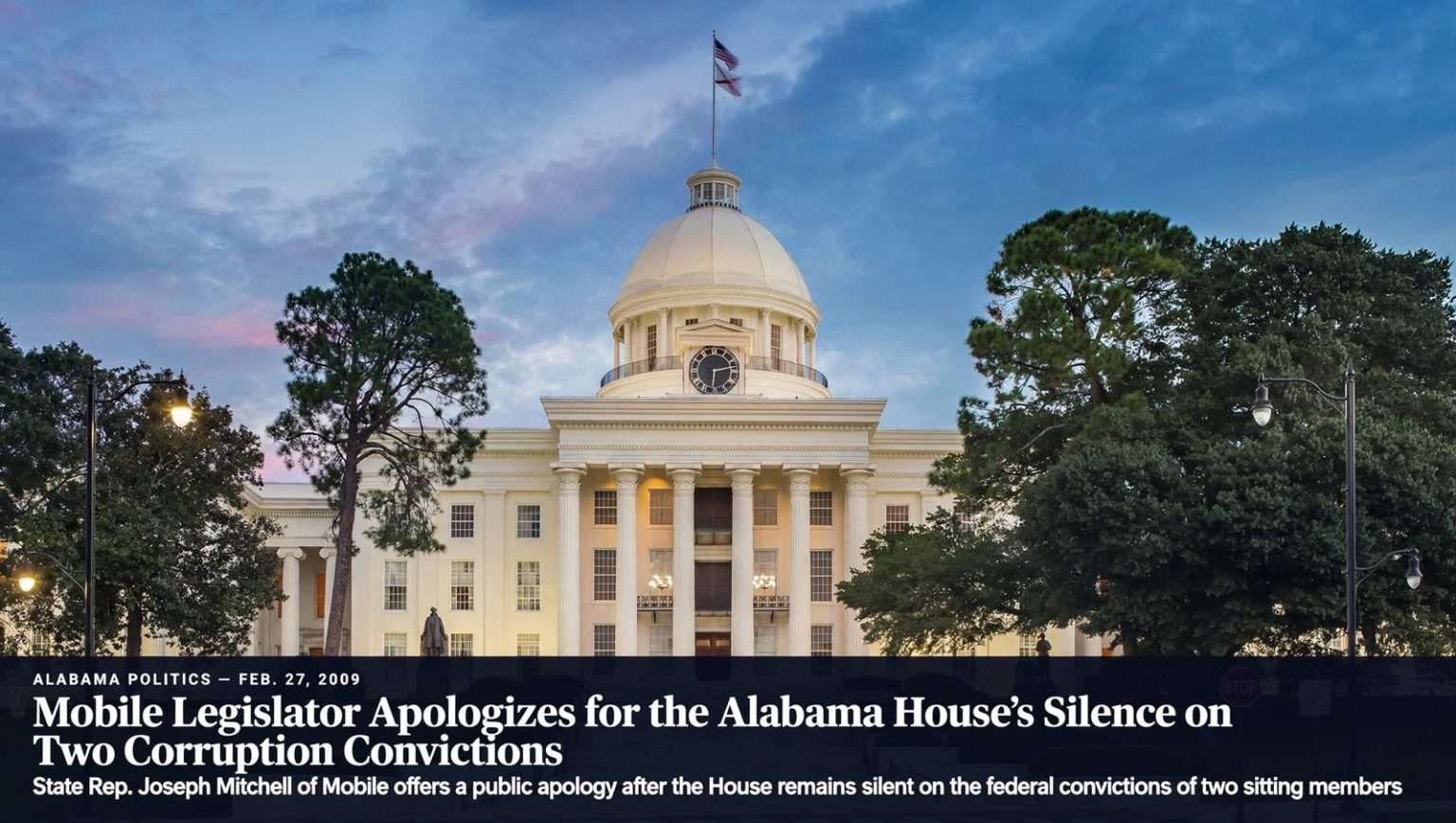
State Rep. Joseph Mitchell of Mobile did something on Friday, Feb. 27, 2009, that none of his colleagues in Montgomery had done: he apologized.
In an open letter addressed to the citizens of Alabama and to the state’s news media, Mitchell, who represented House District 103, offered a public apology on behalf of the Legislature for what he described as its complete and telling silence following the federal corruption convictions of two sitting members.
“Please accept this communication as one of apology,” Mitchell wrote. “I feel fairly certain that your having not received such a statement from individual legislators from around the state is a regretful oversight on the part of their respective offices.”
Mitchell’s district stretched across some of Mobile’s working neighborhoods — communities where trust in public institutions has always had to be earned rather than assumed, and where voters are quickest to notice when their government treats its own failings as unspeakable. A legislator from that part of the city writing an apology on behalf of a chamber that would not write one for itself carried a particular weight: Mitchell was speaking not as an outsider criticizing Montgomery but as a member indicting the house he belonged to.
The letter’s tone made its purpose plain. Mitchell was not defending the convicted members, explaining their cases or minimizing the verdicts. He was addressing a different failure entirely — the silence of the institution around its own dishonor — and he addressed it to the only audience he believed owed it: the citizens the Legislature serves.
The silence in the chamber
What prompted the letter was not the convictions themselves so much as the reaction to them, or rather the absence of one.
Mitchell described a full week of legislative sessions, partisan caucuses and race caucuses in which, he said, not one word was spoken about the fact that two colleagues had been convicted in federal court.
He drew the contrast deliberately. When a member dies, he noted, the Legislature stops its business for a moment of silence. When a member is reported to be gravely ill, business halts again so that members might offer a prayer or a thought for the colleague’s comfort.
In roughly 15 years of service, Mitchell said, he had experienced the deaths of six or seven House members, and each time the body paused.
“Last week there was not a word,” he wrote. “Not a single collective action regarding the circumstances of two serving members of the state legislature.”
The distinction, in Mitchell’s telling, was that these were losses of a different kind, and preventable ones.
“As mortals, all we could do was pray before the fact of their mortal demise,” he wrote of the members who had died. “There was nothing that we could have done to prevent their infirmary and there was nothing that we could have done regarding” the circumstances that put their colleagues in a federal courtroom.
That asymmetry was the heart of his argument. Death and illness are fates the Legislature can only mourn; corruption is a fate the Legislature can prevent, and its failure to prevent it — or even to acknowledge it — made the silence worse than neglect. Mitchell’s letter treated the moment not as an embarrassment to be waited out but as a test of the institution’s character, and he concluded that the chamber had failed it.
The context surrounding the convictions made the silence harder to defend. The Alabama Legislature entered 2009 already under a sustained federal investigation, with prosecutors working through the two-year college system’s network of legislator payroll arrangements, and with a series of guilty pleas and verdicts reaching from the State House into local school systems across the state. Several sitting legislators had been indicted; some had pleaded guilty; others were awaiting trial. Each new development drew headlines, and each drew from the chamber the same response Mitchell described: none.
The pattern was visible well beyond the House floor. Committee meetings proceeded without mention of the cases; press conferences by legislative leaders avoided the subject; even the routine courtesies of the chamber — announcements, recognitions, the week’s scheduling notes — made no reference to colleagues facing sentences. Members who spoke constantly about schools, roads and budgets in the well of the House had found nothing to say about the verdicts, and the omission was conspicuous precisely because the chamber’s ordinary rhythm was so full of words. Mitchell’s week of caucuses and sessions, crowded with every topic but the one, supplied him with his contrast: a Legislature capable of talking all day, and silent about the only thing Alabamians were asking it about.
Why the silence held
Legislative bodies everywhere tend toward discretion about their members’ legal troubles, and Alabama’s House in 2009 had structural reasons for that instinct. Members of both parties had ties to the investigations under way; the caucuses Mitchell mentioned — the partisan ones and the racial ones through which much of the chamber’s business actually moves — had no mechanism for raising an uncomfortable subject without forcing every member to take a position. Convictions in federal court also arrive through a process members understand as personal: an individual’s trial, verdict and sentencing, separate from the body’s collective responsibility.
Mitchell’s letter rejected that separation. An institution that mourns together, he argued, must also answer together, because the public does not experience corruption as one man’s private fall — it experiences it as the failure of the government it pays for. The apology he offered on the chamber’s behalf presumed a collective accountability that his colleagues had declined to claim, and his willingness to speak alone said as much about the Legislature as the silence he was apologizing for.
The man who wrote it
Mitchell was an unusual figure to take the step. A Mobile Democrat with a long record in the House — the roughly 15 years of service he cited — he had built his career on the district’s neighborhoods rather than on Montgomery’s machinery, and his professional background in mediation and conflict resolution shaped the way he approached institutional disputes. Colleagues knew him as a member more inclined to raise uncomfortable questions than to let them pass, and the Feb. 27 letter was in that sense characteristic: it did the thing the institution would not do for itself, in the plainest available form.
The choice of an open letter also reflected the reality of how the silence had played out. A floor speech would have reached the chamber; a press release would have reached the Capitol press corps. Mitchell addressed his letter to the citizens of Alabama and to the news media together, on the theory that the apology’s intended beneficiaries were not his colleagues but the public whose trust the convictions had damaged.
What it asked of the reader
The letter did not demand expulsions, resolutions or reforms; it demanded acknowledgment. Mitchell’s argument was that the first step back from the corrosion of the two-year college scandal and the broader federal investigations was the Legislature’s willingness to say out loud what every Alabama newspaper had already reported: that two of its serving members had been convicted of crimes, and that the chamber bore a responsibility that silence could not discharge.
That modest demand — words, not procedure — is what made the episode resonate. Institutions under investigation typically respond with process: ethics committees, rule changes, task forces. Mitchell’s letter skipped past all of it to the simpler failure underneath: a body that could stop for a moment of silence when a colleague died could not stop for a sentence of acknowledgment when two colleagues were convicted, because death is no one’s fault and corruption is everyone’s embarrassment.
Fifteen years in the chamber had given Mitchell the standing to make the comparison from experience — six or seven member deaths mourned in the well of the House, each met with the rituals of respect, and one week in which the chamber’s rituals had nothing to say about the outcomes that most directly concerned the public. His apology stood in the record afterward as the Legislature’s only collective word on the subject, offered by a single member on behalf of an institution that never offered it for itself.
For Mobile’s District 103, whose neighborhoods had sent Mitchell to Montgomery to watch after their interests in a capital they did not always trust, the letter carried a hometown significance as well. It said that at least one of their representatives would rather stand alone in saying the obvious than stand with colleagues in saying nothing — and that, in a season when Alabama’s State House was losing credibility by the verdict, was its own kind of public service.