Sentencing Set for Mobile Woman Convicted in Retirement Home Theft Case
A Mobile woman who admitted stealing more than $20,000 from residents at a local retirement community now faces sentencing in federal court next week.
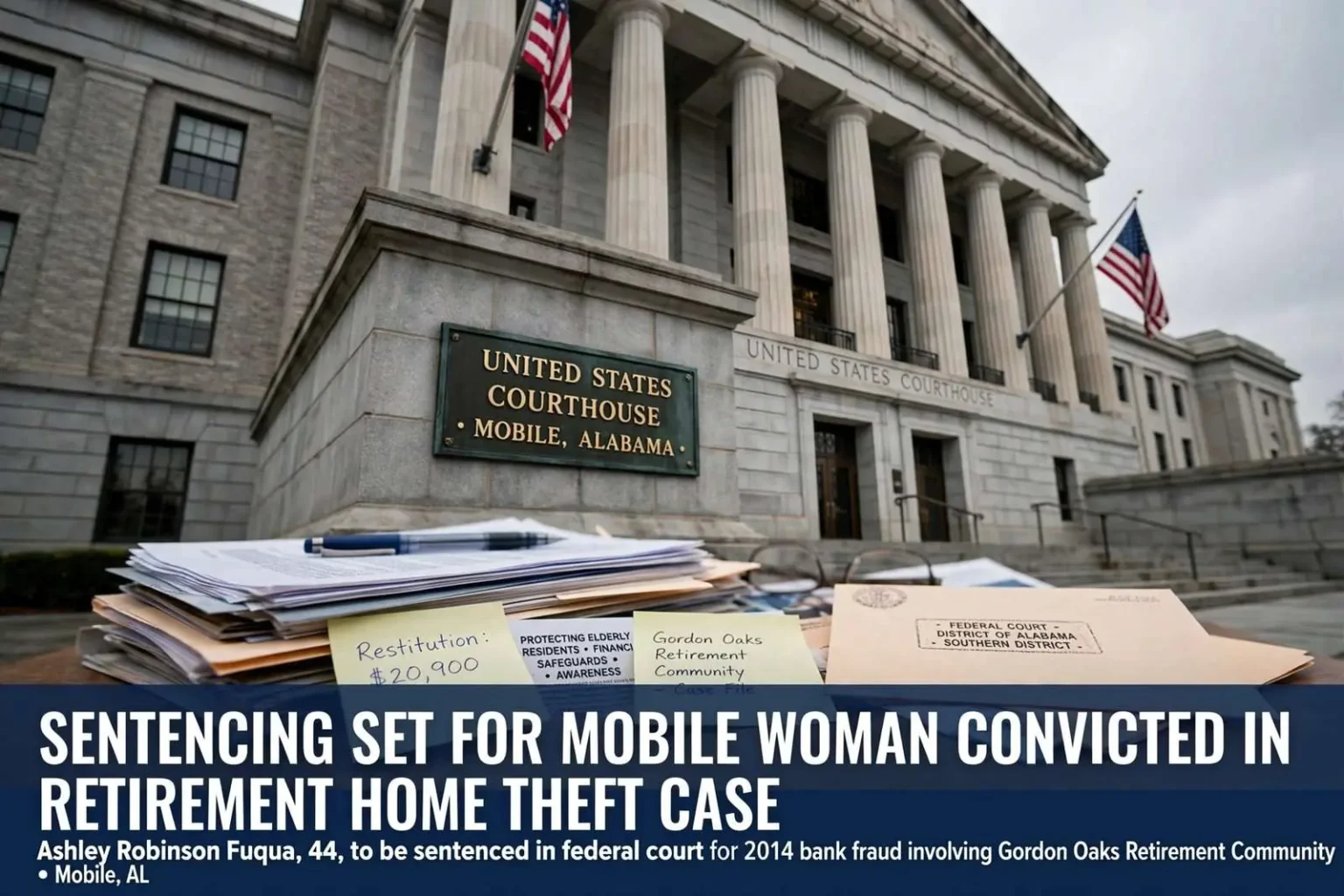
A Mobile woman who pleaded guilty to defrauding residents at a local retirement community is scheduled to be sentenced in federal court, closing out a case that exposed how a trusted employee allegedly exploited her access to elderly residents’ finances.
Ashley Robinson Fuqua, 44, of Mobile, pleaded guilty in 2014 to a single count of bank fraud after federal prosecutors accused her of siphoning money from residents of Gordon Oaks Retirement Community while working as an administrator there. Her sentencing hearing is set to take place at Mobile’s federal courthouse.
Court records show a federal grand jury originally indicted Fuqua on six counts of bank fraud before she agreed to plead guilty to one count.
According to a statement of facts filed in the case, Fuqua’s job duties at Gordon Oaks included assigning rooms, collecting payments from residents and making deposits into the facility’s bank account. Prosecutors say Fuqua exploited that access by instructing some residents and their family members to leave the payee line blank on checks written to the retirement community. She allegedly told them she would stamp the checks with the facility’s official payee information.
Instead, according to court documents, she made many of the checks out to herself or to cash and deposited the funds into her own bank account.
To help conceal the scheme, investigators say Fuqua avoided completing paperwork that would have documented some residents’ status as living at the facility, making the missing payments harder to trace.
Court records show Fuqua owes more than $20,900 in restitution as part of her plea agreement.
Under federal sentencing guidelines, the bank fraud charge she pleaded guilty to carries a maximum possible penalty of up to 30 years in prison, three years of supervised release following any prison term, and a fine of up to $1 million, though actual sentences in fraud cases like this one are often well below the statutory maximum.
Cases involving financial exploitation of elderly residents at care facilities have drawn increased scrutiny from federal prosecutors in recent years, as advocates note that older adults in assisted living and retirement communities can be particularly vulnerable to financial abuse by caregivers or staff with direct access to their accounts and personal information.
The case serves as a reminder for families with loved ones in retirement or assisted living facilities to periodically review financial statements and payment records for irregularities.
How the scheme worked
The mechanics of the alleged fraud were simple enough to go undetected for a period of time, and that simplicity is part of what made the case instructive for families across the region. Residents paying for their care by check were told, by the very administrator handling those payments, to leave the payee line blank so the facility’s stamp could be applied later.
In legitimate practice, a blank payee line is an unusual request. Businesses that accept checks expect to be named as the payee, and a staff member who asks a customer to leave that line empty takes control of who ultimately cashes the instrument. Once residents and their families handed over checks with no named recipient, prosecutors say, Fuqua could fill them out as she chose.
Many of the checks, according to court documents, were made out to Fuqua herself or to cash, then deposited into her personal bank account rather than the retirement community’s. The missing paperwork compounded the problem: because some residents’ occupancy was never documented in the facility’s records, the absence of corresponding payments was harder for anyone reviewing the books to spot.
The total tied to the scheme, more than $20,900 in restitution under the plea agreement, represents money that prosecutors say belongs back with the residents and families who wrote those checks in good faith.
Why the case went federal
Bank fraud is a federal offense because it targets financial institutions whose deposits are insured by the federal government. When checks drawn on a bank are diverted by deception, the crime falls within federal jurisdiction even though the victims are local and the conduct took place entirely inside one Mobile retirement community.
A federal grand jury reviewed the evidence and returned an indictment on six counts, one of the standard tools prosecutors use to frame a series of alleged fraudulent acts. In the end, Fuqua agreed to plead guilty to a single count, a resolution that spared residents and family members the strain of a full trial in exchange for an admission of guilt and a restitution obligation.
Plea agreements of this kind are common in federal court, where the vast majority of cases end in guilty pleas. The admission of guilt removes the need for proof beyond a reasonable doubt at trial, but the sentencing decision still belongs to the judge, who weighs the plea alongside the sentencing guidelines and the facts of the offense.
What happens at sentencing
At the sentencing hearing, prosecutors and defense attorneys will present their positions on how severely Fuqua should be punished, and the judge will consider a presentence report prepared by federal probation officers that details the offense, her background and her financial condition.
Victims have the right to be heard as well. Residents of Gordon Oaks and family members who lost money in the scheme can submit statements or address the court directly, and those statements often influence how judges weigh the human cost of financial crimes that might otherwise appear, on paper, to be relatively modest in dollar terms.
The judge must also address restitution, which in this case has already been fixed at more than $20,900 under the plea agreement. Restitution orders in federal fraud cases are mandatory, meaning the money is owed regardless of the prison sentence imposed, and collections can continue for years after a defendant completes any term of incarceration.
While the statutory maximum for bank fraud reaches 30 years, sentences in cases involving tens of thousands of dollars rather than millions typically land far below that ceiling. The guidelines calculation turns on the loss amount, the vulnerability of the victims and the abuse of a position of trust, factors that cut in different directions in a case like this one.
A position of trust and its abuse
The Gordon Oaks case fits a pattern that elder advocates describe with growing alarm: financial exploitation committed not by strangers, but by the people seniors rely on most. An administrator who assigns rooms and collects payments occupies a position of daily contact and quiet authority, and residents are unlikely to question instructions that come from someone they regard as the face of the facility.
That dynamic explains why the alleged instructions here, to leave the payee line blank, were followed at all. To a resident or an adult child managing a parent’s affairs, the request came from the same office that sent the bills, and refusing it would have seemed like complicating a routine payment.
Retirement communities across Alabama serve residents who are often on fixed incomes, drawing on savings, pensions and Social Security to cover monthly fees that consume most of what comes in. When even a portion of those payments is diverted, the loss lands heavily on households with little room to absorb it.
The vulnerability of care facility residents to this kind of abuse is precisely why federal prosecutors have made such cases a priority, treating exploitation of the elderly as an aggravating factor rather than an afterthought in sentencing.
Warning signs for families
The case offers practical lessons for the thousands of Mobile-area families with loved ones in retirement or assisted living communities. Financial exploitation rarely announces itself; it shows up in details that only a careful reviewer would catch.
Families are advised to review bank statements and canceled checks regularly, looking for payments that lack a named payee, checks made out to cash, or deposits that never appear in the facility’s records. Any request to leave a check blank, pay in cash without a receipt, or route payment to an individual rather than the organization deserves scrutiny.
Communication with the facility matters as well. Asking periodically for an accounting of charges, confirming that payments are credited, and keeping a personal record of what was paid and when creates a paper trail that makes irregularities easier to spot and harder to explain away.
Advocates also encourage families to trust their instincts when something feels off. Residents who are confused about their finances, anxious about money matters they once handled easily, or reluctant to discuss payments may be signaling that something has changed in how their affairs are being handled.
The road ahead
With the plea entered and restitution set, the remaining question in the case is the sentence itself, which will be determined at the hearing at Mobile’s federal courthouse. Whatever the outcome, the judgment of conviction will stand as a formal record of how the scheme operated and who it harmed.
For the residents of Gordon Oaks and their families, the case’s resolution brings accountability but not recovery of the trust that made the scheme possible. Facilities that handle residents’ money are expected to maintain controls, including separation of duties and documentation of payments, and cases like this one are a reminder of why those controls exist.
For elder-care advocates in the region, the prosecution is part of a broader effort to send a message to caregivers and staff at care facilities everywhere: access to seniors’ finances is a responsibility, and treating it as an opportunity carries consequences that reach well beyond a single paycheck.