Foley Leads Push to Build Farm Produce Hub for Baldwin County Growers
Foley is converting a vacant industrial building into a produce hub meant to link Baldwin County farmers with restaurants, schools and grocers.
FOLEY, Alabama — City leaders here are turning a vacant industrial building into the centerpiece of an effort to strengthen Baldwin County’s farming economy, aiming to connect small growers with restaurants, schools and grocery stores across the region. The project builds on the year-old Coastal Alabama Farmers and Fishermens Market, a nonprofit market established by the city, and gives Foley a larger role in shaping how locally grown food moves from the field to the table. For a community that grew up surrounded by farms, the initiative represents an attempt to rebuild a connection that residents say has quietly eroded over decades.
Using a $100,000 U.S. Department of Agriculture grant awarded to the market, Foley is funding roughly half the cost of new equipment that will grade, sort, wash and package fresh produce before it heads to buyers under a “Fresh from Foley” label. The equipment is the kind of infrastructure that individual small farms rarely can afford on their own, and its absence has long limited the ability of local growers to sell beyond roadside stands and weekend markets. By pooling the equipment at a single site, the city hopes to give dozens of small operations access to capabilities normally reserved for large commercial shippers.
A Second Life for a Landmark Industrial Site
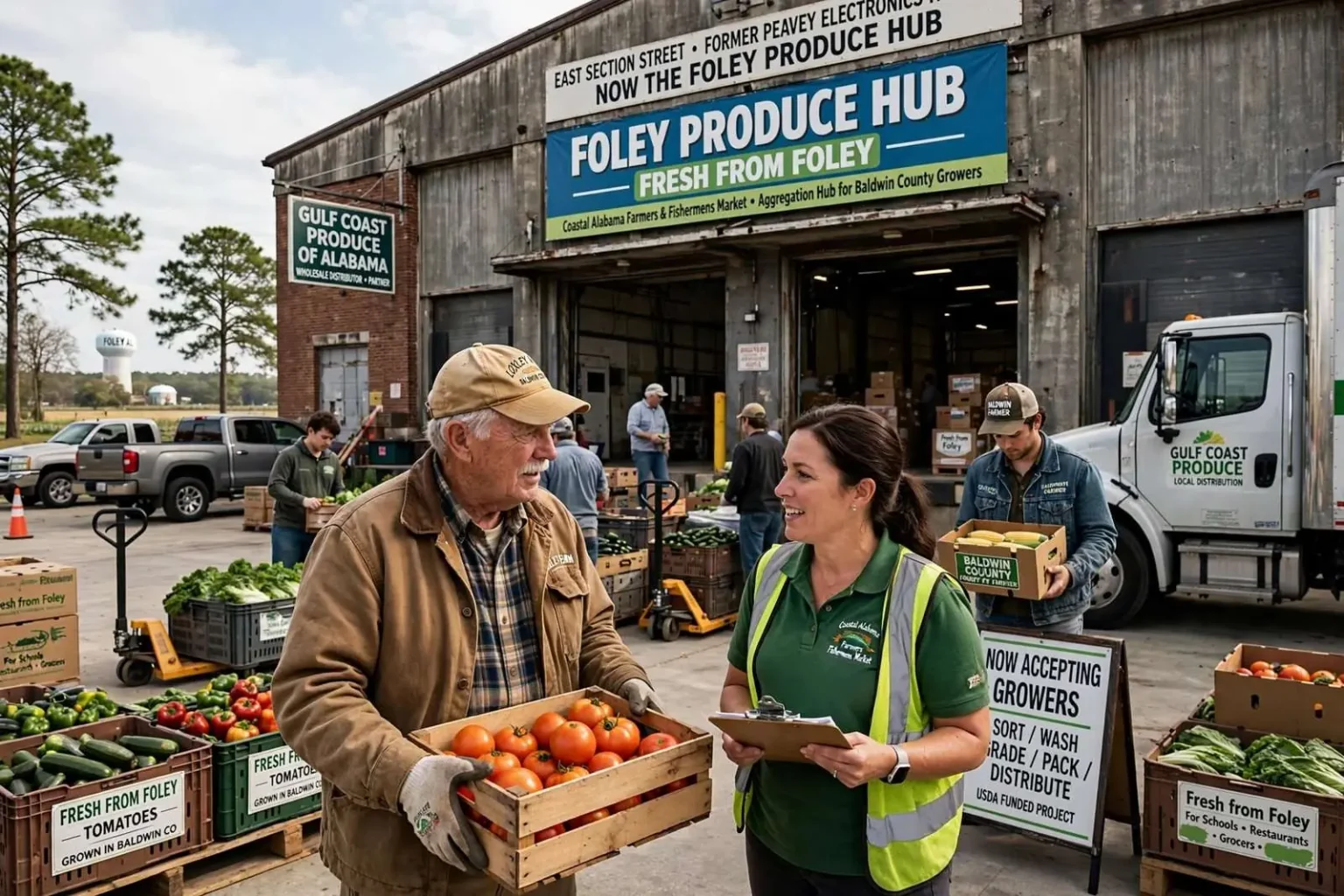
The aggregation hub will operate out of a 94,000-square-foot city-owned building on East Section Street, a structure that once housed audio equipment maker Peavey Electronics. The building has sat largely vacant since the plant closed, and city officials have searched for years for a reuse that fits both the structure and Foley’s identity. Agriculture, they concluded, was a natural fit for a community whose outlying areas remain dotted with produce fields, nurseries and family farms. Repurposing an industrial shell for food processing also spares the city the cost of new construction while keeping a large property on its tax rolls productive.
The site is already home to Gulf Coast Produce of Alabama, a wholesale distributor that began leasing space there the previous year and will partner with the city on the new venture. That existing operation gives the hub an anchor tenant with experience in buying, handling and moving produce at commercial volumes. Market manager Heather Pritchard said longtime Loxley farmer Larry Lovell will coordinate the hub, serving as the link between area growers and wholesale buyers. Lovell’s role is central to the concept: rather than each farmer negotiating separately with restaurants or grocers, the hub consolidates supply so buyers can fill orders from a single, reliable source.
Lovell said the arrangement addresses a gap that has kept small farmers on the sidelines of larger commercial markets for generations, even as demand grows for local produce in farm-to-table and farm-to-school programs. “What this aggregation hub will do for local farmers … is connect all the dots that have been missing for 80 or 100 years,” Lovell said, describing the effort as a way to finally give area growers the packaging, grading and distribution support needed to reach bigger buyers. In his view, the missing pieces were never the farms themselves but the intermediate steps — sorting, washing, packing, labeling and delivery — that turn a pickup load of vegetables into a product a grocery chain or school cafeteria can accept.
How an Aggregation Hub Works
The mechanics of the hub are straightforward even if the logistics behind them are not. Farmers bring produce to the East Section Street building, where staff run it through washing and grading lines, sort it to buyer specifications, package it in standardized containers and apply the Fresh from Foley branding. From there, shipments can be consolidated with Gulf Coast Produce’s existing distribution routes or picked up directly by institutional buyers. The approach smooths out the two biggest problems that plague small-farm sales: inconsistent volume and inconsistent presentation. A restaurant will not build a menu around a supplier who can deliver only on good weeks, and a school system cannot accept cases of mixed-grade produce. Aggregation solves both problems by combining the output of many farms into a steady, uniform supply.
The model also shifts some risk away from individual growers. When a single farm faces a bad stretch of weather, the hub’s pooled supply can still meet commitments, drawing on other producers in the network. That reliability, coordinators say, is what separates a working wholesale channel from the occasional informal sale. For the farmers, the trade-off is sharing margins with the aggregation operation, but supporters argue that a smaller, steadier return beats the boom-and-bust pattern of selling whatever surplus the weekend market will take.
Supporters say the hub could serve farmers within roughly 150 miles of Foley, giving them a reliable, consistent channel for produce that might otherwise go unsold at farmers markets scattered along Baldwin County roads. That radius would extend the hub’s reach well beyond Baldwin County itself, pulling in growers from neighboring counties in Alabama and the Florida Panhandle. Lovell predicted the aggregation model could become standard practice for small farm regions in the years ahead if Foley’s version proves out, positioning the city as an early adopter of an approach other rural communities are watching closely.
Why Baldwin County Growers Have Been Left Out
Baldwin County has a long agricultural history. Its sandy loam soil and mild winters made it one of the South’s leading producers of potatoes, corn and vegetables in the early twentieth century, and towns such as Robertsdale, Summerdale and Elberta still celebrate that heritage with festivals and museums. But the economics of farming shifted. National distribution chains consolidated, demanding volume, uniformity and year-round supply that small local growers could not match. Meanwhile, coastal development converted productive fields into subdivisions and shopping centers. Farmers who remained often adapted by selling directly to consumers at roadside stands and seasonal markets — a model that keeps margins high but caps how much a single farm can sell.
The gap between those two worlds is exactly what the aggregation hub is designed to close. A farmer with three acres of tomatoes cannot supply a school district alone, but twenty such farmers acting together can. The Coastal Alabama Farmers and Fishermens Market, which operates as the nonprofit umbrella for the project, has spent its first year building relationships with both sides of that equation — recruiting growers and, at the same time, introducing area chefs, grocers and institutions to what local producers can offer. The USDA grant that funds the equipment reflects a federal push to strengthen local and regional food systems, an effort that has channeled money into similar aggregation and processing projects across the country in recent years.
Farm-to-school programs have been a particular driver of demand. School systems across the Gulf Coast region have shown growing interest in serving locally grown produce in cafeterias, both for its freshness and for the educational value of connecting students to nearby farms. Until now, Baldwin County growers have had limited ability to participate because schools require graded, packaged, food-safe products delivered on schedule — requirements that individual small farms struggle to meet without shared infrastructure. The same holds true for the farm-to-table restaurants that have multiplied in Fairhope, Foley, Gulf Shores and Orange Beach, where chefs want local ingredients but need dependable supply to write them into menus.
City officials see the project as economic development as much as agricultural policy. Every dollar that stays with a local grower circulates through the county’s economy, supporting feed stores, equipment dealers and trucking firms. The hub also creates jobs at the processing site itself, adding activity to an industrial corridor that lost its largest employer when the audio equipment plant closed. For a city of roughly 20,000 people that brands itself around its farming roots, the symbolism matters as much as the payroll.
What Comes Next for the Fresh from Foley Program
The next steps involve outfitting the building and phasing in operations. The grading, washing and packaging equipment funded by the grant and the city’s matching contribution must be installed and tested before the hub can begin regular processing. Gulf Coast Produce’s presence at the site eases that transition, since the distributor already has loading docks, cold storage and established buyer relationships. Lovell’s coordination role begins immediately, as he works to sign up growers and match their planting plans to the demand signals coming from wholesale buyers. Organizers have said they want the pipeline running smoothly before leaning heavily on the Fresh from Foley label, which they see as a promise to buyers that anything carrying it was grown in the region and handled to a consistent standard.
For local residents, the practical effect should show up gradually — more local produce in area grocery aisles and restaurant kitchens, and a shorter, more transparent supply chain behind it. Shoppers at the Coastal Alabama Farmers and Fishermens Market will remain a visible part of that chain, but the hub extends the market’s reach to customers who never set foot on a market lot. A head of lettuce grown near Loxley could just as easily end up in a school cafeteria in Baldwin County or a restaurant kitchen dozens of miles away as in a shopper’s canvas bag.
The broader stakes go beyond one building. Agricultural advocates across the Gulf Coast have watched small farms disappear at a steady clip, and the question of whether direct-to-consumer sales can evolve into viable wholesale channels is one many communities are wrestling with. If Foley’s experiment works, it offers those communities a template: a modest public investment, an existing nonprofit market as the anchor, and an experienced farmer as the coordinator who bridges the two worlds. Lovell’s prediction that aggregation could become standard practice in small farm regions is, for now, a bet — but it is a bet Baldwin County is better positioned than most to test, with its surviving base of growers, its proximity to growing coastal markets, and a city government willing to put an empty industrial building to work for the people who feed it.