What a US Airways Takeover of Delta Would Mean at Mobile Regional Airport
With US Airways pursuing an $8 billion hostile bid for Delta in late 2006, Mobile Regional Airport's marketing director weighed better connections against the risk of higher fares and less competition.
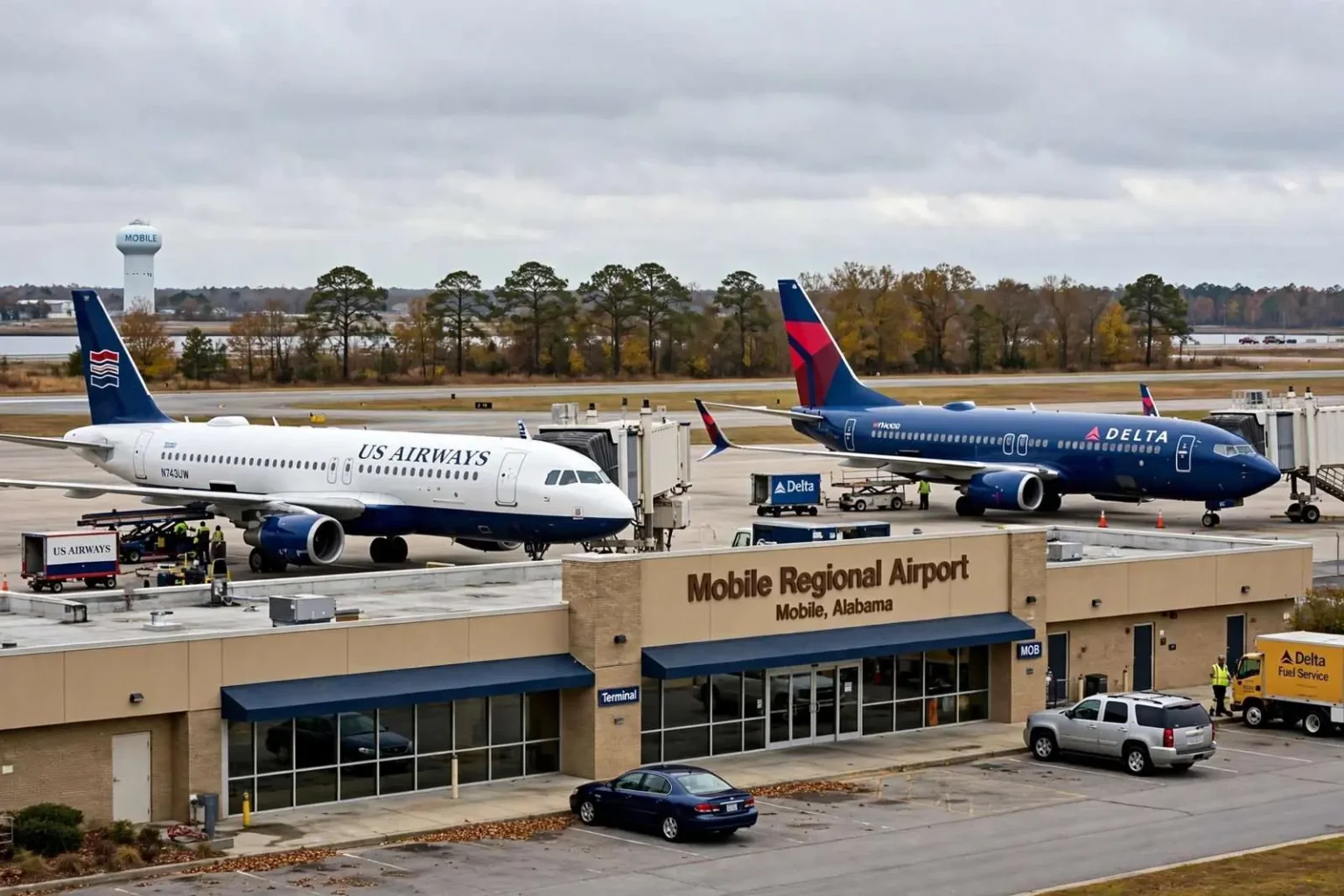
US Airways launched a hostile $8 billion bid for Delta Air Lines in the autumn of 2006, and the prospect raised an immediate and practical question for travelers on the Alabama Gulf Coast: what would a merger mean at Mobile Regional Airport, where both carriers flew?
At the time, Mobile’s airport served as a stop on both airlines’ route maps, with US Airways connecting the city through its hubs and Delta offering the region’s most heavily used links to Atlanta. Any combination of the two would reshape the competitive landscape of a terminal that depended on a handful of carriers for all of its service.
The bid itself was aggressive by the standards of the industry’s recovery era. US Airways, still digesting its own merger, went public with an offer while Delta remained in bankruptcy protection, appealing directly to Delta’s creditors over the objections of Delta’s management. The strategy made the fight one of the most closely watched corporate battles of the decade, and it put every city the two airlines served on alert for what a combined route map might look like.
Marc Pelham, the airport’s marketing director, offered an assessment that was notably even-handed, weighing benefits against risks and landing, in the end, on neither.
The case for the deal
A combined airline, Pelham said, might well produce more flights and more connections for Mobile passengers, along with a stronger, more financially stable company behind them. He pointed to the profitability of the merged US Airways and America West operation as evidence that consolidation could work.
America West had acquired US Airways out of bankruptcy in 2005, keeping the better-known name, and the combined carrier had returned to profit relatively quickly, a rare achievement in an industry that had spent the early 2000s hemorrhaging money.
“A healthier company” was how Pelham described the likely result, and for a mid-sized airport, the health of its carriers is not an academic concern. Airlines in financial distress cut unprofitable routes first, and the routes serving cities like Mobile are precisely the ones that come under review.
That reality had been driven home across the industry. Delta’s own bankruptcy restructuring, filed the year before the bid, had included network changes that rippled through smaller markets, and communities across the Southeast had learned that a financially fragile hub carrier was no guarantee of continued hometown jet service.
Mobile Regional’s position in the market made the calculation concrete. The airport’s passenger volumes were modest by national standards, and its nonstop options were limited, which meant most local travelers connected through hubs such as Atlanta, Charlotte, Houston or Dallas-Fort Worth. The health of the hub carriers — and their appetite for serving a city of Mobile’s size — effectively determined the airport’s fate.
The case against
The obvious downside was equally clear. A merger would lessen competition at an airport where the two carriers competed directly, and reduced competition tends to produce higher fares.
Pelham noted that fares could go either way. If the merged company adopted America West’s lower fare structure, prices might actually fall. If it exploited its stronger position in a market with fewer competitors, they would rise.
The America West merger offered a preview of how such combinations could work. By keeping the US Airways name while running the operation on America West’s lower-cost model, the airline had shown that a merged carrier could slash expenses without abandoning the markets its predecessor served. For Mobile travelers, the practical result had been continued service under a familiar name, a pattern a Delta merger would presumably have extended.
Competition at mid-sized airports like Mobile’s is thin to begin with. When two carriers that each serve a city combine into one, the city typically loses a competitor overnight, and the remaining airlines reprice their fare buckets accordingly. Consumer groups and some members of Congress had pointed to exactly this dynamic in urging regulators to look hard at the US Airways bid.
The proposed deal also raised questions about hubs. US Airways had promised that Atlanta, Delta’s largest hub and the connecting point for most Mobile travelers, would be preserved — but hub promises made during takeover fights have a way of being revisited afterward, and airport officials across the Southeast watched the bid with that history in mind.
Fare data from the period showed what was at stake. Mobile had long ranked among the pricier markets in the region relative to larger cities, a premium travelers paid for the convenience of flying from home rather than driving to Pensacola or New Orleans. Losing one of the two carriers competing for those travelers would, on most analyses, widen rather than narrow that gap.
The verdict: neutral
Asked to sum up the likely effect on Mobile Regional Airport and its customers, Pelham gave an answer of admirable restraint. “I think neutral impact,” he said.
That judgment reflected the genuine uncertainty of the moment. The countervailing forces, better connectivity and a stronger carrier on one side, thinner competition on the other, were roughly balanced, and nobody at a regional airport in Alabama was in a position to know which would dominate.
The answer also reflected the limited leverage a city like Mobile has over decisions made in boardrooms and bankruptcy courts hundreds of miles away. An airport marketing director can make the case for continued service, recruit new carriers and track the industry’s movements, but the outcome of an $8 billion takeover fight is decided by creditors, boards and regulators.
What actually happened
For readers looking back, the postscript is worth recording. The US Airways bid for Delta failed. Delta’s creditors rejected it, and the airline emerged from bankruptcy in 2007 as an independent company.
Delta’s creditors, weighing the bid against the airline’s standalone reorganization plan, concluded that the company was worth more on its own, and the offer lapsed early the next year. The rejection preserved Delta’s management and its hub structure, and it pushed US Airways back to the strategy it would ultimately follow with American Airlines years later.
Consolidation came anyway, just on a different schedule and with different partners. Delta merged with Northwest in 2008. US Airways merged with American in 2013. By the middle of the next decade, four carriers controlled the overwhelming majority of domestic air travel in the United States.
The questions Pelham was weighing in 2006, whether consolidation would bring better service or higher fares to smaller markets, were answered over the following decade, and the answer for many mid-sized airports was neither reassuring nor entirely bleak. Service to regional airports was pared back in the years that followed, fares rose, and the carriers grew more profitable.
For Mobile, the merger wave ultimately delivered a mix of both outcomes. Delta’s Atlanta hub remained the region’s dominant connection, US Airways’ presence at the airport continued through its own merger and into the combined American operation, and travelers gained some connectivity even as fares climbed across the industry.
Why an airport’s fortunes matter
Mobile Regional Airport was, in 2006, an important piece of the region’s economic development pitch. Business travelers, cruise passengers and the executives being courted by industrial recruiters all arrived through it. Every route lost made the case harder to make.
The city’s industrial recruiters were then chasing some of the largest projects in the state’s history, and the airport’s schedule of nonstop flights was among the first details a prospective company’s site-selection team would examine. Convenient air service did not win projects by itself, but the lack of it could quietly remove a city from consideration.
Cruise traffic added another dimension. The port’s cruise terminal drew passengers from across the central Gulf Coast, many of them flying into Mobile Regional to begin their vacations, and the airport’s airline partners were an essential part of the tourism economy that the industry’s financiers never saw.
That was why an airport marketing director in Alabama was studying an $8 billion takeover fight being waged in New York and Atlanta. The outcome would be decided far from Mobile Bay, but it would be felt there.
Airport officials also had to plan around the industry’s volatility. Long-term agreements, hangar leases and terminal improvements all assume a stable airline landscape, and the years around the 2006 bid made those assumptions harder to hold. Mobile Regional’s capital planning, like that of airports everywhere, had to accommodate carriers that might merge, move or disappear.
The episode remains a useful case study in how national consolidation reaches into local economies. Travelers in Mobile experienced the airline mergers of the following decade as changes in schedules, fares and the names on the tails of the jets at the terminal — small, concrete consequences of decisions made in places they would never visit.
For Pelham and his counterparts at airports of similar size, the lesson of the 2006 bid and its aftermath was straightforward: in an era of consolidation, the best strategy available to a mid-sized airport is to stay close to every carrier that serves it, because the industry’s next reorganization is always somewhere on the horizon.