Fairhope Seawall Repair Moves Forward as Restore Council Adds $5 Million to Waterfront Project
Fairhope's Working Waterfront project is moving forward after the Restore Council approved a $5 million funding increase to repair the deteriorating pier seawall.
After more than six years and a string of delays, Fairhope’s long-planned Working Waterfront project is finally advancing. The Gulf Coast Ecosystem Restoration Council approved a $5 million increase to the project’s estimated cost on April 1, clearing the way for repairs to the deteriorating seawall along the city’s pier.
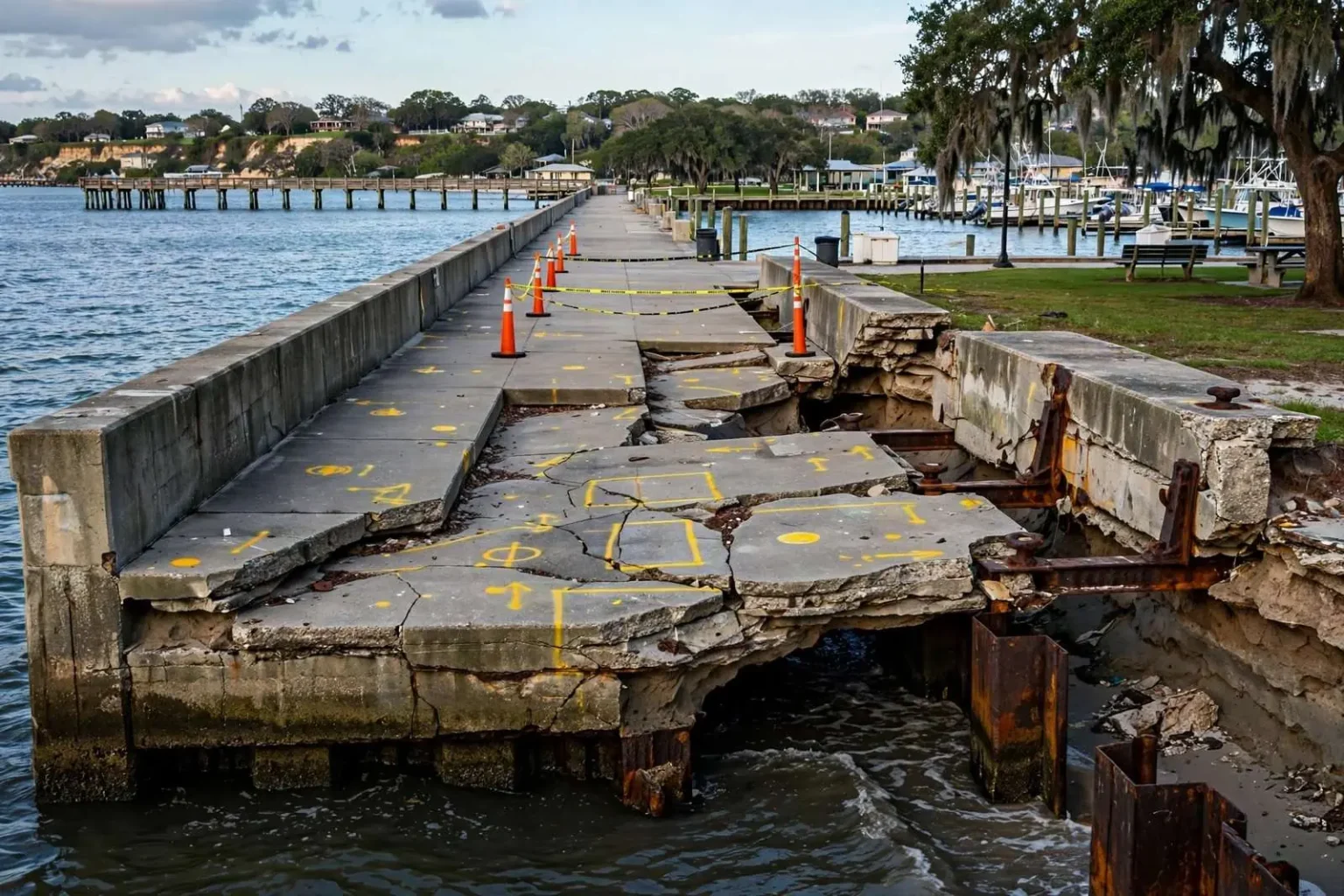
Time and weather have not been kind to the seawall at Fairhope Pier, and the damage has become increasingly visible. Built roughly 50 years ago, the structure’s anchoring hardware has failed over time, allowing sections of the wall to shift out of place. In other areas, water has worked its way in behind the wall, eroding the soil that supports the walkway above it.
“It takes the sand that’s underneath that walkway out and leaves a void, and that walkway will settle and possibly leave a sinkhole,” said Fairhope City Engineer Richard Johnson. “That’s happened pretty regular after especially tropical storms, so part of that is just the serviceability of the walls, so that’s going to get fixed in this project.”
The mechanics of the failure are familiar to anyone who maintains waterfront structures on Mobile Bay. A seawall holds back the land; waves and tide work at its face, and water finds its way through and behind it. Once the anchoring hardware corrodes and loosens, the wall’s sections move independently, and every overtopping storm carries a little more of the supporting soil out through the joints. What begins as a hairline settlement becomes a void, and the walkway above — carrying hundreds of visitors on a busy evening — settles over empty space.
City public works crews inspected the damage April 2 and determined that at least a portion of the walkway needed to be blocked off, even if only temporarily. The stretch closest to the pier has worsened noticeably after recent storms sent waves washing over the walkway. Settling sidewalk panels have also created tripping hazards in several spots, prompting the city to mark the problem areas with bright yellow paint as a stopgap measure.
The closures and paint marks are interim measures pending the construction work the restored funding makes possible, but they change how the waterfront is used in the meantime. Sections of the walkway that once carried fishermen with coolers and families heading to the pier’s end are now off limits or flagged, and visitors navigating around the marked panels see plainly what the engineering reports describe: a structure at the end of its service life.
What the money means
The Gulf Coast Ecosystem Restoration Council’s approval of a $5 million increase to the project’s estimated cost is the funding milestone that six years of planning had been waiting on. The council administers money from the settlement of the Deepwater Horizon oil spill litigation under the RESTORE Act, the federal law that directs the penalties from the 2010 disaster back to the Gulf Coast communities that endured it. Fairhope’s Working Waterfront project was selected among the region’s restoration and economic development priorities, putting the city’s pier and seawall in line for the spill recovery dollars.
For a project of this scale, the increase reflects the gap between what planners hoped the work would cost when it was first proposed and what the engineering required. More than six years of delays — design revisions, funding cycles, environmental review — carry their own price, and the deterioration that continued through those years made the eventual repair larger than it would have been at the start. Approving the increase acknowledges the reality of the structure’s condition rather than the optimistic budget of the project’s first draft.
The Working Waterfront project, as its name suggests, is broader than the seawall alone. Fairhope’s waterfront — the pier, the park at the top of the bluff, the beach and the municipal marina below — is the city’s most visited public space and a working harbor as well as a destination. The project ties the structural repairs to the long-term use of the waterfront as a place where boats launch, fishermen work and the public gathers, which is why the city pursued RESTORE funding for it rather than treating the seawall as an ordinary maintenance line item.
Regular visitors to the park and pier say they’ve noticed the deterioration and are relieved that repairs are finally on the way.
“I have noticed it and I also know that if you’re this close to the water, if you don’t maintain it, it’s going to do nothing but get worse and worse and more and more expensive,” said Fairhope resident Pete Olesky. “Anything’s better than just seeing it fall to nothing, you know,” added Willie Walsworth, another regular at the pier. “I’d like to see them do something about it.”
The visitors’ assessment matches the engineering: waterfront structures do not stabilize on their own. Every tropical system that pushes water over the walkway accelerates the erosion, and the voids that form beneath the panels only grow. Johnson’s description of sinkholes forming “pretty regular” after storms describes a structure in active decline, not one waiting patiently for its turn in the capital plan.
Why the seawall matters to Fairhope
Fairhope Pier is the landmark by which the city is known. Extending more than a quarter mile into Mobile Bay from the base of the bluff, the pier and its surrounding park draw visitors from across the region for the fishing, the sunsets and the view of the bay that made Fairhope’s bluff famous. The municipal beach, the marina, the waterfall pond and the rose garden at the top of the hill form a single waterfront complex whose centerpiece is the walk out over the water.
The seawall is the structure that makes the complex possible. It holds the edge between the upland park and the bay, carries the walkway that leads to the pier and shelters the shoreline that storm after storm has tested. Its failure is not cosmetic: a void under the walkway is a safety hazard, and a wall that shifts section by section eventually compromises the whole edge.
That is why the project’s restart drew such attention in a city that has grown rapidly around its historic core. Fairhope’s population gains have made the waterfront more valuable and more heavily used than ever, and the pressure on its aging infrastructure has grown with the crowds. The repairs funded by the council’s approval aim to restore the seawall’s serviceability for the decades ahead — anchoring the wall sections, filling and stabilizing the voids behind it and rebuilding the walkway surfaces that have settled into hazards.
From approval to construction
The council’s April 1 approval moves the project from the funding queue into the construction pipeline. With the estimated cost restored to a level that covers the actual repair scope, the city can proceed with the work that has been designed and revised across six years of delays: stabilizing the roughly 50-year-old wall, repairing its anchoring hardware and rebuilding the walkway that thousands of residents and visitors use in every season.
The sequence between approval and construction still involves the usual steps — final contracting, scheduling around weather and tides, and phasing that keeps as much of the waterfront open as possible while crews work. Waterfront projects of this kind are typically built in sections, so that part of the walkway remains usable while another is under repair, and Fairhope’s staff have already shown how they will handle the interim: closures where the danger is real, yellow paint where the hazard can be flagged.
The April 2 inspection that led to the partial closure shows the pattern the construction is meant to end. Each storm season brings waves over the walkway, each overtopping carves away more of the supporting sand, and each inspection finds the panels more settled than the last. The repair interrupts that cycle at the source — the failed anchoring and the eroded soil behind the wall — rather than continuing to repaint and re-block the symptoms above it.
For the regulars at the pier, whose observations about the deterioration were quoted as the funding moved forward, the change will be gradual but visible: panels reset and stabilized, closures lifted, the yellow paint marks retired as the hazards they mark are repaired. The seawall that has held the edge of the bluff for half a century will hold it for the next generation with its anchoring renewed and the voids behind it filled.
The project’s six-year journey — from proposal through delays to the council’s $5 million increase — reflects both the difficulty of funding waterfront infrastructure and the persistence required to keep it moving. The Gulf Coast Restoration Council’s approval puts Fairhope’s seawall at the front of the line for the region’s recovery dollars, and the city’s engineers now face the work itself: rebuilding, section by section, the wall between the bluff and the bay.
Until the work is done, the city’s interim measures remain in place: the marked panels, the blocked-off stretch near the pier and the inspections that follow every significant storm. Residents planning a visit to the pier will find the waterfront open and in use, with the work zones marked and the views as uninterrupted as ever — while behind the scenes, the money is finally in place to fix what the weather has spent fifty years wearing down.