Democratic Governor Nominee David Jolly Brings Affordability Pitch to Pensacola
Florida's Democratic gubernatorial nominee David Jolly stopped in Pensacola to tout an affordability agenda — and a statewide moratorium on AI data centers.
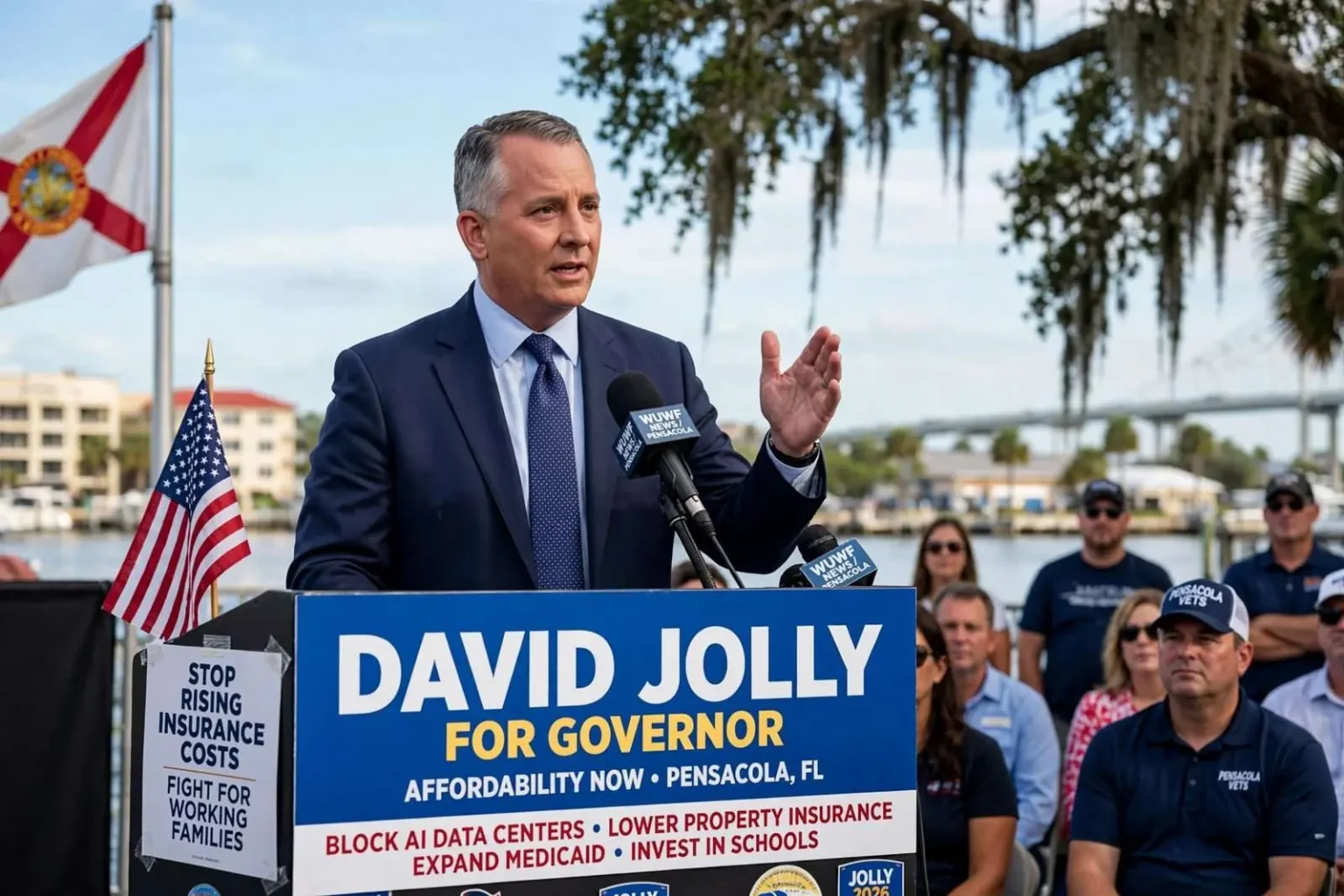
PENSACOLA, Fla. — David Jolly, the Democratic nominee running to become Florida’s next governor, brought his campaign to Pensacola this week, putting affordability — and a promise to block AI data centers — at the center of his pitch to Northwest Florida voters.
Jolly has made affordability the defining issue of his campaign, and he argues that Florida’s property insurance crisis is one of the biggest forces driving up housing costs for families across the state. Premiums that have climbed year after year, he argues, now shape what Floridians pay for a roof over their heads as much as home prices themselves. The pitch lands hardest in coastal counties like Escambia, where wind risk and reinsurance costs have driven premiums well above state averages.
Healthcare and Schools on the Platform
Beyond insurance, Jolly is campaigning on expanding Medicaid and widening access to healthcare, along with increasing investment in public schools and teacher pay. He has framed both as affordability issues in their own right — arguing that healthcare costs and underfunded classrooms weigh directly on family budgets in every corner of Florida. In Northwest Florida, where rural hospitals have closed and teacher pay trails nearby states, Jolly’s team believes the message resonates with voters who do not typically vote Democratic.
The campaign also ties Medicaid expansion to the working poor and to veterans — a significant constituency in the Pensacola area given the presence of Naval Air Station Pensacola and surrounding military communities. Jolly argues that leaving federal Medicaid dollars on the table has cost Florida hospitals, including several that serve the western Panhandle, hundreds of millions of dollars that would otherwise help stabilize rural healthcare.
Call for a Statewide Data Center Moratorium
One of Jolly’s most distinctive positions is a call for a statewide moratorium on AI data centers — an issue that has become a flashpoint in Escambia County, where local officials have already moved to restrict the facilities. Jolly argues the state’s current approach — letting individual counties decide case by case — produces a patchwork that leaves residents in some communities exposed while rewarding developers in others.
“The data center issue is real because voters across the state are saying we don’t want them here,” Jolly said. “Sadly, my opponent, I think because he’s taken so much money from data centers, has said he’ll let them come. He just wants them to pay their way. That’s not good enough. Florida voters don’t want data centers. We [see] that in Escambia County right now. I think that should be a statewide moratorium.”
Escambia County has already moved to ban large-scale data centers in unincorporated areas, and the City of Pensacola has approved a one-year moratorium on the facilities within city limits — actions that have made the Pensacola area one of the most visible battlegrounds in Florida’s debate over where massive AI facilities belong. Local leaders cite concerns over water use, electrical grid impact, and noise from industrial-scale cooling fans.
Critics of the projects cite their enormous electricity and water demands and question the long-term job creation they deliver, while supporters point to construction spending and tax revenue. Jolly’s position puts him directly at odds with opponents who favor letting the market decide, so long as the projects pay their own infrastructure costs. The disagreement has been sharpened by an ongoing fight in Escambia County over whether utility providers can pass the cost of new transmission lines needed to serve the facilities on to ratepayers.
Northwest Florida’s Role in the Race
Pensacola and the surrounding Panhandle have historically leaned Republican in statewide races, but Jolly’s stop signals that his campaign sees an opening on kitchen-table issues in a region where insurance costs and utility bills hit hard. Escambia County voters have shown a willingness to act unilaterally on the data center question, banning the facilities before a statewide consensus emerged.
Jolly’s team sees an opening among independent voters and moderate Republicans who have grown frustrated with the cost of doing nothing on insurance, and with the prospect of new industrial water users moving into the drought-prone western Panhandle. Recent municipal elections in Pensacola and Escambia County have shown competitive races at the local level, and the campaign is betting that affordability and data center concerns can push some of those voters across the aisle in a gubernatorial contest.
Jolly’s Pensacola appearance is part of a broader swing through Florida as the general election campaign takes shape. With affordability, healthcare, education, and the data center fight expected to dominate the debate, Northwest Florida is likely to see plenty more of both campaigns before Election Day.
For voters in Escambia and Santa Rosa counties, the practical stakes are unusually concrete. Property insurance rates along the coast have continued to climb, local school districts are bracing for another tight budget year, and Pensacola’s city council is working through exactly where the line should be drawn on new data centers within city limits. Jolly’s platform touches all three, which is why his campaign is investing time in the western Panhandle this early in the general election.
Why Pensacola Is the Staging Ground
Pensacola is likely to remain a focal point of the campaign because it sits at the intersection of several of Jolly’s top issues. Insurance rates along the Gulf are some of the highest in the country, the local debate over data centers has already produced two local moratoriums, and the area’s healthcare economy stretches from Baptist Hospital to the Naval Hospital at NAS Pensacola. Each of those issues gives Jolly a reason to keep returning to the western Panhandle through the fall.
How Republicans Plan to Respond
Republican state leaders have pushed back on the moratorium idea, arguing that data centers can bring significant tax revenue and construction jobs to rural counties that need both. Several Panhandle legislators have already prefiled bills for the next session that would set statewide standards for the industry rather than leave decisions to individual cities. That debate is likely to run alongside the governor’s race all the way to Election Day, with Pensacola serving as one of the more visible battlegrounds.
How the Insurance Fight Is Playing Out
Florida’s property insurance market has been in crisis for years, with multiple carriers pulling out of the state or requesting steep rate increases. Jolly has argued that legislative inaction has allowed the problem to fester, while the governor has pointed to recent reforms that have begun to stabilize the market. Both sides agree that rates along the Gulf Coast remain higher than anywhere else in the country, and both have proposed different approaches to bringing them down. Escambia County residents, who pay some of the highest premiums in the state, are likely to hear plenty more about the issue between now and Election Day.
How Campaign Stops Translate to Voter Outreach
Jolly’s Pensacola stop was part of a multi-city swing that included stops in Tallahassee, Jacksonville and Tampa, with Pensacola serving as the only western Panhandle event on the schedule. Campaign staff said the visit included meetings with local Democratic officials, a press availability and a community forum that drew several hundred attendees. The campaign is expected to return to the Panhandle multiple times before Election Day, with stops planned in Escambia, Santa Rosa and Okaloosa counties.
Where the Race Stands Heading Into the Fall
Polls released over the summer show the Florida governor’s race remains within the margin of error, with both campaigns expecting turnout to be driven by base voters in Miami-Dade, the Tampa Bay area, and the I-4 corridor. Northwest Florida is unlikely to decide the race, but it can affect the margin and the message, and both campaigns are spending accordingly. For Pensacola voters, that means more candidate visits, more local news coverage and more direct mail between Labor Day and Election Day.
What Local Officials Are Saying
Pensacola and Escambia County officials have continued to weigh in on the data center fight even as it has become a statewide campaign issue. Local leaders say the moratoriums were driven by concerns from residents who showed up at public hearings to talk about water use, electrical demand and noise. Jolly’s call for a statewide moratorium echoes those local concerns, and his campaign has made the Pensacola experience a centerpiece of its argument. Local officials from both parties have said the issue is unlikely to fade before the next legislative session, regardless of who wins the governor’s race.
What the Polling Has Shown
Public polling has consistently shown that affordability — particularly property insurance and housing costs — is one of the top issues for Florida voters heading into the fall campaign. Healthcare access and education funding typically follow close behind. Jolly’s platform speaks directly to all three, and his campaign has used those issues to argue that the race is competitive even in places where Republicans have historically had a structural advantage. Local Democrats say the Pensacola stop is part of a deliberate strategy to compete for votes that have not been seriously contested in recent statewide elections.