A Sorority Chapter Threw a ‘Teacher Shower’ for a New Huxford Elementary Teacher Instead of Making Her Buy Her Own Classroom Supplies
The Gamma Omega chapter threw a 'new teacher shower' for incoming Huxford Elementary teacher Jameson Janes, stocking her classroom with supplies ahead of the new school year.
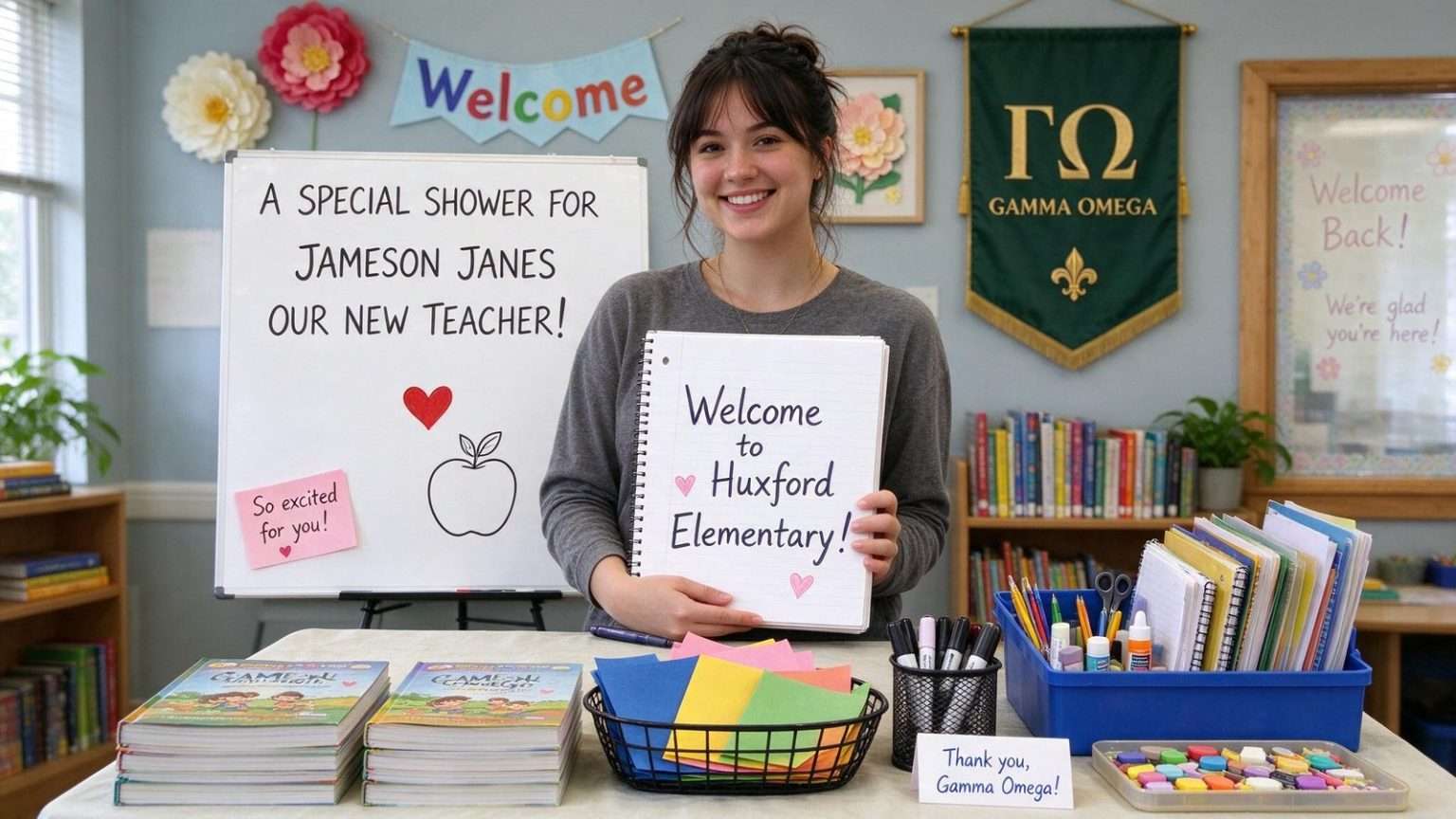
A new teacher at Huxford Elementary School got a send-off most first-year educators don’t: instead of digging into her own paycheck for classroom supplies, Jameson Janes had a “new teacher shower” thrown in her honor by the Gamma Omega chapter of a local sorority.
A shower for the classroom
The event, styled after a baby or bridal shower but built around classroom supplies instead, is part of a growing trend among community and civic groups looking to ease one of the most consistent complaints in public education: teachers routinely spending hundreds of dollars of their own money each year on basic classroom materials.
The mechanics of a teacher shower are simple. Guests bring items the way they would bring gifts to a baby shower — except instead of bottles and blankets, the gifts are construction paper, dry-erase markers, books, manipulatives, storage bins and the countless small objects a functioning elementary classroom consumes. Some organizers work from a registry or a list the teacher provides; others let guests choose freely. Either way, the teacher ends the afternoon with a stocked classroom and a room full of people invested in how the year goes.
For a first-year teacher, the timing matters as much as the merchandise. New educators typically walk into empty or inherited classrooms in late summer with a start date looming, and the traditional advice is to spend the weeks before school getting the room ready. A shower held before the year begins converts that preparation from a solo shopping trip into a community event, and it hands the new teacher both materials and a roster of local faces who have already met her.
The out-of-pocket problem
The gap the Gamma Omega chapter set out to fill is well documented in American education. Surveys of teachers across the country consistently find that the large majority spend their own money on classroom supplies — commonly running to hundreds of dollars a year, and considerably more for teachers in elementary grades, where paper, art materials and reward items are consumed constantly.
Public school supply budgets cover core instructional materials, but the working reality of an elementary classroom runs past what any district allocation stretches to. First-year teachers face the steepest version of the problem: they inherit whatever the previous teacher left behind, if anything, and they build their collection of books, games, posters and organizational tools from zero at the precise moment their salaries are at their lowest.
Federal tax law has long allowed educators a limited deduction for classroom expenses — an above-the-line deduction for eligible educators, originally $250 per year — but the deduction covers only a fraction of what many teachers actually spend. The shortfall is made up, informally and unevenly, by teachers’ paychecks, by parent-teacher organizations, and by the kind of community intervention the Huxford shower represents.
Huxford and its school
Huxford is a small community in northern Escambia County, Alabama, an area of timberland and family farms nearer to the Butler County line than to the county seat at Brewton. Huxford Elementary School serves the surrounding rural area, and its size — like that of most Escambia County schools — reflects the community around it, with classes small enough that every teacher’s preparation touches every student in the grade.
Rural districts across south Alabama face a particular version of the school-funding squeeze. Property tax bases are thin in timber counties, state funding formulas stretch to cover basic operations, and the discretionary money that suburban PTAs raise through fall festivals can be hard to come by. In that environment, civic groups play a larger role than they do in bigger systems, and the habits of support run deep: churches fill backpacks with weekend food, service clubs fund scholarships, and local chapters of fraternal and professional sororities adopt classrooms and teachers.
Why a shower rather than a donation
By throwing a shower rather than simply donating supplies directly to the school, organizers gave Janes a personalized stock of materials for her own classroom before the school year even begins, alongside the kind of community welcome that can make a first-year teaching job feel less isolating.
The distinction is more than ceremonial. A box of supplies delivered to a school office is anonymous; a shower is a relationship. The new teacher meets the people whose children she will teach, hears the local context that no orientation covers, and starts the year with allies she can call when the copy machine breaks or the first open house approaches. Rural schools in particular depend on those ties — in communities like Huxford, the teacher who feels connected to her town is the teacher who stays.
Retention is the quiet issue underneath every teacher-support effort. Alabama, like most states, loses a significant share of new teachers within their first years in the classroom, and the factors cited most often are pay, isolation and workload. Community gestures do not fix salary schedules, but they attack the isolation directly, and research on early-career teachers consistently finds that support from colleagues and community is among the strongest predictors of whether a first-year educator returns for a second.
A growing pattern
Teacher showers have spread in recent years alongside other community-funded efforts: supply closets stocked by churches, “clear the list” campaigns in which strangers buy items from teachers’ online wish lists, and adopt-a-teacher programs run by civic clubs at the start of each school year. The Gamma Omega chapter’s version in Huxford fits the pattern of small-town Alabama groups turning national ideas into personal, local events.
Community-driven support like this has become an increasingly common supplement to school-provided supply budgets in smaller Alabama districts, where civic groups, churches and sororities often step in to fill gaps that stretched school budgets can’t always cover on their own.
For Jameson Janes, the result is a first year at Huxford Elementary that starts with a stocked classroom and a roomful of neighbors already on her side — a send-off most first-year educators never get, and one her Gamma Omega organizers clearly hope her students will feel the benefits of all year long.
Inside an Escambia County classroom
What a rural elementary teacher actually buys with her own money illustrates the scale of the habit. A third-grade classroom runs through pencils faster than any district allocation anticipates; anchor charts, sentence strips and laminating pouches are consumables; the classroom library — the single most powerful tool an elementary teacher has — is almost always assembled book by book through Scholastic orders, yard sales and personal spending. Chairs wear out, rug squares fray, and the flexible-seating arrangements popular in modern classrooms are typically funded by the teacher’s own card.
Teachers in Escambia County’s schools, like their colleagues across south Alabama, also pay out of pocket for the extras that make a rural classroom work: snacks for students who arrive hungry, winter coats and school supplies for families that fall short, and the postage and materials that connect classrooms to pen pals, book clubs and field trips the district budget cannot reach.
The school year in a small school intensifies the picture. At Huxford Elementary, where grade levels may field only a single class each, one teacher’s preparation covers every student in her grade — there is no colleague down the hall with duplicate supplies to borrow from. The margin for shortage is correspondingly thin, which is why community contributions land with such force in schools this size.
The sorority tradition of school support
Women’s civic and professional sororities have long made education their signature cause in Alabama’s small towns. Chapters of organizations for educators, businesswomen and community volunteers adopt schools each fall, fund scholarships for graduating seniors, and supply classrooms throughout the year. The Gamma Omega chapter’s decision to focus its attention on a single new teacher follows the model those groups have refined over decades: concentrated help for one person at the moment it matters most.
The shower format adds an element the direct-donation model lacks — celebration. First-year teachers describe the summer before their first class as one of the most anxious stretches of their careers, and an event that treats classroom preparation as an occasion worth marking changes the emotional frame. The gifts matter; so does the message that the community considers her arrival an event.
The practice also builds a bridge between generations of educators. Showers organized by sorority chapters are typically planned by women who taught in the same schools a generation earlier, and the event doubles as an orientation in miniature — advice about the community, the parents and the unwritten routines of the school, delivered alongside the wrapping paper. Veteran teachers who attend often leave with their own commitments made: to mentor, to substitute, to show up at the fall festival. In small schools, those quiet pledges are infrastructure.