
Catholic Charities of Mobile Sets $4.5 Million Goal for 89th Annual Appeal
The Archdiocese of Mobile's Catholic Charities launched its 89th Annual Appeal with a $4.5 million goal to fund more than 30 ministries across South.
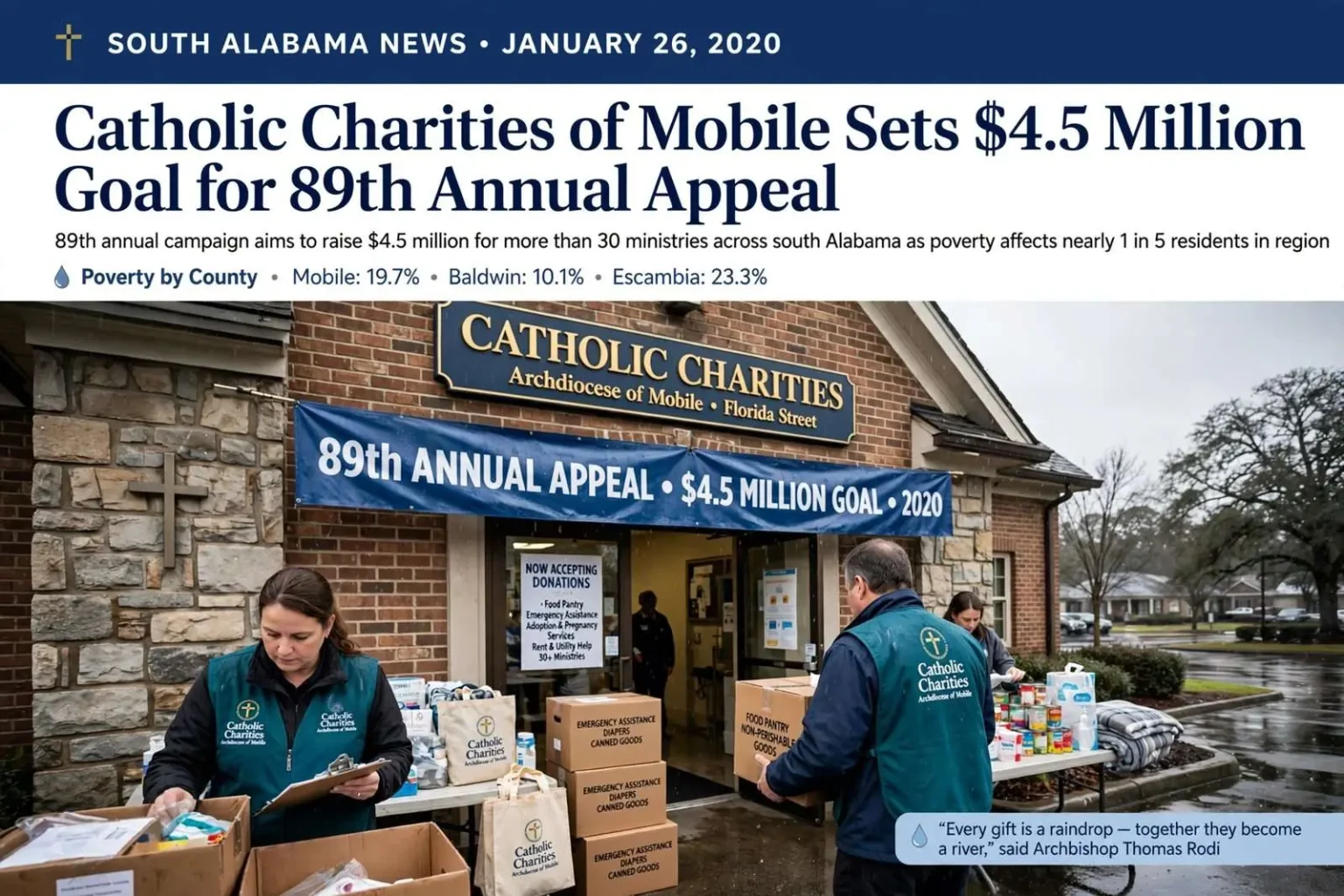
Catholic Charities of the Archdiocese of Mobile is asking the community to give as it kicks off its 89th Annual Appeal, with a fundraising goal of $4.5 million for 2020. The appeal, announced for Sunday, January 26, asks Catholics across south Alabama to support the church’s charitable arm at a moment when the Archdiocese reports that nearly 20 percent of the people it serves live in poverty.
Eighty-nine years of continuous operation makes the Annual Appeal one of the longest-running fundraising traditions on the Gulf Coast, predating most of the modern social-service agencies now working in the region. The 2020 goal keeps the campaign among the largest annual charitable drives in south Alabama, and its reach extends well beyond the pews of the Archdiocese’s parishes to anyone in need who walks through the door of its Mobile headquarters.
Poverty varies sharply across the Archdiocese
Figures shared by the Archdiocese show poverty rates vary widely across the south Alabama counties it serves: 19.7 percent in Mobile County, 10.1 percent in Baldwin County, and 23.3 percent in Escambia County — the highest of the three. The spread is a portrait of the region’s economic geography, and it explains why Catholic Charities’ work looks different from one county to the next.
Mobile County, the most populous of the three, pairs a concentrated urban core with persistent pockets of deep need; its poverty rate sits above the mark that would describe a healthy regional economy. Baldwin County, across Mobile Bay, has been one of the fastest-growing counties in Alabama for years, and its comparatively low rate reflects a coastal economy built on tourism, construction and retirement migration. Escambia County, on the state’s western edge and anchored by the city of Atmore, tells a harder story: a rural county where job losses in manufacturing and a thin social-service safety net push nearly one resident in four below the poverty line.
For the Archdiocese, which administers parishes and charitable programs across all of these communities, the figures are more than statistics. They determine where emergency assistance requests concentrate, where adoption and pregnancy services see the most demand, and how the money raised through the appeal has to be deployed across a service area that runs from the Gulf beaches to the state line.
Funding more than 30 ministries
Catholic Charities helps more than 7,000 people a year at its Florida Street location alone, a volume of service that touches families in every phase of crisis. The Florida Street operation functions as the central point of contact for much of the Archdiocese’s charitable work, connecting people who arrive with one urgent problem to the wider network of programs that can address the others that usually follow.
Money raised through the appeal funds more than 30 ministries across the Archdiocese. Among the most prominent are adoption services, which place children with families and guide birth parents through one of the most difficult decisions they will ever make, and crisis pregnancy services, which offer counseling and material support to women facing unplanned pregnancies. The ministries also include emergency assistance for families in crisis — the rent help, utility payments and food support that keep a temporary setback from becoming homelessness.
The breadth of the ministry list is deliberate. A family that arrives needing help with a power bill may also be dealing with job loss, a medical crisis or a housing problem, and the range of programs funded by the appeal lets caseworkers respond to the whole situation rather than a single symptom. That model, refined over nearly nine decades, is what the $4.5 million goal is meant to sustain.
Rodi’s raindrops: every gift counts
Archbishop Thomas Rodi, who has led the Archdiocese of Mobile since 2008, encouraged donations of every size, comparing giving to raindrops: each may look very small on its own, he said, but enough of them together create a river — and together they make a tremendous difference in the community.
The image is well suited to a campaign of this structure. An annual appeal raising millions does not get there through a handful of large gifts; it depends on thousands of contributions from parishioners across the Archdiocese, many of them modest checks from families who give faithfully every year. The raindrop framing is both an encouragement and a practical argument: a $10 or $25 gift is not symbolic in a campaign that counts its donors in the thousands.
It also reflects the way the appeal is conducted. Announcement Sunday, January 26, marks the point when parishes across south Alabama direct their congregations toward the campaign, with collection materials and pledge forms distributed through the churches themselves. The parish-by-parish structure means the appeal’s success rests on local pastors presenting the need in their own communities, from downtown Mobile to the rural parishes of Escambia and Washington counties.
A safety net with deep roots
Catholic Charities’ footprint in Mobile long predates the modern federal safety net. Organizations of its kind emerged in an era when the church, not the government, was the first stop for a family facing eviction or hunger, and the Archdiocese’s charitable work has adapted through every decade since — adding professional casework, licensed adoption services and coordination with public agencies while keeping the same founding mission.
That history matters for how the appeal operates today. The organization’s Florida Street presence in Mobile places it within reach of the city’s poorest neighborhoods, and its programs serve clients regardless of their connection to the church. The 7,000 people helped each year at that single location include families of every background, drawn by the fact that the services are free, established and, in many cases, unavailable elsewhere in the community.
The appeal’s timing also reflects the rhythm of need on the Gulf Coast. Winter brings higher utility bills and strained household budgets; the months that follow bring hurricane season preparation and, in bad years, the recovery work that south Alabama has learned to expect. Donations raised in early 2020 fund the ministries through all of it, from the emergency assistance that spikes in cold snaps to the pregnancy and adoption services that run steadily year-round.
What the money does
For donors weighing the request, the mechanics are straightforward. A contribution to the Annual Appeal is distributed across the more than 30 ministries according to their needs, and the Archdiocese’s reporting on poverty rates and service volumes is the accounting for why the goal stands at $4.5 million — a figure sized to the demand the organization already sees, not to an expansion plan.
The appeal’s organizers make the case that the need is measured, not speculative: nearly one person in five served lives in poverty, more than 7,000 come through the Florida Street doors each year, and the ministries funded by past appeals are already operating at capacity. Eighty-nine years in, the Annual Appeal’s pitch remains what it has always been — that the region’s poorest residents are best served by an institution the community sustains itself, one raindrop at a time.
The counties behind the numbers
The poverty figures the Archdiocese shared are worth reading closely, because they describe three very different service territories under one charitable umbrella. Mobile County’s 19.7 percent rate covers the largest population in the Archdiocese’s footprint, which means the raw number of people in need there dwarfs the totals elsewhere — and explains why the Florida Street operation, sitting in the middle of that population, processes more than 7,000 people a year on its own.
Baldwin County’s 10.1 percent rate, the lowest of the three, can be misleading in the other direction. Rapid growth has lifted the county’s averages while leaving behind fixed-income residents, seasonal workers in the tourism economy and families priced out by the coastal housing market. The need is less concentrated there, but it is real, and the ministries funded by the appeal extend into it through parishes and program sites across the bay.
Escambia County’s 23.3 percent rate — nearly one resident in four — reflects a rural economy with fewer employment options and fewer charitable alternatives. In counties like that, a church-based agency is often the only structured assistance available within a reasonable drive, which makes the appeal’s cross-county reach more than administrative convenience. The $4.5 million raised in 2020 funds work in all three of these territories, and the Archdiocese’s case for support rests on exactly that spread: the need does not stop at any county line, and neither does the ministry.
For the Archdiocese, the Annual Appeal is the mechanism that keeps the entire charitable operation running. Unlike grants tied to specific programs, appeal dollars follow the need, and the organization’s leadership has consistently argued that flexibility is what allows a caseworker to solve a family’s actual problem instead of the problem a particular funding stream happens to cover. That is the practical meaning behind the $4.5 million goal for 2020 — a target sized to keep more than 30 ministries serving the region for another year.


