An Oddsmaker’s Verdict: Alabama Was Sending Its Gambling Money to Everybody Else
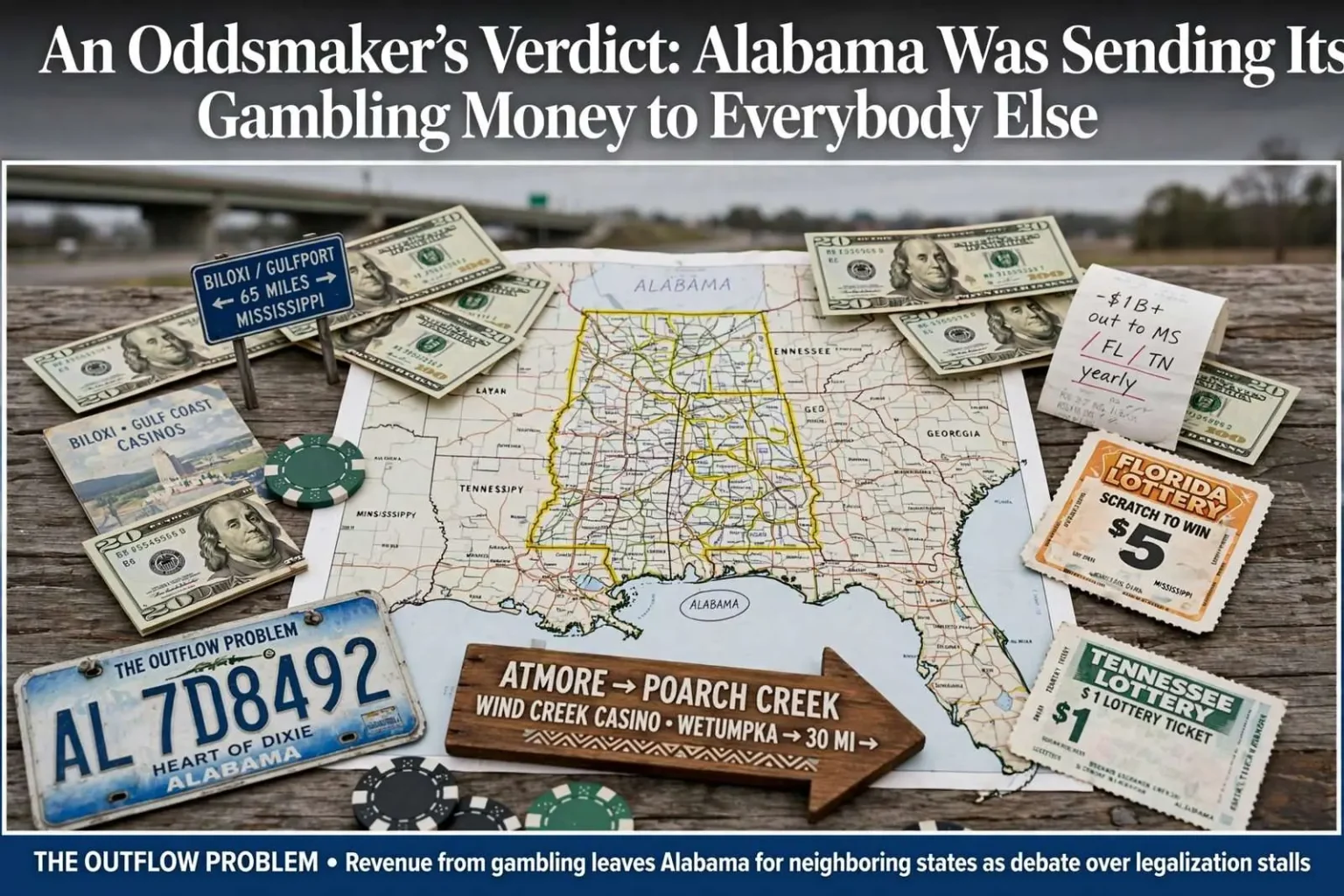
Mobile oddsmaker and sports analyst Danny Sheridan said it was past time for Alabama to consider a lottery or casinos, arguing the state was subsidizing gaming in Mississippi, Florida and Tennessee.
MOBILE — Few Alabamians are better positioned to talk about betting than Danny Sheridan, the Mobile-based oddsmaker and sports analyst whose point spreads have been quoted in newspapers across the country for decades. Asked whether it was time for Alabama to revisit expanded legal gambling, his answer was unhesitating.
“It’s past time for a lottery or casinos in Alabama,” Sheridan said, “but I don’t see casino gambling happening until the Poarch Creek Indians get the right to have full blown casinos in Atmore and Wetumpka (Atlanta market).”
The remark compressed into a sentence the argument that has circulated around the State House for a generation: Alabama’s gambling debate is not really a debate about whether Alabamians gamble. It is a debate about where they do it, and who collects the money when they do.
The argument from arithmetic
Sheridan’s case rested less on morality than on money leaving the state. Alabamians, he argued, were already gambling in large numbers — simply not at home.
“When Alabamians see those two casinos combined making over $1 billion annually and paying no taxes to the state, the politicians will do a 180 (degree turn) and the people will legalize casino gambling in Alabama,” he said. “The people of Alabama currently play a huge roll in supporting casinos on the (Mississippi) coast and one 90 miles from Birmingham and also heavily support lottery sales in Florida and Tennessee.”
The geography he described was, and remains, familiar to anyone living in South Alabama. The Mississippi Gulf Coast casinos at Biloxi and Gulfport sit within an easy drive of Mobile and Baldwin counties. Florida sells lottery tickets a short trip down the interstate from the Wiregrass and across the line from Escambia County. Tennessee’s lottery draws from north Alabama. The state, in Sheridan’s telling, had achieved the worst of both worlds: the gambling happened anyway, and none of the revenue stayed home.
For residents of Mobile and Baldwin counties, the pattern plays out on Interstate 10 every weekend. Buses and caravans run from Mobile to the Biloxi and Gulfport casino floors, where Alabama license plates fill the parking decks, and the sales taxes, gaming taxes and payroll those visitors generate accrue to the state next door. Mississippi legalized dockside casino gambling along its Gulf Coast decades ago, and the beachfront and bay-side casinos there have since become a pillar of that state’s coastal economy — built in no small part on customers from states that did not offer the same option.
The same logic runs in every other direction. A shopper in Dothan can cross into Florida for a lottery ticket; a family in Huntsville can do the same in Tennessee; a resident of Phenix City can reach Georgia’s lottery in minutes. Alabama stood alone in the region — one of the few states with no lottery and no commercial casino gambling — while its neighbors sold tickets and housed resorts along every border.
The Poarch Creek question
The reference to the Poarch Band of Creek Indians was not incidental. The Poarch Creeks, Alabama’s only federally recognized tribe, are headquartered near Atmore in Escambia County and operated electronic bingo facilities there and at Wind Creek Wetumpka, near Montgomery.
Because tribal gaming operates under federal law rather than state law, those facilities occupied a different position from any state-sanctioned casino. Under the federal Indian Gaming Regulatory Act, gaming on Indian lands is divided into classes, and tribes may offer certain games on their own sovereign territory regardless of whether the surrounding state has authorized them, while other, more extensive forms of gaming require a compact negotiated with the state government.
That legal structure is what Sheridan was pointing to when he tied the future of casino gambling in Alabama to the Poarch Creeks’ status. The tribe’s facilities already drew players from across the state — including, by his argument, a large share of the money Alabamians were otherwise carrying to Biloxi — and their two operations, by his estimate, were generating more than $1 billion a year while paying no state taxes, because a state cannot tax tribal gaming operations the way it taxes commercial businesses.
A state that kept saying no
Alabama’s refusal to embrace lottery or casino gambling has never been for lack of trying by its advocates. A state lottery was the centerpiece of a major gubernatorial campaign and a statewide referendum in the late 1990s, and it failed at the ballot box after a well-funded opposition campaign that included religious organizations and out-of-state gaming interests. The defeat left a mark on Alabama politics: for years afterward, proposals for lotteries, bingo amendments and casino compacts surfaced in the Legislature, and for years they died in committee or on the floor without ever reaching voters.
The result was a patchwork that satisfied no one. Counties approved local amendments allowing charitable bingo halls, and electronic bingo machines became the subject of years of litigation and political fighting over whether they were legal bingo or illegal slot machines. Governors and attorneys general of both parties took different positions. Raids, court rulings and task forces turned electronic bingo into one of the recurring stories of Alabama government, while the underlying question — whether the state should simply regulate and tax gambling — went unanswered.
Through all of it, the tribe’s operations continued to run under federal oversight, and the state’s gamblers continued to travel. The money Sheridan described flowing out of Alabama — to the Mississippi coast, to Florida and Tennessee lotteries, to the casino near Birmingham — kept flowing in good years and bad alike, because the appetite it fed did not depend on what the Legislature did or did not pass.
What the money would mean at home
Advocates of legalization have always framed the case in terms of the uses the money could serve. A state lottery, in most of the states that have adopted one, directs proceeds to education — college scholarships in some, pre-kindergarten programs and classroom funding in others. Neighboring Georgia’s lottery-funded HOPE scholarship became the template southern lottery advocates pointed to for decades: a visible, popular program that gave voters a concrete answer to the question of where the money goes.
In Alabama, lottery proposals typically carried similar education earmarks, and casino proposals carried promises of gaming taxes for the general fund, local governments or the General Fund budget that pays for Medicaid, prisons and public safety. The scale of the numbers was the point Sheridan was making: even a fraction of the money Alabamians were spending across the state lines, redirected home, would be significant in a state budget that has historically strained to fund its obligations.
The counterargument has remained consistent as well. Opponents — many of them motivated by religious conviction, others by skepticism of gambling’s social costs — have argued that gaming revenue is a volatile foundation for government, that casinos and lotteries take disproportionately from the people least able to afford it, and that the social costs of problem gambling offset much of the fiscal gain. Those arguments have kept enough legislators in the “no” column, session after session, to keep the question off statewide ballots.
The oddsmaker’s read on the politics
Sheridan’s prediction carried the tone of a man who sets lines for a living: the game was already decided, the state just hadn’t looked at the scoreboard. In his telling, the economics were inexorable. Alabamians were gambling; the tribe’s facilities were thriving; neighboring states were collecting the rest. Sooner or later, he argued, voters and politicians would see the billion dollars a year being made tax-free in their own state and conclude that a state that licenses and taxes gaming would do better than one that pretends it does not exist.
The obstacle he identified was the same one that has shaped every Alabama gaming debate: the tribes do not need the state’s permission to operate what they operate now, and the state cannot tax it. A compact that allowed full-scale casinos in Atmore and Wetumpka — and perhaps on additional tribal land — would give the tribe certainty and give the state a negotiated share, but it would also require the state to accept gaming it has spent decades declining to endorse.
Until that political equation changed, Sheridan predicted, the status quo would hold: Alabamians would keep driving to Biloxi for the casino floors, to Florida and Tennessee for the lottery tickets, and the revenue would keep arriving everywhere but Montgomery.
What it means for South Alabama
For the Mobile area, the stakes in the debate are tangible. The coast’s proximity to Biloxi means the region sends more gamblers across the line than any other part of the state, and it stands to capture a disproportionate share of any gaming dollars that stay home. A casino market in Alabama — or even a lottery with South Alabama retail points — would redirect spending that now supports resort hotels, restaurants and entertainment venues in Harrison County, Mississippi.
Atmore tells the other half of the story. The Poarch Creeks’ operations have made the tribe one of the largest employers in rural Escambia County, and its facilities have anchored economic activity in a small town that, like much of rural south Alabama, has watched young people leave for Mobile, Pensacola and Birmingham for decades. Tribal gaming revenue has funded services, infrastructure and charity across the region, and the tribe has become a significant political and economic presence in the state despite its small enrollment.
The tension between those two facts — a thriving tribal industry the state cannot tax, and a commercial industry the state refuses to license — is the hole in the middle of Alabama’s gambling policy that Sheridan was describing. The state’s bet, in effect, has been that ignoring gaming costs less than managing it. The numbers he cited were his argument that the bet was losing.
The bigger picture along the Gulf
Alabama’s position is a relic of a regional map that no longer exists. When Mississippi opened its coast to casinos, Florida and Tennessee had no lotteries; today Florida runs one of the largest lotteries in the country and Tennessee operates one as well, along with a growing online sports betting market. Georgia combines a lottery with scholarship funding. Every state touching Alabama, in other words, has some form of legal gaming that Alabama residents help fund — a fact that has slowly eroded the political cost of saying yes at home.
Oddsmakers, whose business is separating wishful thinking from probability, have a vantage point on that shift that most commentators lack. Sheridan spent his career watching where money moves, and his assessment was less a moral argument than a weather report: the front was coming, the question was when it would arrive and on what terms.
His terms were specific. A lottery alone, he suggested, would not settle the question, because the large money is in casino gaming, and the path to casinos runs through the Poarch Creeks’ federal status. A state that wants gaming revenue will eventually have to make peace with the tribe’s position — compact, revenue share and all — rather than pretending the facilities on tribal land are not already the largest gaming operations in Alabama.
Whether that settlement comes, and when, remains in the hands of the Legislature, the governor’s office and the tribal council. What has never been in doubt is the underlying behavior: Alabamians gamble, in volume, and they have always been willing to drive to do it. The only open question — the one Sheridan answered without hesitation — is which state’s treasury gets to bank the proceeds.