Toxey Man Dies Days After Single-Vehicle Crash in Choctaw County
A 29-year-old Toxey man died days after his truck left Narrow Road and struck a tree in a single-vehicle crash investigated by Alabama State Troopers.
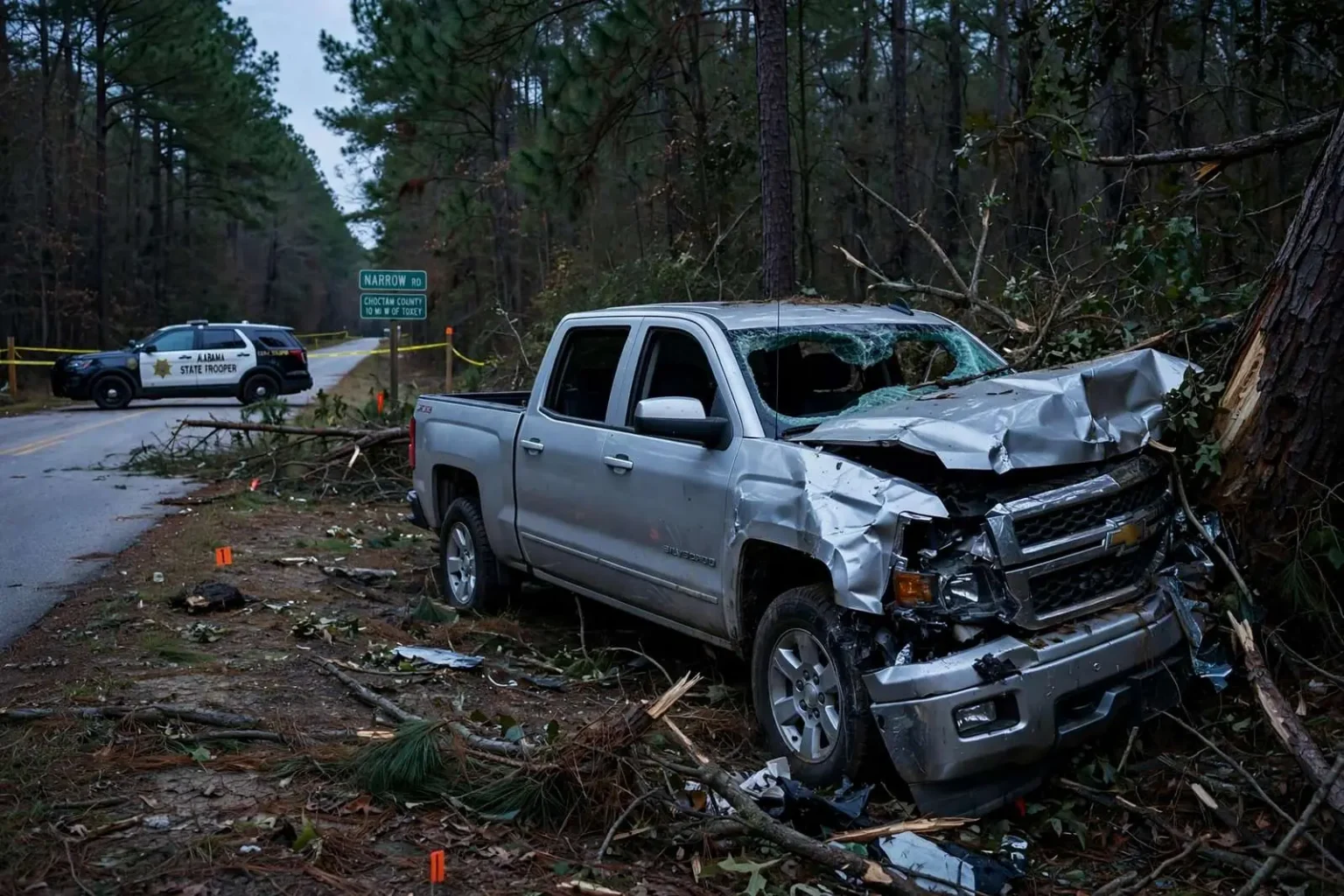
A Choctaw County man has died several days after suffering serious injuries in a single-vehicle crash near Toxey, according to Alabama State Troopers. William Robert Vonfrick, 29, of Toxey, was driving a 2013 Chevrolet Silverado on Narrow Road when the truck left the roadway and struck a tree, troopers said. The crash happened about 10 miles west of Toxey on a Wednesday.
Vonfrick was transported by medics to a hospital, where he was treated for his injuries before succumbing to them several days later. Trooper Jamie Maloy, who is investigating the crash, said troopers were still working to determine the exact cause as of the following Monday. State troopers routinely investigate single-vehicle crashes on rural roads in Choctaw County to determine whether speed, road conditions, mechanical failure or driver error played a role, though no additional details about the cause had been released at the time.
Where the Crash Happened
Narrow Road, like many rural routes in Choctaw County, winds through wooded terrain with limited shoulders and few streetlights, conditions that can make single-vehicle crashes especially dangerous when a driver runs off the pavement. Crashes involving a vehicle leaving the roadway and striking a fixed object such as a tree remain one of the leading causes of traffic deaths in rural stretches of west Alabama, where higher speed limits and long, unlit roads offer less margin for error than in town.
The geography of Choctaw County — one of Alabama’s larger counties by land area and among its least densely populated — shapes both the character of its roads and the response to crashes on them. With a county seat at Butler and small communities like Toxey scattered across wooded countryside, residents depend on two-lane rural routes for nearly every trip, and a wreck 10 miles from town can mean 20 minutes or more for emergency medical responders to reach the scene. That distance is part of why injuries that might be survivable closer to a trauma center can prove fatal: the interval between the crash and definitive hospital care stretches out on rural roads, and medical research consistently shows survival rates falling as transport times rise.
The fact that Vonfrick survived the initial impact and lived for several days afterward places the crash among the more common rural patterns: a run-off-the-road collision with serious rather than immediately fatal injuries, followed by a hospital course that ultimately could not overcome them. Troopers investigating such crashes work backward from the scene — measuring the truck’s path off the pavement, looking for skid marks or their absence, checking the vehicle for mechanical problems, and considering factors like speed, fatigue, distraction or a medical event behind the wheel.
Rural Roads and Fixed-Object Fatalities
Vonfrick’s death adds to a string of fatal crashes state troopers have investigated on rural roads across the Choctaw County area in recent years. The pattern is a statewide and national one: while most traffic fatalities happen on urban streets by volume, rural roads carry a far higher fatality rate per mile driven, and run-off-the-road collisions with trees, utility poles and embankments account for a disproportionate share of those deaths.
The reasons are structural. Rural routes like Narrow Road typically lack the shoulders, clear recovery zones, center barriers and rumble strips that give urban and interstate drivers a second chance when a wheel drops off the pavement. Trees often stand within a few feet of the travel lane, and in wooded terrain a driver who drifts asleep or overcorrects meets a fixed object almost immediately. Speed limits on rural county roads can run well above what the curves and sight lines tolerate at night, and darkness removes the visual cues that help drivers anticipate a sharp bend. Enforcement coverage is thinner too — a county the size of Choctaw may have only a handful of state troopers and sheriff’s deputies on duty at any hour across hundreds of square miles of road.
Safety officials have long recommended a set of countermeasures for exactly this kind of road: edge-line and center-line rumble strips that wake a drifting driver, clear zones that remove or soften fixed objects near the pavement, brighter and better-placed curve warning signs, and reflective pavement markers that define the road in darkness. Rural counties across west Alabama have applied such treatments selectively as funding allows, but the low traffic volumes that characterize roads like Narrow Road mean they rarely rise to the top of statewide improvement lists — leaving driver behavior as the main variable troopers can influence.
The Message Troopers Repeat
Local officials and troopers have periodically urged drivers on rural routes to slow down, avoid distractions and stay alert for wildlife or debris that can suddenly appear in the roadway, particularly on narrow, two-lane roads without center barriers. Deer strikes are a chronic hazard across southwest Alabama’s wooded counties, and the swerve to avoid an animal — a natural reflex at highway speed — is itself a frequent precursor to run-off-the-road wrecks. Troopers investigating single-vehicle crashes routinely reconstruct whether the driver braked, swerved or simply drifted, because each points to a different cause and a different prevention message.
Fatigue and distraction figure prominently in rural single-vehicle crashes as well. Long distances between destinations, late-night travel after work, and the absence of other traffic all combine to lull drivers; a moment of inattention at 55 or 60 miles per hour covers more than the length of a football field, which on a narrow, unlit road is more than enough to leave the pavement. Seat belt use, which investigators document in every serious crash they work, remains the single largest determinant of whether a run-off-the-road collision becomes a fatality.
The Investigation Continues
The Alabama Law Enforcement Agency’s Highway Patrol Division continues to investigate the crash. ALEA, which consolidated Alabama’s state law enforcement functions including the former Department of Public Safety, assigns certified troopers to reconstruct and document fatal crashes across the state’s rural counties, and findings in cases like this one can take weeks to finalize as vehicle inspections, scene measurements and medical records come together.
Anyone with information about the circumstances leading up to the wreck is asked to contact state troopers, who have emphasized in past rural-fatality investigations that even minor details — a vehicle seen traveling erratically earlier in the evening, road hazards noticed on the same stretch, or the last contact with the driver — can help establish what happened on Narrow Road in the moments before the 2013 Silverado left the roadway.
For Toxey and the surrounding communities, the death marks another loss on the rural roads residents travel daily, and another entry in the pattern that southwest Alabama’s troopers and county officials continue to warn against: darkness, speed, narrow pavement and trees close to the road, with no margin left for the moment a driver’s attention slips.
How Rural Fatal-Crash Investigations Work
When a crash on a rural road turns fatal, the response looks different from an urban collision scene. The first deputies or volunteer responders to arrive often begin care while troopers are still en route from a post that may be a county or more away. Once the Highway Patrol takes over, the investigation proceeds in stages: the scene is photographed and measured before the roadway reopens, the vehicle is examined and eventually impounded for inspection, and investigators canvass for witnesses in an area where the only passers-by may be neighbors who heard the impact rather than saw it. In wooded terrain like the stretch of Narrow Road where Vonfrick’s truck left the pavement, a vehicle that travels off the road can be difficult to spot from the highway, which sometimes delays the initial report as well.
Troopers document everything that will later bear on cause: the distance the vehicle traveled off the pavement, the damage pattern against the tree, whether the truck’s lights and brakes were functioning, the condition of the tires, and any indicators of speed. Medical findings from the hospital course add the final layer, since injuries that prove fatal days later are still attributed to the crash under Alabama law. The completed investigation supports any charges that may be warranted and, just as often, closes with a finding that speed, darkness and a narrow road were the only causes — an outcome that carries its own lesson for the drivers who use the same road every day.
Choctaw County’s Roads and Its People
Choctaw County’s residents live with the arithmetic of rural travel in a way urban drivers rarely think about. A trip to a hospital, a job or a grocery store can mean 30 minutes or more of two-lane driving in each direction, much of it after dark in the winter months, and the county’s aging population means many of those miles are logged by older drivers whose recovery from serious injury is harder still. Volunteer fire departments and small rescue squads carry the first-response burden across the county’s countryside, and their response times are shaped by the same distances that shape everything else about rural life in west Alabama.
It is against that backdrop that troopers repeat their standing guidance for roads like Narrow Road: expect curves that hide what lies beyond them, slow down between dusk and dawn, watch the shoulders for deer, wear the seat belt on every trip no matter how short, and never assume the empty road makes speed safe. The crash that claimed William Robert Vonfrick 10 miles west of Toxey had none of the ingredients of a multivehicle disaster — no other cars, no intersection, no traffic — and it was fatal anyway. That is the nature of rural-road risk in Choctaw County, and it is why the Highway Patrol’s investigation of this wreck will be studied by exactly the drivers who travel the same road tonight.