
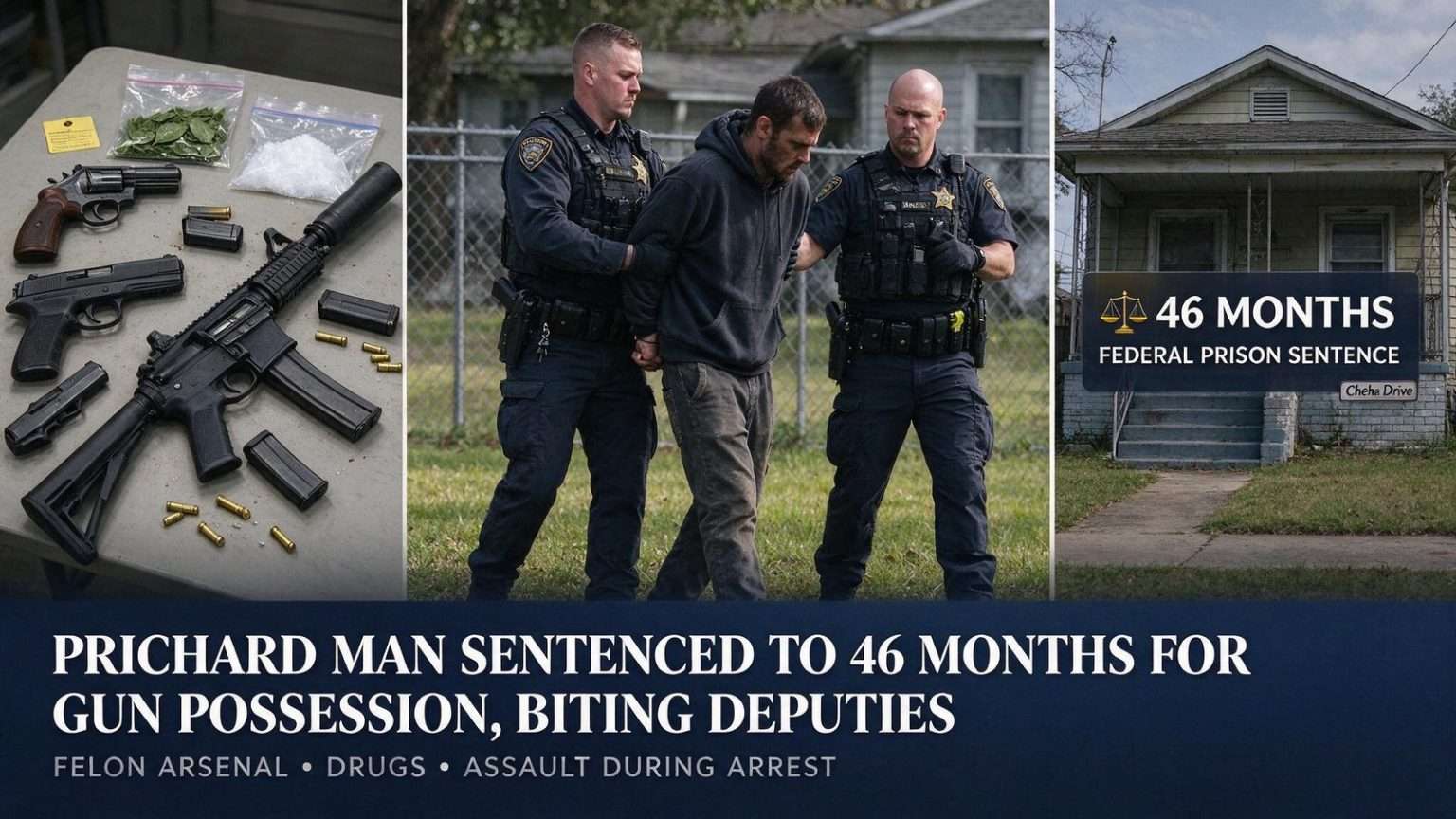
PRICHARD, Ala. — A 25-year-old Prichard man has been sentenced to 46 months in federal prison after illegally possessing multiple firearms as a convicted felon and assaulting law enforcement officers during his arrest, according to the Department of Justice. Delando Travon Perkins received the sentence after a case that began with a routine warrant and ended with two bitten deputies, a stash of weapons and a lesson in how federal prosecutors in south Alabama handle repeat gun offenders.
Perkins was arrested at his home on Cheha Drive in February on an outstanding drug warrant. When officers arrived to take him into custody, they found him riding a four-wheeler in the area of the residence, wearing an “ESPN” chain. Officials said the chain is typically worn by members of a Prichard gang, a detail that flagged the encounter as something more than an ordinary warrant service from the start.
The arrest quickly turned physical. Perkins ran from officers before being caught and placed in a patrol vehicle. Once inside, he tried to kick out the window partition separating him from the front seat, and he slipped his handcuffs from behind his body to the front — a maneuver that turns a restrained detainee into a dangerous one.
When a Mobile County Sheriff’s Office deputy grabbed his cuffs to re-secure them, officials said Perkins “lunged toward the deputy and bit him on his left hand,” drawing blood. He then bit a second deputy on the right hand while continuing to kick at officers. Agents finally re-secured Perkins’s handcuffs and placed him back in the vehicle, where he continued challenging agents to “fight” him, according to the DOJ release describing the incident.
What officers found
The weapons came into view almost immediately. On the four-wheeler Perkins had been riding, officers located a loaded .38-caliber revolver and a loaded 9mm pistol. Neither weapon was registered to him, and as a convicted felon he was barred from having either one anywhere within reach.
A search of his home on Cheha Drive turned up far more. Investigators seized a .223-caliber rifle that had been modified to fire .50 Beowulf-caliber ammunition, along with marijuana, cocaine, precursor chemicals used to manufacture crack cocaine, multiple firearm magazines, 79 rounds of ammunition in various calibers and items bearing Perkins’ name. The modified rifle alone signaled deliberate intent: converting a standard rifle to the larger caliber produces a hard-hitting, close-range weapon favored for its stopping power, not for target practice.
The precursor chemicals and the drugs suggested the firearms were not incidental to Perkins’ life but central to it — protection for product, product to fund weapons, and a cache ready at home. Federal prosecutors have long argued that this combination of drugs and guns is what drives violence in neighborhoods like those in Prichard, where shots-fired calls and aggravated assaults tax a small municipal police force.
Forensics closed the loop. Perkins’ DNA was later matched to DNA found on the guns, tying him physically to weapons he might otherwise have claimed belonged to someone else. In federal court, that kind of laboratory evidence is often the difference between a negotiated plea and a trial, and it left little room to contest possession.
A repeat offender under federal law
Perkins had previously been convicted of a felony gun charge in 2022, making it illegal for him to possess firearms at all. That prior conviction is the hinge on which the entire case turned. Under federal law, anyone previously convicted of a felony who is caught with a firearm faces prosecution for felon-in-possession, a charge that carries substantial prison time precisely because the law treats armed repeat offenders as the most urgent category of gun cases.
The case was prosecuted in the Southern District of Alabama, the federal court district covering Mobile, Baldwin and the surrounding counties. Federal gun prosecutions of this kind are a staple of the Justice Department’s work in the district, which frequently takes cases from municipal and county officers when the defendant’s record, the weapons involved or the violence of the offense makes a federal sentence the more certain path to a meaningful penalty.
For defendants, the difference matters. Federal sentences carry no parole — a defendant serves at least 85 percent of the term imposed — and supervised release after prison is strict. A 46-month federal sentence is therefore a far different proposition from a state sentence of the same nominal length, which could have been whittled down in ways that frustrate the officers who made the arrest.
The assault on the deputies compounds the picture. Biting an officer hard enough to draw blood exposes the officer to bloodborne pathogens and requires medical evaluation, and attacks on law enforcement officers are charged and sentenced severely. Perkins’ conduct during the arrest — fighting, biting two deputies and daring agents to fight him — was laid out in detail in the DOJ account of the case, and it will follow him into any future proceedings as evidence of how he behaves in custody.
Why these cases matter in Prichard
Prichard, a city of roughly 20,000 people just north of Mobile, has struggled for decades with violent crime, population loss and the economic strain that follows both. Its police department operates with limited manpower across a compact but dense city, and calls involving guns — whether shots fired, robberies or disputes that escalate — consume a disproportionate share of its resources. Cases built by Mobile County deputies and federal agents working together are part of a deliberate strategy: identify the armed repeat offenders, remove them, and sentence them where parole does not exist.
The “ESPN” chain detail in the arrest report reflects that strategy as well. Officers in Mobile County are trained to read the signs of gang affiliation, and identifiers like that chain help investigators connect an individual arrest to broader patterns of activity. A single warrant service can thus feed intelligence into investigations that reach well beyond one man’s home on Cheha Drive.
The seizure inventory tells its own story about the illegal gun market on the Gulf Coast. A revolver, a 9mm pistol and a rifle converted to a bigger caliber, plus 79 rounds spread across calibers, is a working arsenal for someone in the drug trade. Multi-caliber stashes like the one found in Perkins’ home are common because ammunition is easier to scavenge than to buy for people who cannot pass a background check — whatever fits, they keep.
For residents of Prichard, the sentence is a data point in a longer effort. Federal prison terms for armed felons do not solve the underlying problems of a struggling city, but prosecutors argue they remove, one at a time, the individuals most likely to pull a trigger. The 46 months Perkins will serve began the day the deputies closed their hands over his fists, and two of them carried bite wounds home from what started as a drug warrant on an ordinary street.
The federal playbook on the Gulf Coast
Perkins’ case follows a pattern that residents of Mobile County have seen repeatedly over the past decade. When a felon with a violent record is caught armed, the case is often “adopted” federally rather than left to state court. The United States Attorney’s office for the Southern District of Alabama, working with agents from the Bureau of Alcohol, Tobacco, Firearms and Explosives out of its Mobile field office, screens arrests across the region and selects the ones where a federal indictment delivers the longest certain sentence.
The logic is straightforward. A state felon-in-possession conviction in Alabama carries a presumptive sentence that can be shortened through parole eligibility and jail credit, and local jails cycle defendants through quickly. A federal conviction under the same conduct means the defendant is held in federal custody, serves most of the sentence day for day, and finishes under supervised release with conditions that can return him to prison for a third of the remaining term on a single violation. Prosecutors weigh that certainty heavily when deciding which cases to take.
The weapons themselves also shaped the outcome. A rifle converted to fire .50 Beowulf ammunition is not a common street find. The round was developed for close-quarters stopping power and delivers dramatically more energy than the .223 cartridge the rifle was built to chamber. Converting a rifle to that caliber requires a barrel swap and deliberate intent, and federal prosecutors routinely highlight such modifications as evidence that a defendant was arming himself for confrontation rather than for self-defense in the ordinary sense.
The drugs and precursor chemicals add a second layer. Crack manufacturing in a residence where loaded firearms and a converted rifle are stored is precisely the fact pattern federal sentencing guidelines treat most harshly, because it links firearms directly to drug trafficking. The guidelines instruct judges to enhance sentences when a gun was present in connection with drugs — the presumption being that the weapon protected the product. Perkins’ home contained all of those elements in one place.
The deputies’ injuries and the cost of an arrest
For the two deputies who were bitten, the incident was more than a footnote. Human bite wounds are treated in emergency medicine as serious injuries because of the bacteria transferred in the bite, and any officer bitten through the skin is tested for bloodborne pathogens and placed on precautionary treatment. The deputy whose hand was bitten hard enough to bleed faced exactly that sequence, on top of the immediate physical struggle of re-securing a suspect who had already slipped one set of handcuffs.
Assaults during arrest are also a leading reason officers in the region ask for federal partners. When a suspect injures officers while resisting, the eventual sentence in a state court may not fully reflect the violence of the arrest itself. Federal prosecutors can fold the assaultive conduct into the sentencing calculus, and judges see the full record of what happened on Cheha Drive rather than a single moment of the case.
The outcome in Perkins’ case — 46 months — reflects a mid-range federal sentence for a felon with one prior gun conviction rather than an extensive violent history. Defendants with longer records in the same district routinely receive twice that, and those who brandish or fire a weapon in connection with another felony face mandatory minimum enhancements that push sentences past seven years. In that spectrum, Perkins’ prior 2022 conviction and the converted rifle put him squarely in the category of offenders the Justice Department singles out.
What remains after the sentence is the message to the neighborhood. A man who ran from officers, fought them, bit two of them and dared the rest to fight was removed from the streets of Prichard for close to four years, and the arsenal he kept at home is off the board. For the officers who served the warrant that February day, that is the part of the job that makes the bitten hands worth the paperwork.


