Mobile and Baldwin Counties Ride Record Wave of Alabama Tourism Growth
Alabama's tourism industry had its best year since before the 2010 oil spill in 2017, with Mobile County visitor spending topping $1.2 billion and Baldwin County drawing an estimated $4.4 billion from beachgoers.
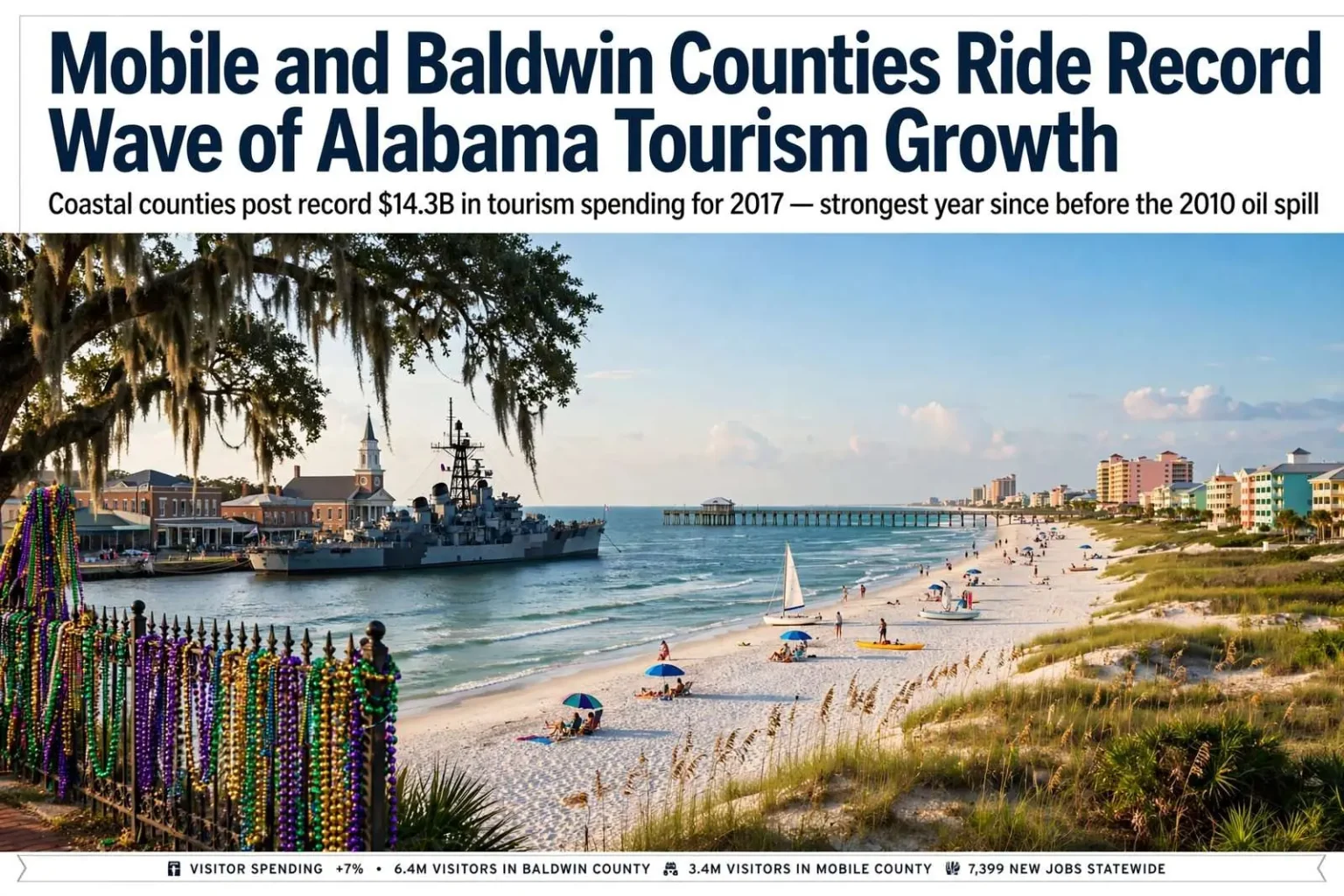
Alabama’s tourism industry posted its strongest year since before the 2010 Deepwater Horizon oil spill in 2017, and South Alabama’s coastal counties were at the center of the surge, according to figures released by the governor’s office.
Statewide, visitor spending climbed to a record $14.3 billion for the year, a 7 percent increase over 2016 that added roughly $1 billion in new economic activity and created an estimated 7,399 additional jobs in an industry that now employs more than 180,000 people across Alabama.
The scale of those numbers is best understood against the industry’s recent history. The 2010 oil spill draped tar balls on the same beaches that anchor the state’s tourism economy and forced summer cancellations across the coast, costing the industry hundreds of millions in a single season. The recovery that followed — assisted by BP-funded marketing campaigns that advertised Gulf State Park, Gulf Shores and Orange Beach to audiences across the Southeast — took years to complete, which is why 2017’s record carried symbolic weight beyond the dollar figures: the coast was not merely back, it was bigger than it had ever been.
Mobile County saw tourism activity grow by about 8 percent, with an additional 178,770 visitors pushing the county’s total to 3.4 million guests who spent a combined $1.2 billion during the year. That total ranked fourth among Alabama counties for tourism revenue, trailing only Baldwin, Jefferson and Madison counties.
Finishing fourth in the state — ahead of every county but the three that contain the beaches, Birmingham and Huntsville — reflects Mobile’s growing success at selling itself as a destination rather than a pass-through. The city’s tourism pitch has long rested on assets no other Alabama county can claim: the historic heart of America’s original Mardi Gras, the USS Alabama Battleship Memorial Park, a walkable downtown historic district, and a working port whose cruise terminal brings ships and their passengers directly downtown.
Mardi Gras alone moves the county’s numbers every winter. The Mobile celebration predates New Orleans’ by years, runs for weeks before Lent, and fills downtown hotels and restaurants during a season when beach traffic is at its thinnest — the mirror image of Baldwin County’s summer-concentrated calendar. That seasonal complementarity is one of the quieter strengths of South Alabama’s tourism economy: the two counties sell their peak seasons at opposite ends of the year, keeping hospitality employment and revenue in the region more stable than either county’s calendar alone would allow.
Baldwin County’s beach economy
Baldwin County, home to the beach communities of Gulf Shores and Orange Beach, recorded some of the highest tourism figures in the state. An estimated 6.4 million visitors spent roughly $4.4 billion in the county over the course of the year, cementing its status as one of the top tourism draws on the Gulf Coast.
The county’s 6.4 million visitors dwarf its year-round population of just over 200,000, and the imbalance defines life along the coast. Beach towns that hold a few thousand permanent residents swell by tens of thousands on a summer weekend, and the season’s rental revenue, restaurant sales and lodging taxes finance municipal budgets for the entire year. State park expansion on the Gulf — acres of protected dunes and beachfront added through post-spill restoration funding — has broadened the county’s appeal beyond the condo-and-gulf model toward eco-tourism that draws visitors in the shoulder seasons as well.
State officials credited a mix of factors for the gains, from beach vacations and annual traditions like Mobile’s Mardi Gras celebrations to a growing calendar of meetings, conventions, museum visits and youth sports tournaments. Communities that have invested in sports venues, in particular, were singled out as a driver of new visitor spending.
Youth sports has become the quiet workhorse of Southern tourism economics, and Mobile’s experience illustrates why. A traveling baseball or soccer tournament brings not just players but families — parents, siblings, grandparents — who fill hotels on weekends that business travel never touches, eat every meal locally, and stay in town from Friday arrival to Sunday bracket completion. Cities that build tournament-grade complexes effectively manufacture hotel demand, and hotel occupancy is the metric every tourism economy is measured by.
The convention and meetings segment works the same way on weekdays. Business travelers arrive when leisure travelers are absent, and every conference booked into a downtown venue translates into midweek occupancy that keeps hotels staffed year-round. Museums and cultural attractions — the history museums, the art museum, the historic districts — feed the same calendar, giving convention planners a package of activities that competes with larger Southern cities. The 8 percent growth Mobile County recorded sits on top of all three segments at once: leisure, meetings and sports.
Mobile County Commission President Connie Hudson said the connection between sports facilities and tourism dollars is something local leaders have emphasized for years as they’ve pushed for investment in athletic complexes and event spaces designed to draw traveling teams and their families.
What the tax figures show
The tourism totals were compiled by Montgomery economist Keivan Deravi, whose analysis found the hospitality industry generated $627.5 million in state tax collections and another $251.6 million in local tax revenue in 2017, for a combined $879 million in public revenue tied to travel spending. An estimated $70 million of that came from state lodging taxes, three-quarters of which flows into Alabama’s General Fund.
Lodging taxes are the fiscal engine hiding inside those totals. Every hotel night on the coast and in Mobile collects a stack of state and local taxes, and because visitors pay them without demanding services in return — they do not send children to local schools or require county services year-round — tourism revenue functions as a net export of tax dollars into public coffers. The General Fund’s three-quarters share of state lodging tax revenue means beach traffic in Baldwin County directly underwrites state services from Medicaid to public safety.
Local governments along the coast have learned to build on that base. Lodging tax proceeds fund beach renourishment projects that protect the very asset the taxes depend on, marketing campaigns that keep the county’s name in front of prospective travelers, and sports and events staff who recruit tournaments and festivals. Each dollar spent on those functions is judged by how many visitor dollars it returns — a feedback loop that has made Baldwin County’s municipal budgets among the most tourism-dependent in Alabama and its officials among the industry’s most attentive watchdogs in Montgomery.
Deravi’s report also estimated that, without the tax revenue generated by tourism, the average Alabama household would have needed to pay an additional $467 in taxes to maintain the state’s current level of government services.
That per-household figure is the argument tourism officials make in Montgomery every budget season. An industry this large is not a luxury for coastal counties; it is a substitute for taxes every family in the state would otherwise pay. The $467 number translates the abstractions of economic impact studies into the one measure taxpayers grasp immediately, and it grows with every record year the industry posts.
The jobs side of the ledger matters just as much in the counties themselves. Hospitality work — hotels, restaurants, attractions, charter boats, rental management — is often a family’s first rung on the employment ladder and a mainstay for students, seasonal workers and retirees. An industry adding thousands of positions a year changes the labor picture in communities where year-round career work has historically been scarce, and each record season makes the case for hospitality training programs at the region’s schools and community colleges a little stronger.
Alabama’s tourism director called 2017 a landmark year for the industry, noting that the state welcomed more visitors than at any other point in its history and that visitor spending alone added a billion dollars to the economy compared with the year before.
The billion-dollar one-year gain is remarkable even by the standards of a growing industry, and it reflects multiple tailwinds converging: a national economy adding jobs and travel budgets, a coast fully recovered from the spill and its aftermath, expanded marketing, and destination investments — sports complexes, convention space, attractions — that gave travelers new reasons to come. None of those factors existed in the years immediately after 2010, when the industry was fighting for its survival rather than its records.
For Mobile and Baldwin counties, the numbers underscore the growing economic weight that beaches, festivals and sports tourism carry along the central Gulf Coast, an industry that local officials say will likely continue to shape investment decisions in the years ahead.
The officials’ caution about the future is well placed — hurricanes, oil spills and recessions have each interrupted this industry before — but the 2017 figures establish the baseline. Tourism along the central Gulf Coast now ranks among the state’s core industries, employing tens of thousands and feeding both municipal budgets and the state’s General Fund. Every future decision about beach nourishment, convention centers, sports complexes and park expansion will be weighed against the standard this record year set.