Bebo’s Teams Up With Red Cross for Blood Drives Across Mobile and Baldwin Counties
Popular Mobile taco spot Bebo's is backing American Red Cross blood drives in Mobile and Baldwin counties as pandemic-era donations lag.
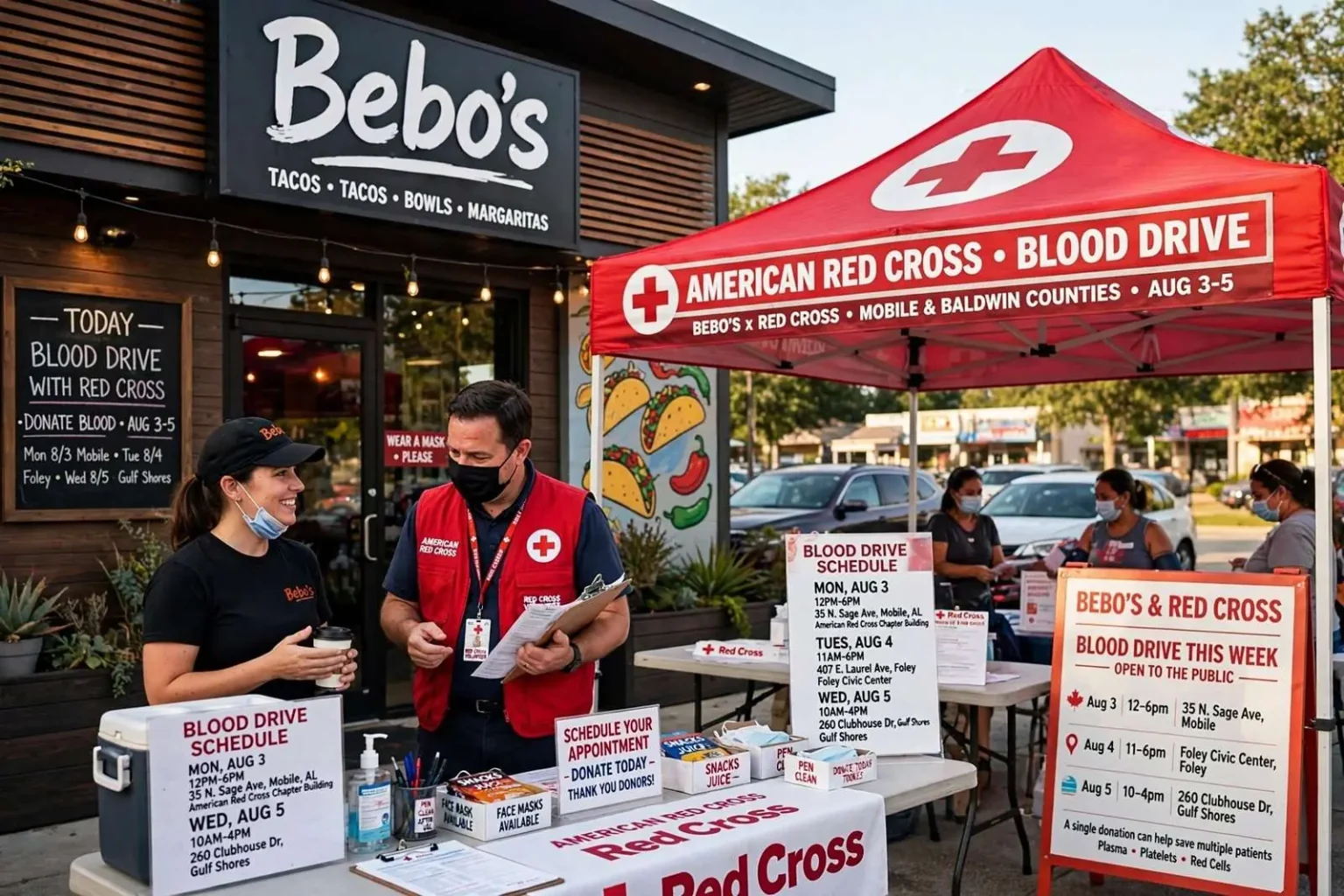
MOBILE, Ala. — Bebo’s, the well-known local taco restaurant with a devoted following in Midtown Mobile, is putting its weight behind a different kind of cause this summer: restocking the region’s blood supply.
The restaurant is sponsoring a series of American Red Cross blood drives across Mobile and Baldwin counties in early August 2020, part of an effort to keep donations flowing at a time when the coronavirus pandemic has disrupted the usual rhythm of community giving. School gyms, office lobbies and church halls — the routine settings for blood collection — have been unavailable or underused through the pandemic, leaving collection agencies looking for new partners willing to open their doors and their parking lots.
For a restaurant whose brand is built on neighborhood loyalty, lending its name to a blood drive serves both missions at once: it gives the Red Cross access to donors who trust a familiar local business, and it gives Bebo’s customers a reason to come out during a summer when many of the usual community gatherings had disappeared.
Where and when to donate
Three drives are on the calendar across the first week of August, spanning both sides of Mobile Bay:
Monday, Aug. 3 — noon to 6 p.m., American Red Cross chapter building, 35 N. Sage Ave., Mobile. Tuesday, Aug. 4 — 11 a.m. to 6 p.m., Foley Civic Center, 407 E. Laurel Ave., Foley. Wednesday, Aug. 5 — 10 a.m. to 4 p.m., 260 Clubhouse Drive, Gulf Shores.
The schedule spreads the drives across three consecutive days and three different communities, so donors in Midtown Mobile, south Baldwin County and the beach communities each have a nearby option. The Foley Civic Center has long served as a civic gathering point for Baldwin County, and the Gulf Shores location extends the reach to the state’s coastal tip, where a seasonal population swells the potential donor pool.
Donors are encouraged to schedule appointments ahead of time, a practice that became essential during the pandemic to manage spacing between donors and keep collection sites operating smoothly. Anyone feeling ill or having recently traveled to a high-risk area is asked to postpone donating, part of the screening measures in place at blood drives throughout the pandemic.
A critical time for the blood supply
The summer of 2020 has been a difficult stretch for blood collection nationwide. Widespread cancellations of workplace drives, school events and other group gatherings left the Red Cross and other collection agencies scrambling to maintain supply levels through the pandemic. Blood does not pause for a public health crisis — trauma cases, surgeries, cancer treatments and chronic conditions all continue to require transfusions regardless of what is happening in the wider world.
Local businesses stepping in to host and sponsor drives has become one of the main ways communities are filling the gap. When schools and large employers — historically the backbone of blood collection — cannot host, smaller venues step in, and sponsors with strong local followings help draw donors who might otherwise assume the drives have all been canceled. Every collection site that operates safely during the pandemic represents a small victory in keeping hospital shelves stocked.
The Red Cross reports that a single donation can help save more than one patient, since donated blood is separated into red cells, plasma and platelets for hospital use across the Gulf Coast region. That separation is why donors are needed continuously rather than occasionally: each component has a different shelf life, and hospitals draw on all three every day for patients ranging from accident victims to newborns.
What donors should know before giving
Blood donation is a straightforward process, but the pandemic version comes with added precautions. Donors arrive by appointment, wear face coverings, and are checked over before giving — a temperature check, a brief health history and a hemoglobin screening — to protect both the donor and the collection staff. The donation itself takes roughly eight to ten minutes, with the entire visit usually finished in under an hour.
Eligibility basics remain the same as in normal times: donors generally need to be in good health, meet minimum age and weight requirements, and be feeling well on the day they give. The Red Cross asks anyone who is sick to stay home and reschedule, which is why the appeal for appointments matters — a predictable schedule lets staff plan for the donors who will actually appear rather than the ones who might.
After donating, staff recommend a short rest, fluids and a snack, and most donors are back to their normal routine the same day. For first-time donors, the August drives offer a low-pressure introduction: the familiar restaurant sponsorship and community settings tend to ease the nerves that keep many willing people from ever making a first appointment.
Why Gulf Coast hospitals need the supply
The blood collected at a drive in Mobile or Foley does not travel far before it is needed. Hospitals across the Gulf Coast region draw on regional blood supplies for emergency rooms, surgical suites and ongoing treatment programs, and the summer months historically strain the system even in normal years — vacations thin the ranks of regular donors while highway accidents and trauma admissions rise.
Add a pandemic on top of that seasonal pattern, and the shortfall becomes severe. Patients recovering from COVID-19, elective surgeries that were postponed and rescheduled, and the ordinary daily demand all compete for the same shelf-stable inventory. When collection agencies warn that the supply is at a critical point, it means hospital orders are being filled with less margin for error than anyone would like.
That is the backdrop against which Bebo’s sponsorship matters. A popular restaurant attaching its name and its customer base to a week of drives can move the needle locally — filling appointment slots that would otherwise go empty and introducing new donors to a habit the Red Cross hopes will continue long after the pandemic. For the patients on the receiving end, the arithmetic is simple: donations collected in Mobile and Baldwin County in early August become the transfusions that keep Gulf Coast hospitals supplied in the weeks that follow.
A local brand with a community record
Bebo’s has built its reputation as a Midtown Mobile gathering spot as much as a restaurant, and the blood-drive sponsorship extends a pattern of local businesses using their visibility for community benefit. In a summer when the hospitality industry itself was under strain from pandemic restrictions, a restaurant choosing to spend its promotional energy on the blood supply said something about priorities in the local business community.
The partnership also reflects how the Red Cross adapted its outreach during 2020. Rather than waiting for donors to come to traditional sites, the organization leaned on hosts who could guarantee safe spaces and promote the drives through their own channels — social media followings, storefront signage and the everyday conversations of a loyal customer base.
For residents of Mobile and Baldwin counties, the takeaway is practical: three chances in three days to give, in three convenient locations, with appointments recommended and sick donors asked to postpone. A single donation may take less than an hour, but separated into its red cells, plasma and platelets, it can reach more than one patient somewhere on the Gulf Coast — the kind of return on an hour that few community efforts can match.
How the pandemic changed blood collection
Before the coronavirus arrived, the Red Cross and other collectors relied on a dependable rhythm: corporate office parks hosted quarterly drives, high schools and colleges ran student donation days, and churches and civic clubs filled the gaps. That rhythm broke almost completely in the spring of 2020, when offices emptied, schools closed and gatherings were canceled across the country. Collectors reported tens of thousands of unanswered appointments nationwide, and blood banks entered the summer with inventories well below the levels considered safe.
The response required reinventing the drive itself. Temperature checks at the door, spaced donation beds, sanitized surfaces between donors and appointment-only scheduling became standard at every collection site. Smaller venues — restaurants, shops, community centers — proved easier to manage safely than the big institutional drives they replaced, because staff could control the flow of donors in and out of the room.
Sponsors like Bebo’s fit that new model precisely. A restaurant already practiced at managing foot traffic and food-safety protocols could host a drive with minimal adjustment, and its name recognition did the advertising work that a generic community drive would struggle to match. In place of a school gymnasium full of student donors, the summer of 2020 called for parking-lot setups and storefront partnerships — and for donors willing to come out even when the usual social incentives had vanished.
The component math behind “one donation, multiple patients”
The claim that a single donation can save more than one patient comes down to how modern blood banking works. A whole-blood donation is almost never transfused as whole blood. Instead, it is spun in a centrifuge and separated into red cells, plasma and platelets, each with a distinct medical use: red cells carry oxygen for trauma and surgery patients, plasma provides clotting factors for burn and liver patients, and platelets are essential for cancer patients whose treatments deplete their own supply.
Each component also has a different shelf life, which shapes the constant need for donors. Red cells can be refrigerated for weeks, platelets last only days, and plasma can be frozen for months but is drawn down steadily by hospital demand. A region’s supply is only as strong as its most recent week of collection, which is why agencies describe blood donation as an ongoing civic habit rather than a one-time act.
Across the Gulf Coast, hospitals draw on that regional pool every day — the trauma centers of Mobile, the surgical programs of Baldwin County and the coastal hospitals serving a summer tourist population all depend on collections gathered from donors in their own communities. When donations fall short locally, hospital systems must look farther afield, adding cost and delay to care that often cannot wait.
The week ahead
With the three drives set for Aug. 3 in Mobile, Aug. 4 in Foley and Aug. 5 in Gulf Shores, the organizers’ goal is simple: full appointment books at each site. Donors who cannot make one day have two more chances within the week, and the geographic spread means few residents of the two counties are more than a short drive from a collection site.
The Red Cross guidance bears repeating for anyone planning to attend: schedule ahead of time, wear a face covering, and postpone if you are feeling ill or have recently traveled to a high-risk area. Those rules keep the drives safe and keep them open — a single collection site that has to pause operations sets back the supply it was created to build.
For Bebo’s, the sponsorship closes the loop between a business and the community that sustains it. For donors, it is a chance to turn an hour in early August into transfusions for patients they will never meet, in hospitals scattered across the Gulf Coast — a quiet transaction whose value accumulates one pint, one component and one patient at a time.