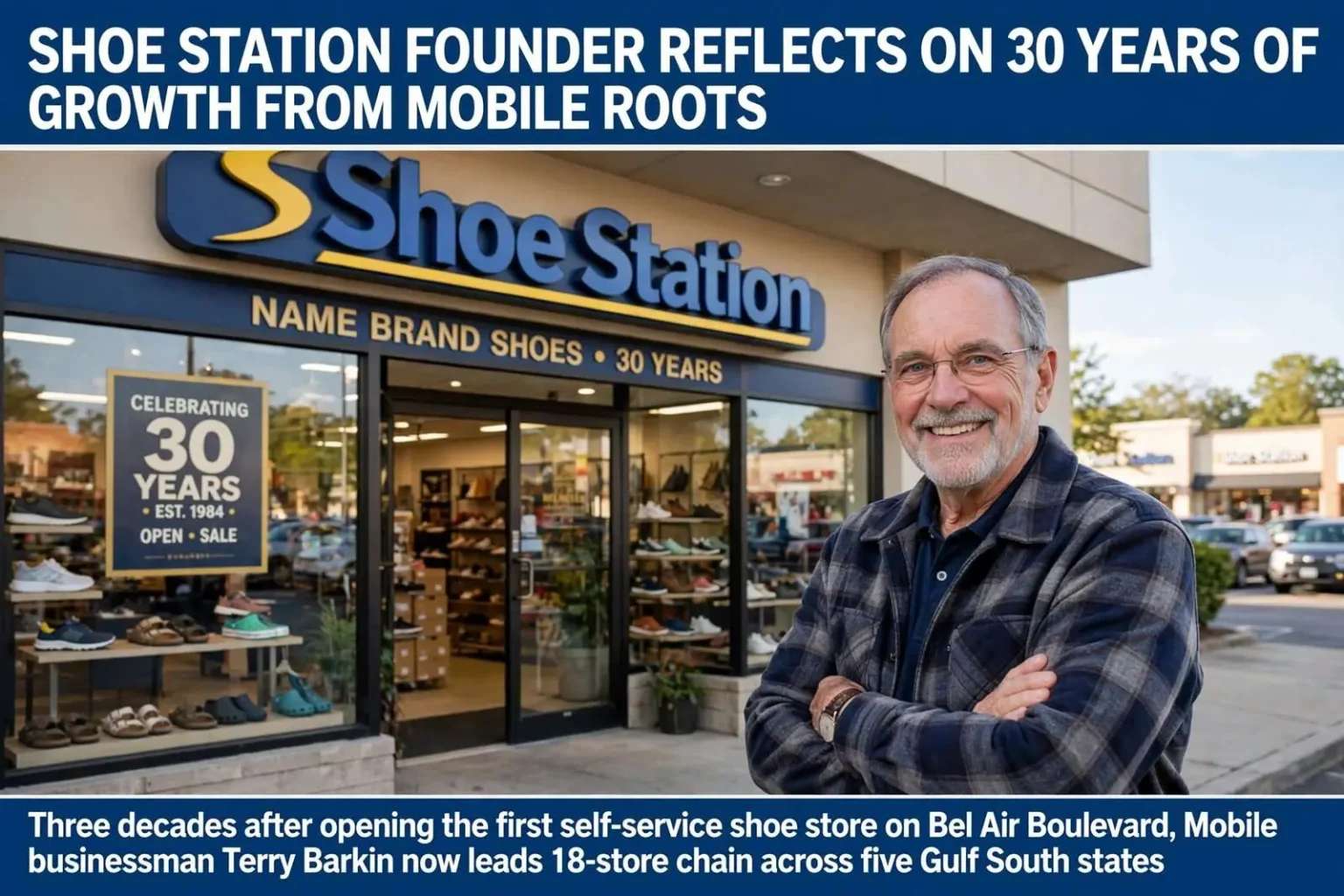
Three decades after opening a single self-service shoe store on Bel Air Boulevard, Mobile businessman Terry Barkin has grown Shoe Station into an 18-store chain spanning five Gulf South states, and he says the company’s roots in the Port City remain central to its identity.
Barkin spent 22 years at the Atlanta-based Rich’s department store chain before deciding to strike out on his own in the mid-1980s. After Rich’s was acquired by Federated Department Stores in 1979, he rose to senior vice president overseeing a third of the company’s total sales volume, but eventually concluded there was no further room to advance. Rather than take a job with another retailer, he chose to build something of his own, drawing on 15 years of experience merchandising footwear.
His concept was simple but distinctive for the era: an open-shelf store where customers could browse name-brand shoes displayed directly on the sales floor, with minimal staff overhead keeping prices competitive. After scouting locations across the Southeast, Barkin settled on a vacant building near Bel Air Mall that had previously housed a tire and battery center. The first Shoe Station opened there on October 1, 1984.
The Mobile store’s early success allowed Barkin to expand quickly, opening in Pensacola in 1986 and Biloxi the following year. Today Shoe Station operates in Alabama, Florida, Georgia, Mississippi and Louisiana, employing roughly 450 workers between full- and part-time staff. Two of Barkin’s sons are now part of the leadership team: Brent Barkin serves as vice president, and Jordan Barkin has been helping open a new store location on U.S. 59 in Foley, expected to open in early 2015.
Mobile remains home to three Shoe Station locations, including the original site and a Hillcrest Road store that Barkin said has become the chain’s top seller. A store on the Eastern Shore is slated to double in size by spring 2015 to match the footprint of the company’s west Mobile location. Barkin credited the Port City with the company’s overall trajectory, saying the strength of the original store gave him the confidence to expand into neighboring markets.
The company relocated its headquarters about seven years ago from the original Bel Air Boulevard building to an office park off Cottage Hill Road, a move Barkin said was necessary to accommodate a growing buying and merchandising staff. Shoe Station now carries more than 100 brands, including Crocs, Dansko, Birkenstock and Chaco, and Barkin said the company remains one of the largest independent Crocs retailers in the country.
Looking ahead, Barkin said Shoe Station plans to add about 40,000 square feet of retail space over the next 15 months, including a location in Madison, Mississippi, set to open in 2016. He said the company typically targets mid-sized metro areas where one or two stores can serve the entire local market, and that despite decades of growth, he still believes in investing in physical storefronts even as online shopping expands.
Barkin, who has spent more than 50 years in the retail industry, said staying nimble has been essential to the company’s survival. “We make decisions very quickly, right or wrong,” he said, adding that increased competition from big-box and specialty retailers has made growth harder to come by than it was when he first opened the Bel Air Boulevard store three decades ago.
Mobile is the county seat of Mobile County in southwest Alabama and the state’s only saltwater port. Situated where the Mobile River meets Mobile Bay near the northern Gulf of Mexico, the city has long served as a commercial and cultural gateway between Alabama and the wider Gulf Coast. Founded in 1702 as Fort Louis de la Louisiane and ruled in turn by France, Britain, and Spain before joining the United States in 1813, Mobile carries a layered heritage distinct from the rest of the state.
Today Mobile anchors a metropolitan area spanning Mobile County and neighboring Baldwin County, and it remains a center for shipping, aerospace, healthcare, and higher education in the region. Its downtown and waterfront have seen sustained revitalization, while historic neighborhoods preserve architecture from its colonial and antebellum past. The city’s identity is shaped as much by its working port and industrial base as by its festivals and food culture, making it a frequent focal point for news about growth and change in southern Alabama.
Baldwin County sits directly east of Mobile County across Mobile Bay and is the largest county in Alabama by land area. It encompasses the Eastern Shore communities of Daphne, Fairhope, Spanish Fort, and Foley and stretches south to the beaches of Gulf Shores and Orange Beach along the Gulf of Mexico.
Long among the fastest-growing counties in the state, Baldwin blends suburban development near the bay with tourism-driven coastal economies. Its proximity to Mobile and its position on the Eastern Shore make it a recurring subject of regional news covering growth, infrastructure, schools, and the balance between development and coastal preservation.
The Gulf of Mexico borders Alabama’s southern edge and defines much of the state’s coastal identity. Alabama’s Gulf coastline, centered on Dauphin Island, Gulf Shores, and Orange Beach, supports a tourism industry built around beaches, charter fishing, and marine recreation, while offshore waters host shipping lanes and energy interests.
The Gulf’s warm, shallow shelf and exposure to hurricanes make weather and disaster preparedness recurring concerns for communities from Mobile to Baldwin County. The marine environment also underpins commercial seafood harvests that have sustained Gulf Coast families for generations, tying the region’s economy and culture closely to the water.
Alabama is a state in the southeastern United States bordered by Tennessee, Georgia, Florida, the Gulf of Mexico, and Mississippi. Often called the Heart of Dixie, it spans Appalachian foothills in the north and flat coastal plains in the south. Its largest cities include Birmingham, Montgomery, Huntsville, and Mobile.
Alabama’s history encompasses Indigenous roots, Spanish and French colonial settlement, a cotton-plantation economy, the Civil War and Reconstruction, and the Civil Rights Movement of the 1950s and 1960s, followed by a shift toward manufacturing, aerospace, and technology. Local news across the state frequently reflects this mix of tradition and change.
The economy of the Mobile region is diversified across shipping and logistics, aerospace and shipbuilding, healthcare, tourism, and manufacturing. The Port of Mobile is one of the nation’s busiest seaports and a cornerstone of the local and state economy.
Major employers in aviation and defense contribute to a skilled workforce, while economic-development organizations aim to attract investment and jobs through incentives and infrastructure improvements. Small businesses, from restaurants to professional services, form the backbone of neighborhood commerce.
The health of the regional economy is a frequent subject of public discussion and reporting. Workforce development, recruitment of industry, and the fortunes of local retailers all feed into a broader picture of how the Gulf Coast competes and adapts in a changing national economy.
Collegiate athletics are a major part of life in southern Alabama, where the University of South Alabama in Mobile fields the Jaguars across a range of sports. The university’s football program, which began competition in the 2000s, has become a rallying point for students, alumni, and residents and a source of regional pride.
Beyond the campus, youth, high-school, and recreational leagues across Mobile and Baldwin counties sustain a deep local sports culture, and tailgating and game-day traditions reflect the social fabric of the community. Coverage of local teams regularly intersects with broader themes of economic impact, community engagement, and the role of athletics in mid-sized Southern cities.
Sports also serve as a lens on community investment. Stadium construction, scheduling, and the success of local programs ripple into nearby businesses and neighborhoods, making them a recurring and widely followed subject in regional reporting.
Mobile Bay is a shallow estuary in southern Alabama where freshwater from the Mobile, Tensaw, and other rivers mixes with saltwater from the Gulf of Mexico. It is among the largest estuarine systems in the United States and supports commercial and recreational fishing, shipping through the Port of Mobile, and wetlands that buffer the coastline from storms.
The bay’s Eastern Shore, in Baldwin County, includes Daphne, Fairhope, and Spanish Fort, while the Western Shore lies in Mobile County. Its ecology and economy have guided settlement for centuries, and the bay figures in regional debates over development, navigation, and conservation. Events on either shore are routinely covered as part of the interconnected life of the Mobile metro area.
The Federal Bureau of Investigation is the principal investigative arm of the United States Department of Justice, tasked with protecting the country against terrorist threats, foreign intelligence operations, cyber attacks, and major criminal activity. Established in 1908, the bureau operates a network of field offices across the country, each responsible for federal law-enforcement matters within its region.
Field offices such as the one serving Mobile work closely with state and local agencies, reflecting the bureau’s reliance on partnerships rather than unilateral action. The director, appointed by the president and confirmed by the Senate, sets national priorities that cascade down to individual offices handling everything from counterterrorism to public-corruption and civil-rights investigations.