Foley City Council Eyes Airport Terminal Grant and Airfield Upgrades at Work Session
Foley is positioning its municipal airport for growth, with the City Council reviewing a grant application for a new terminal building alongside FAA-funded airfield drainage upgrades.
Foley is positioning its municipal airport for growth, with city leaders preparing to advance plans for a new terminal building as part of a broader package of transit, drainage and community infrastructure projects. The City Council reviewed the proposals during a joint work session and regular meeting Monday, July 20, at 4 p.m. in the City Council Chambers, putting the airport at the center of an agenda that stretched from airfield drainage to neighborhood road resurfacing.
The centerpiece of the discussion was a resolution authorizing a grant application to the Alabama Department of Transportation Aeronautics Bureau. The funding would support construction of a modern, multi-use airport terminal building to replace the airport’s existing facilities. City officials have framed the project as a needed modernization for a facility that serves corporate, private and emergency aviation traffic in one of Baldwin County’s fastest-growing cities.
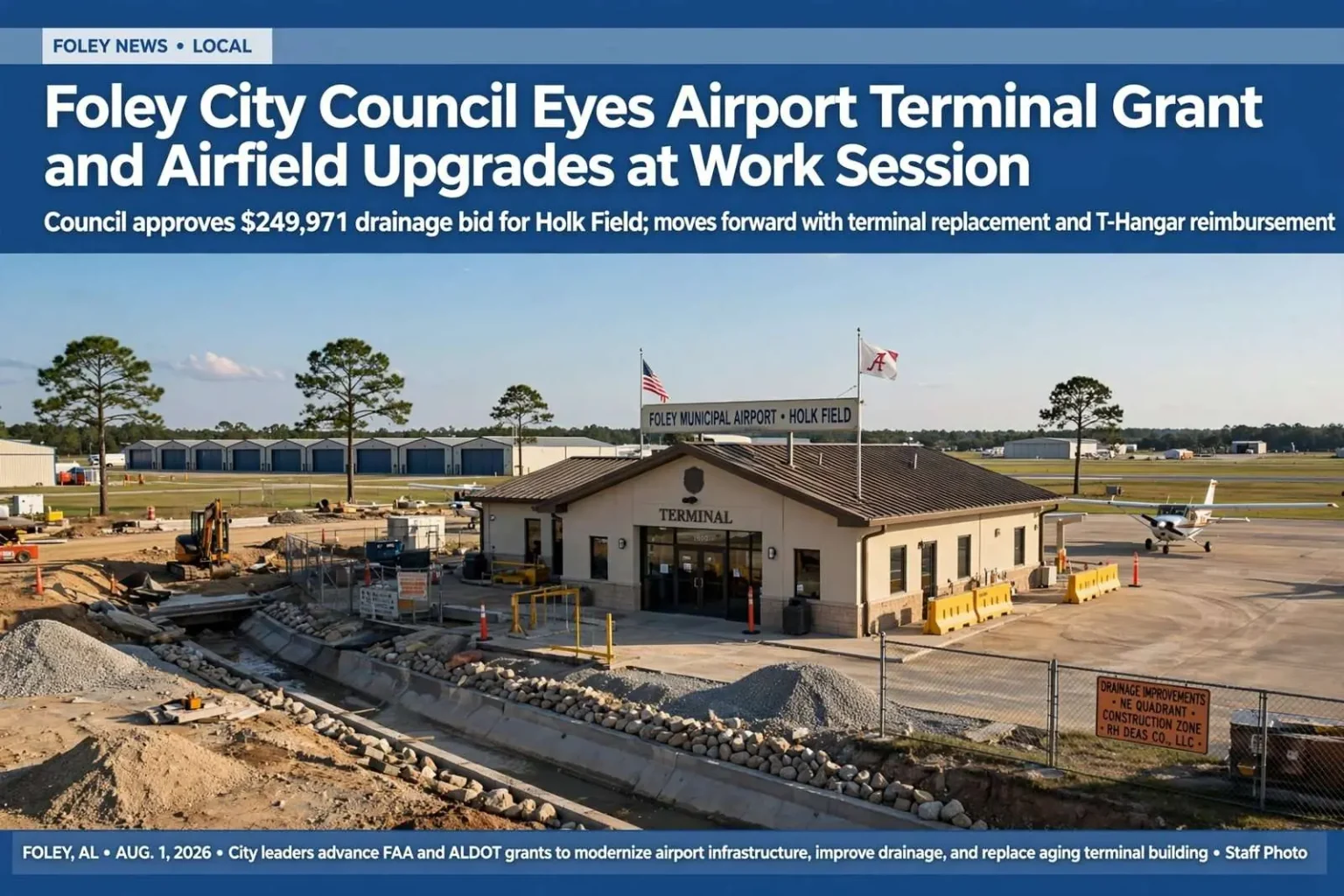
Alongside the terminal expansion, the city is upgrading its airfield infrastructure. Council members are set to accept formal grant offers from the Federal Aviation Administration and ALDOT to fund critical drainage improvements across the airfield, with local contractor RH Deas Co., LLC recommended for the drainage construction contract. The council also expects to close out a recently completed eight-unit T-Hangar project to secure final federal and state reimbursements for the hangar construction.
Together, the three airport items — terminal planning, drainage construction and hangar reimbursement — represent a sustained push to bring the airport up to the standards expected of a general aviation facility in a growing region. Grants from the FAA and the state have carried most of the cost of that work, with the city’s local match representing a fraction of total project spending, an arrangement Foley has relied on for years to stretch its capital budget.
Why the terminal matters
The airport’s existing terminal building has served the field for many years, and its replacement is pitched as a multi-use facility that can house the airport’s fixed-base operation while accommodating pilots, passengers and airport staff. For a city whose economy is increasingly tied to growth along the Foley corridor and traffic from the Gulf Coast’s tourism economy, the terminal is both a working building and a first impression for visitors arriving by air.
ALDOT’s Aeronautics Bureau administers state airport funding across Alabama, sharing costs with federal FAA programs and local governments. Grant applications like Foley’s are typically scored on safety, airport role and local contribution, and a multi-use terminal aligns with the state’s interest in keeping municipal airports functional and self-sustaining. The resolution approved for review would set that application in motion, beginning the state’s evaluation of the project.
Airport supporters argue the investment pays for itself in economic terms. Municipal airports support business aviation, medical and emergency flights, flight training and the contractors who keep them flying, and cities across Baldwin County have invested steadily in their fields as the region grows. Foley’s airport sits within a network of South Alabama general aviation facilities that together anchor a significant share of the county’s business travel.
Drainage work takes center stage
The airfield drainage improvements rank among the more technically significant items on the agenda. Standing water on runways and taxiways is a persistent hazard at Gulf Coast airports, where heavy seasonal rainfall can leave pavement edges saturated and sod weakened, and drainage failures can force closures or weight restrictions. Accepting the FAA and ALDOT grant offers allows the city to address the problem with federal and state money covering most of the cost.
RH Deas Co., LLC, the local contractor recommended for the drainage construction contract, has a long history of public-works work in the Foley area. The selection process paired the contractor with grant-funded work that must meet FAA construction standards, from grading tolerances to materials specifications, so that the improvements qualify for the federal and state reimbursement attached to them.
The T-Hangar closeout is the quieter administrative side of the same pipeline. The eight-unit hangar project, recently completed, must be formally closed out with grant documentation before the final federal and state reimbursements are released, returning money to the city’s accounts and freeing the airport to pursue its next round of projects. Hangar rentals also generate ongoing revenue that supports airport operations between grant cycles.
Beyond the airport: roads and pedestrians
Beyond the airport, Foley is leveraging state partnerships to improve its vehicle and pedestrian networks. The Street Department is seeking dedicated internal funding to begin in-house construction of the East/West Corridor, a project connecting Wilson Avenue and Equestrian Park Road that is meant to relieve traffic congestion. Building the corridor with city crews rather than outside contractors stretches the available budget further, a strategy Foley has used on other municipal projects.
Pedestrian safety is also getting a boost through the Highway Safety Improvement Program. The council reviewed additional funding for pedestrian improvements along Highway 98, which will bring enhanced crosswalks and safety infrastructure to intersections at Cedar Street, Oak Street, Pine Street, Chicago Street and the Rose Trail crosswalk. Highway 98 is Foley’s main commercial spine, and its intersections carry a dense mix of vehicle and foot traffic, particularly during the tourist season.
The HSIP program, administered through ALDOT, directs federal safety money to intersections and corridors with documented crash histories or risk factors. Crosswalk upgrades — signal timing, markings, lighting and signage — are among the most common uses of the funds, and their effect is measured in reduced pedestrian injuries along corridors like the one running through Foley’s downtown.
The rest of the agenda
The council’s agenda also included a range of other items: an appraisal proposal from Premier Appraisals for right-of-way acquisitions at West Michigan Avenue and South Cedar Street; authorization to solicit bids for the fiscal year 2026 neighborhood road resurfacing cycle; a resolution exercising the city’s option to repurchase undeveloped land in Zones 2, 3 and 4 from IRH Foley, LLC; reappointments of Billie Nardell to the Senior Center Advisory Board and JaNay Dawson to the Foley Historic Commission; a fee waiver for Beulah Heights Park to support a Back to School Community Kickoff and Fundraiser hosted by Alicia Watts; a liquor license review for Xian Noodle Place on South McKenzie Street; and the city’s annual insurance and stop-loss reinsurance contract renewals.
Each item represents routine municipal business, but together they sketch the shape of Foley’s growth management. Right-of-way appraisals and road resurfacing keep pace with new traffic, land repurchases preserve the city’s control over future development sites, and board reappointments keep volunteer advisory bodies staffed as the city’s workload expands. The insurance renewals, a fixed annual cost, reflect the rising replacement values of a city that has added facilities and vehicles steadily over the past decade.
The FAA and ALDOT grant structure underlying most of the airport work follows a familiar pattern for municipal fields: the federal government typically covers the largest share, the state adds a secondary portion, and the city funds the remainder, often with in-kind work or existing staff time. Grant closeouts like the hangar reimbursement formalize the accounting after construction ends, and disciplined closeout records are what keep an airport eligible for the next round of funding.
Update: council acts on airport plan
Update (Aug. 1, 2026): The Foley City Council has formally acted on the airport plans outlined above. Council members voted to accept a $249,971 low bid from RH Deas Co. to construct the drainage improvements at Holk Field, and approved FAA and ALDOT grants covering about 90% of that cost — $287,000 from the FAA and $7,553 from ALDOT. The work, in the airport’s northeast quadrant extending from Peachtree Avenue to the Magnolia River, will include regrading, concrete sidewalls at the Peachtree drainage outfall and rock reinforcement of channel sides.
Airport manager Rachel Keith said Public Works crews have already completed some drainage work, with more still needed. In separate votes, the council accepted additional FAA and ALDOT grants totaling more than $140,000 to provide final reimbursement for the eight-unit T-hangar built at the airport in 2024, and approved seeking grant funding to replace the airport’s aging terminal building.
Mayor Ralph Hellmich emphasized that the terminal project is not aimed at adding commercial airline service. “When we say terminal, this is not going to commercial service,” Hellmich said. “This is maintaining the current status. Our FBO is in a terminal that’s been there for a lot of years. We need this.”
The drainage bid acceptance also locks in a construction schedule, with the northeast quadrant work expected to proceed under the FAA grant timeline. Airfield projects of this kind are typically completed outside peak flying periods, and the city will coordinate closures with airport users as the regrading and channel reinforcement move forward.
With the drainage bid accepted, the grants secured and the hangar reimbursements finalized, Foley’s airport program moves from planning into construction. The terminal grant application remains the next milestone, and city officials expect it to advance through the state’s funding cycle as the drainage work gets underway on the airfield’s northeast side.