Prichard Council President Says Mayor Put Entire Police Department on Leave Without Telling Council
Prichard City Council President Traci Hale says she was not notified before Mayor Carletta Davis placed all members of the police department on 30 days of administrative leave.
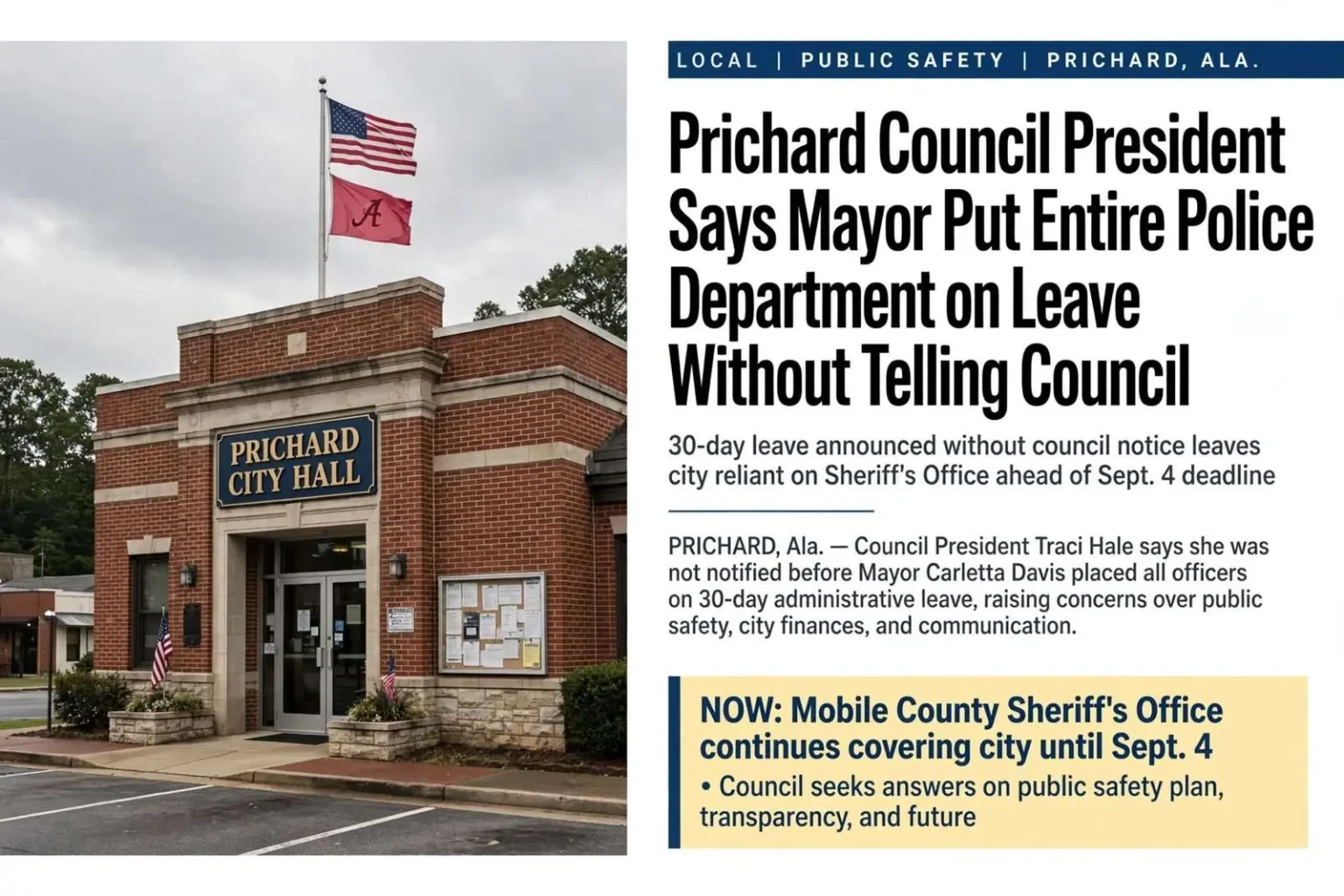
PRICHARD, Ala. — Prichard City Council President Traci Hale says Mayor Carletta Davis did not notify the council before placing every member of the city’s police department on administrative leave this week — a move that has sharpened tensions inside a city already scrambling over its public-safety future.
In a statement released Wednesday, Hale said she learned of the decision only after it had already been communicated to employees. She said the move raises serious questions about public safety, city finances and communication between the mayor’s administration and the council. Hale’s statement is the most pointed public criticism yet from the council side of a city government that has spent much of the year at odds with itself.
Council Response
“I recognize that the Mayor has certain administrative authority and responsibilities,” Hale said. “However, as Council President, I also have a responsibility to the citizens of Prichard, particularly when decisions of this magnitude may affect public safety, city finances, and the livelihood of our employees.”
Hale said the council and the public need answers about what the leave means for the affected officers — including their pay, benefits and future employment opportunities — as well as how police services will be maintained while they are off the job. Her statement also asked for clarity on how the leave was decided, who was consulted, and what the city’s long-term plan is for rebuilding the department.
Entire Department on 30 Days’ Leave
Sources confirmed Tuesday that Davis had placed the department’s remaining officers on 30 days of administrative leave, and Hale’s statement later confirmed that all members of the department were included in the action. The scope of the leave — every remaining officer — surprised council members, who said they had expected at most a partial staffing action.
Hale said the council and the public need answers about what the leave means for the affected officers — including their pay, benefits and future employment opportunities — as well as how police services will be maintained while they are off the job. Officers on administrative leave typically remain city employees but are barred from performing law-enforcement duties while reviews are underway.
Sheriff’s Office Still Covering the City
The timing is especially delicate. The Mobile County Sheriff’s Office is currently providing law-enforcement services in Prichard. Sheriff Paul Burch had planned to end that arrangement on Aug. 25 but pushed the deadline to Sept. 4 after Davis publicly said she was working on a plan to reduce some of the financial cost the Sheriff’s Office has been absorbing.
Burch said Tuesday he was not aware of the mayor’s decision before it was made. Later that night, he declined to comment on the action or whether it could affect his decision to pull Sheriff’s Office services out of the city in 10 days. The sheriff’s posture underscores how dependent Prichard has become on county-level resources during the standoff.
That leaves Prichard — one of Mobile County’s largest cities — facing the possibility of having no dedicated police coverage and no agreement in place with the county less than two weeks from now. For residents, that scenario would mean 911 calls routed to sheriff’s deputies who are already stretched thin across Mobile County.
‘Communication Must Be a Priority’
In her statement, Hale acknowledged the mayor does not need council permission to exercise the authority of her office, but argued that decisions affecting an entire department and the city’s residents should not come as a surprise to council members.
“Keeping one another informed is not about control; it is about respect, responsible government, and making sure we are all prepared to answer to the people who elected us,” Hale said.
Hale, who has lived in Prichard for nearly two decades, said she did not enter public service as a politician but as a mother and resident who wanted a safe, stable city for children, seniors and families. She said she still believes the relationship between the council and the administration can be repaired, but that it will require better communication, transparency and a willingness to work as a team.
“Right now, my two greatest concerns are the financial stability of the City of Prichard and the safety and well-being of our citizens, and those concerns must remain at the center of every decision we make,” she said.
What Happens Next
The mayor’s office has not publicly detailed the reasons for placing the department on leave or how long the arrangement will last. With the Sept. 4 deadline for the sheriff’s office to pull out now less than two weeks away, council members are expected to demand answers at the next regular council meeting and to push for a written timeline of how the city intends to staff public safety once the leave expires.
Hale’s statement signals that the council intends to keep pressing for transparency on the police situation, the city’s finances, and the mayor’s broader public-safety plan. Whether that pressure produces cooperation or a deeper standoff is the question that residents and city employees will be watching over the coming days.
Why This Moment Is Different
Previous flare-ups between the mayor and the council in Prichard have played out over budgets and contracts, but the police department decision is the first that directly affects every resident’s day-to-day safety. Hale’s statement reflects an effort by the council to put on the public record that it was not consulted before a decision of that magnitude, and to make clear that any further actions on the department should involve formal coordination with council members.
How Residents Have Responded
Residents who have spoken up at recent council meetings have generally asked for two things: a clear timeline for the police review, and a transparent process for how officers will be evaluated. Several have asked the council to schedule a town hall on the issue before the Sept. 4 deadline. Hale’s statement is likely to increase pressure on the mayor’s office to release more information in the coming days.
How the Standoff Could Be Resolved
Several council members have said they would support a written transition plan that includes the sheriff’s office, the consultant’s review, and a timeline for returning officers to duty. Hale’s statement is a public version of that request. Whether the mayor’s office produces such a plan before Sept. 4 will likely determine whether the city can secure continued sheriff coverage or face a coverage gap. Both sides have signaled they want to avoid that gap, but the details of any agreement are still being negotiated.
How the Communication Breakdown Could Heal
Council members have said they are open to sitting down with the mayor’s office to work through a shared public-safety plan before the Sept. 4 deadline. Hale has signaled she wants the meeting to happen in a formal setting with city attorneys present, so that any agreement is documented and enforceable. Whether the mayor agrees to that format is the next test of whether the relationship between the two branches of city government can be repaired in time to keep deputies on the streets of Prichard.
How the City Has Tried to Communicate Before
Past flare-ups between the mayor’s office and the council have generally been handled with closed-door meetings followed by joint statements. Hale’s decision to issue a public statement rather than continue those private conversations signals a more confrontational posture, and it puts the council’s concerns on the record in a way that private meetings cannot. Whether that shift produces a more durable outcome or simply deepens the standoff will depend in part on whether the public responds to the council’s call for transparency by showing up at upcoming meetings and weighing in.
How the Public Can Weigh In
Prichard residents who want to weigh in on the public-safety discussion can speak at the next regular council meeting, submit written comments to the clerk’s office, or attend committee meetings where the police review and the sheriff’s office funding are likely to be discussed. Council meetings are held at Prichard City Hall, and the clerk’s office posts agendas and minutes on the city’s website. Hale’s statement is likely to keep the issue in front of residents heading into the next several weeks of council work.
Why the Communication Issue Resonates
Residents who have watched the Prichard mayor-council dispute for months say the communication breakdown is what frustrates them most. Even when they disagree with one side or the other, residents say they want both branches of city government to talk to each other so that routine business does not stall. Hale’s statement is in part an effort to put that frustration on the record, and to push both sides toward the kind of cooperation that residents say they want to see as the city works through one of the more difficult chapters in its recent history.