Sexual Misconduct Allegations Trail Herman Thomas as He Heads Into Mobile City Council Runoff
Herman Thomas, a former Mobile County circuit judge who lost his law license amid abuse-of-power allegations, advanced to an October runoff for a Mobile City Council seat even as lawsuits from men who accused him of sexual coercion continue to surface.
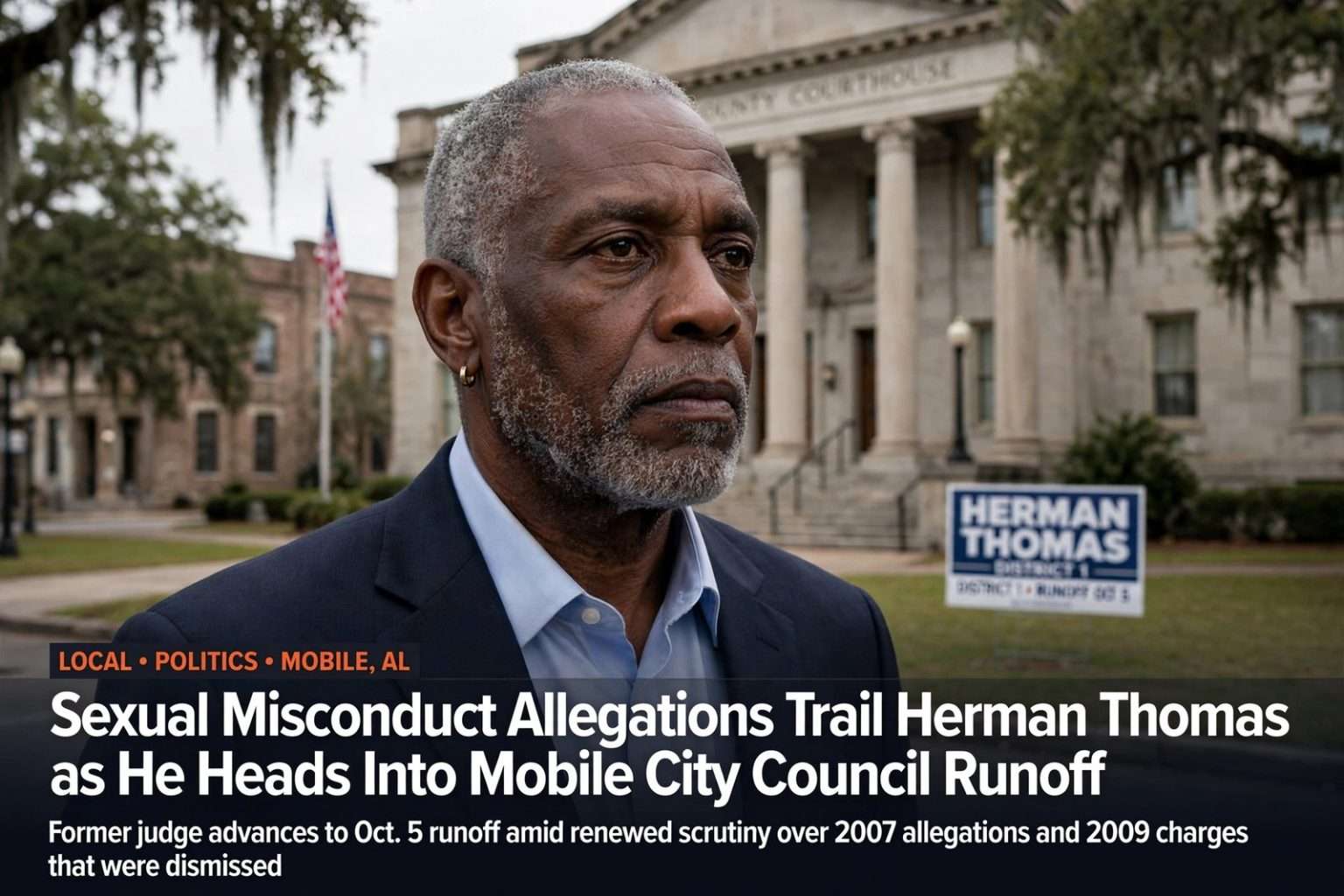
A former Mobile County circuit judge whose career was upended by allegations that he coerced sexual favors from young men under his authority has advanced to a runoff election for a seat on the Mobile City Council, reviving questions about a scandal that has followed him for two decades. Herman Thomas placed second in last week’s municipal election for the council’s District 1 seat, setting up an Oct. 5 runoff against Cory Penn, a political newcomer who led the field. A third candidate, Chamyne Fortune-Thomson, captured roughly 23 percent of the vote, a bloc large enough to tip the outcome toward either remaining candidate.
Thomas resigned from the bench in 2007 and was indicted nearly two years later on 180 criminal charges tied to allegations that he abused his authority as a judge. Prosecutors accused him of having sexual contact with inmates, paddling them in his chambers, and improperly pulling cases from other judges’ dockets so he could preside over them himself. The criminal case ended in 2009 when a jury deadlocked and the charges were dismissed. Even without a conviction, disciplinary authorities in both Alabama and Florida disbarred him, and his law license has remained suspended ever since.
The Original Allegations
The charges against Thomas stemmed from his tenure as a circuit judge in Mobile County, where he presided over criminal and civil cases from 1999 until his resignation. The indictment detailed a pattern of conduct involving young men, many of them defendants or probationers appearing before his court. Prosecutors alleged Thomas used his judicial authority to isolate these individuals, summoning them to his chambers under the guise of official business. The allegations included sexual contact, physical punishment with a wooden paddle, and manipulation of case assignments to maintain access to specific defendants.
The investigation began after a former inmate reported the conduct to the Mobile County District Attorney’s office. The Alabama Judicial Inquiry Commission, which investigates ethical complaints against judges, conducted a parallel inquiry. In 2007, facing mounting pressure, Thomas resigned his position. The 180-count indictment, returned by a Mobile County grand jury in 2009, represented one of the most extensive prosecutions of a sitting judge in Alabama history. The charges included sodomy, sexual abuse, assault, and ethics violations.
The 2009 Trial and Aftermath
The criminal trial, held in Mobile County Circuit Court, lasted several weeks and featured testimony from multiple alleged victims. The prosecution presented evidence of a systematic pattern of abuse enabled by Thomas’s position and the deference accorded to judges in the courtroom. The defense argued the encounters were consensual and that the accusers had motives to fabricate claims, including pending criminal cases and potential civil lawsuits. After days of deliberation, the jury reported it was hopelessly deadlocked. The judge declared a mistrial, and prosecutors declined to retry the case, dismissing all charges.
Despite the dismissal, the Alabama State Bar’s Disciplinary Board conducted its own proceeding. In 2010, the board found clear and convincing evidence of ethical violations and ordered Thomas disbarred. The Florida Bar followed with reciprocal discipline, barring him from practice in that state as well. The disciplinary findings, unlike the criminal case, required only a preponderance of evidence rather than proof beyond a reasonable doubt. Thomas’s law license remains suspended in both states, effectively ending his legal career.
Previous Political Comeback Attempts
The former judge has tried repeatedly to return to public life since leaving the bench. In 2010, he challenged incumbent state Sen. Vivian Figures for the Alabama Senate District 33 seat and lost badly. Figures had testified against Thomas during his criminal trial regarding corporal punishment her son received. The race drew national attention, with Figures emphasizing her legislative record and Thomas attempting to frame the campaign around his judicial experience and claims of vindication. Figures won with over 70 percent of the vote in the heavily Democratic district.
Thomas ran again in 2018 for the Alabama House District 99 seat but finished a distant second to Sam Jones in the Democratic primary. Jones, a former Mobile police officer and community organizer, consolidated support from the district’s political establishment and labor unions. Thomas’s campaign struggled to gain traction, with many local officials and community leaders declining to endorse him. The primary results suggested his base of support had eroded significantly since his judicial tenure.
District 1 Demographics and Politics
Mobile City Council District 1 encompasses the city’s historic core, including downtown, the waterfront, and several historic neighborhoods such as De Tonti Square, Oakleigh Garden District, and parts of Midtown. The district’s population is majority African American, with a significant white minority concentrated in the historic districts. The district has been represented by Fred Richardson since 1997, making him the council’s dean and a powerful voice in city politics. Richardson’s decision not to seek re-election in 2025 opened the seat for the first time in nearly three decades.
District 1’s political dynamics are shaped by its economic diversity. The district includes the Port of Alabama’s downtown terminals, the cruise terminal, the Mobile Convention Center, and the historic commercial corridors of Dauphin Street and Government Street. It also includes some of the city’s poorest census tracts, where poverty rates exceed 30 percent and infrastructure needs are acute. Candidates must balance the interests of downtown business owners, historic preservation advocates, and residents of underserved neighborhoods.
The 2025 Race and Runoff Dynamics
Outgoing District 1 Councilman Fred Richardson effectively endorsed Thomas last week, calling him a familiar leader likely to continue his work on the council. Richardson’s endorsement carries significant weight in the district, where his personal relationships and constituent service operation have built a loyal following over twenty-eight years. However, the endorsement also drew criticism from advocacy groups and some community leaders who argued that Thomas’s history disqualifies him from public office.
Cory Penn, the runoff leader, has declined to discuss the allegations against Thomas, saying he intends to run a positive campaign focused on infrastructure, public safety, and economic development. Penn, a political newcomer with a background in community development, finished first in the general election with approximately 38 percent of the vote. His campaign has emphasized his outsider status and his work with neighborhood associations on blight removal and youth programs. Fortune-Thomson, who captured roughly 23 percent, has not responded to requests for comment on whether she will endorse either candidate.
The runoff electorate will likely differ from the general election turnout. Municipal runoffs in Mobile typically draw 30-40 percent of the general election vote, with older voters and those with strong partisan or personal loyalties overrepresented. Thomas’s name recognition and Richardson’s organizational support give him a structural advantage in a low-turnout election. However, the allegations remain a potent issue for voters who prioritize character and accountability in public officials.
Legal and Ethical Questions
Thomas’s candidacy raises questions about Alabama’s framework for restoring rights to individuals who have faced serious allegations without criminal conviction. Alabama law does not bar individuals from holding municipal office based solely on disciplinary actions by the bar or dismissed criminal charges. The Alabama Constitution disqualifies officeholders convicted of felonies or certain misdemeanors involving moral turpitude, but Thomas was never convicted. The disbarment, while a severe professional sanction, does not carry the same legal disabilities as a criminal conviction.
Ethics experts note that voters serve as the ultimate check on candidate fitness in the absence of legal barriers. The Mobile City Council has no formal vetting process for candidates beyond verifying residency and age requirements. Some Alabama municipalities have adopted local ethics ordinances requiring financial disclosure and conflict-of-interest statements, but Mobile’s charter does not include character-based qualifications for council members beyond the state constitutional minimums.
The runoff campaign will test whether Mobile voters prioritize institutional experience and political continuity or a clean break from a controversial past. For District 1 residents, the choice carries implications beyond the council seat — the district’s next representative will help shape downtown development priorities, police department oversight, and the allocation of federal community development block grants that fund housing and infrastructure projects in the city’s oldest neighborhoods.
Community Perspectives and Historical Context
The Thomas case remains a reference point in Mobile’s legal and political circles for the challenges of holding powerful officials accountable. The Judicial Inquiry Commission, established in 1973 as part of post-Watergate reforms, gained expanded authority in the 1980s and 1990s, but the Thomas case exposed gaps in the system’s ability to act swiftly against a sitting judge. The commission’s proceedings are confidential until formal charges are filed, a protection designed to shield judges from frivolous complaints but one that can delay public awareness of serious allegations.
Mobile’s African American community, which constitutes a majority of District 1’s voters, has a complex history with the criminal justice system. The city’s first black municipal judge was appointed in 1977, and the first black circuit judge followed in 1985. Thomas, appointed by Governor Fob James in 1999, was among the few African American judges in the circuit at the time. His initial appointment was celebrated as progress, making the subsequent allegations particularly painful for community leaders who had advocated for judicial diversity.
Vivian Figures, the state senator who defeated Thomas in 2010, emerged as a leading legislative voice on criminal justice reform and victims’ rights. Her testimony against Thomas during his trial — regarding corporal punishment her son received while in his courtroom — was a rare instance of an elected official testifying against a sitting judge. Figures has since sponsored legislation extending statutes of limitations for sexual abuse victims and improving oversight of juvenile detention facilities, citing her family’s experience as motivation.
Looking Toward October
As the October 5 runoff approaches, both campaigns are mobilizing their ground operations. Thomas’s team is leveraging Richardson’s extensive voter contact database and the institutional knowledge of longtime precinct workers. Penn’s campaign has recruited volunteers from neighborhood associations and faith-based organizations that have not traditionally aligned with a single political faction. The Mobile County Democratic Party, which dominates local elections in the city, has not endorsed in the runoff, reflecting the division among party leaders.
Local media coverage has intensified, with WKRG, WPMI, and the Lagniappe publishing investigative pieces on both candidates’ backgrounds. The Mobile Press-Register, now published three days a week under the AL.com digital platform, has allocated reporting resources to the race. Social media discourse has been vigorous, with competing narratives about redemption, accountability, and the weight of past allegations versus present qualifications.
For Mobile’s civic institutions, the District 1 runoff represents a moment of reckoning. The city council, which operates under a mayor-council charter adopted in 1985, has seen its profile rise as Mobile pursues economic development projects including the Airbus assembly plant, the Austal USA shipbuilding expansion, and the revitalization of the waterfront district. The next District 1 councilmember will participate in decisions affecting billions in public and private investment, making the race consequential for the entire city, not just the district’s residents.