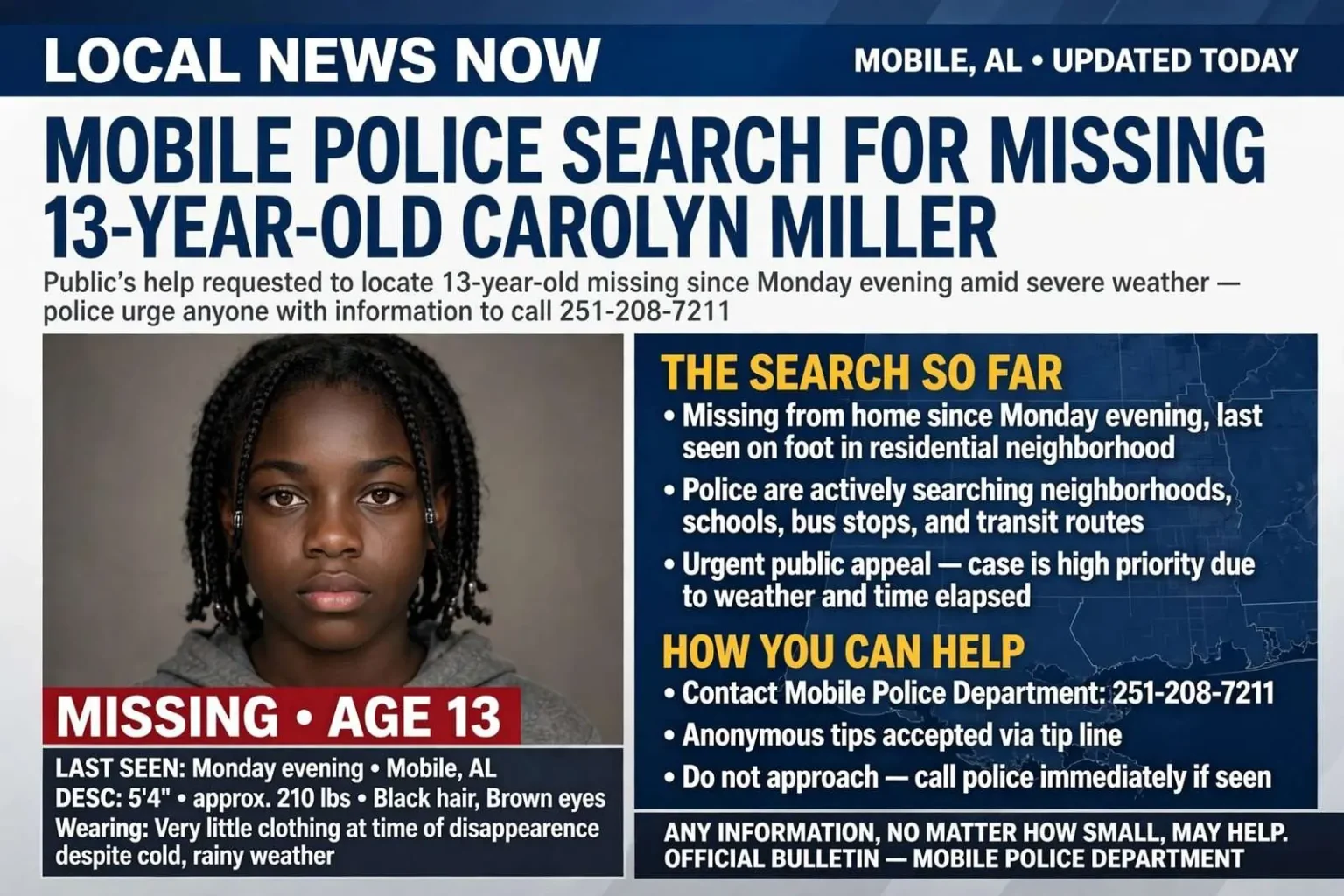
Mobile police are asking for the public’s help locating 13-year-old Carolyn LaShawn Miller, who has been missing from her home since Monday evening. Authorities said Miller left her residence wearing very little clothing despite inclement weather that evening and has not returned home. She is described as roughly 5-foot-4, weighing approximately 210 pounds, with brown eyes and black hair.
Police have not released further details about the circumstances surrounding her disappearance, but the combination of her age, the weather conditions at the time she left and the length of time she has been missing has prompted an active search and a public appeal for information. Detectives treat the passage of time in a missing-child case as a factor that raises urgency, not lowers it, because the longer a juvenile stays away from home the wider the area where she may have traveled and the more difficult witnesses become to find.
The Search So Far
Missing-persons cases involving minors are treated as high priority by Mobile police, who rely heavily on tips from neighbors, family friends and the general public to locate children quickly. In a city of roughly 187,000 people spread across a large footprint of neighborhoods from downtown and Midtown out to West Mobile, that kind of grassroots awareness is often what closes a case. Patrol officers, investigators and specialized units coordinate on juvenile cases, checking locations a child is known to frequent — schools, friends’ homes, bus stops, shopping areas and transit routes — while canvassing the area around the residence for anyone who may have seen her Monday evening or since.
The detail that Miller left home wearing very little clothing despite bad weather has added to the concern. In cases involving minors, officers weigh such circumstances carefully, because they can indicate a child who left in distress rather than a planned departure. The Mobile Police Department has asked residents to think back to the evening she disappeared and any days after, and to report anything out of the ordinary they may have noticed in their neighborhoods.
How Missing-Child Investigations Work
When a juvenile is reported missing in Mobile, the report is entered into state and national databases so that law enforcement agencies across the region and the country can flag any contact with the child. Information may also be shared with the National Center for Missing and Exploited Children, which assists departments with photo distribution, search support and case analysis. Depending on the circumstances, departments evaluate whether the case meets the criteria for an Amber Alert, which is reserved for abducted children in imminent danger and requires specific, confirmable details before it is activated.
Even when an Amber Alert is not issued, investigators typically move quickly on juvenile cases. Standard steps include interviewing family members and people close to the child, reviewing any available surveillance footage from homes and businesses along likely routes, checking social media activity, and following up on each tip as it arrives. Officers also encourage the family to keep the child’s photo and description circulating publicly, because tips frequently come from people who recognize a face rather than from exhaustive canvassing alone.
Why the Public’s Role Matters
Residents who may have seen Miller in the days since she went missing are encouraged to come forward, even with information that may seem minor. Investigators stress that fragmentary tips — a sighting at a convenience store, a group of kids on a corner, a figure walking along a busy road in bad weather — often only make sense when combined with other reports. A detail a witness considers insignificant can be the piece that tells detectives where to focus a search.
Residents can also help in ways that do not involve direct sightings. Sharing the department’s bulletin within neighborhood groups, checking yards, sheds, vehicles and other concealed spots on private property, and keeping an eye out during routine travel through the area are all practical steps. Mobile’s neighborhoods are close-knit, and in past cases local awareness — a neighbor recognizing a child, a store clerk remembering a face — has been decisive in bringing minors home.
Anyone with information about Miller’s whereabouts is asked to contact the Mobile Police Department at 251-208-7211. Callers who wish to remain anonymous can submit tips through the department’s tip lines and partner organizations that pass along information without revealing a caller’s identity. Authorities urge people not to attempt to approach or detain a missing child themselves but instead to report what they see so trained officers can respond.
The Broader Context of Missing-Child Cases on the Gulf Coast
Missing-child reports are an unfortunate recurring feature of life in any city the size of Mobile, and most juvenile cases resolve quickly when children turn up at a relative’s home or a friend’s house within hours or days. But the cases that do not resolve quickly demand sustained public attention. The Gulf Coast region’s geography — with interstate corridors, port activity and a steady flow of travelers — is one reason local departments emphasize speed and broad public awareness when a child is unaccounted for overnight.
Weather is another factor that adds urgency in this case. Anyone spending extended time outdoors in bad weather, particularly a child without adequate clothing, faces real risk of exposure and illness. That danger compounds with each day a child remains away from shelter, which is why police have made a point of publicizing the conditions under which she left home. Departments across Mobile County and the surrounding area routinely assist one another on such cases, and word of a missing child often spreads quickly to neighboring jurisdictions along the Eastern Shore and across the state line.
Regional cooperation is a practical reality of Gulf Coast law enforcement. Mobile County’s municipal departments, the Baldwin County Sheriff’s Office, and agencies across the state line in Mississippi and Florida exchange information on missing juveniles as a matter of routine, because children do not respect city limits and transportation along the interstate corridors is easy. That network works best when each agency’s public bulletins carry the same basic facts — the description, the date and time last seen, and the number to call — which is why departments ask the public to pass along the official version of a bulletin rather than a paraphrased one.
What Families and Neighbors Should Know
For families, the Mobile Police Department and child-safety organizations recommend reporting a missing child immediately rather than waiting a set period — the outdated idea that authorities require a 24-hour wait before accepting a report is a myth, and officers want the first hours of a search to be spent searching, not lost. A current photograph, an accurate description of clothing and a list of places the child goes are among the most useful things a family can provide, because they make bulletins and canvassing effective right away.
Schools also play a quiet but important role in cases like this one. Attendance records, bus drivers, coaches and school resource officers often hold practical knowledge about a child’s daily routine and social circle that can point investigators toward the people and places most likely to produce a lead. When school is in session, districts typically cooperate closely with police in missing-student cases, and staff who interact with students each day are often asked to stay alert for any sign of the child or word about her among classmates.
Social media has changed the dynamics of missing-child searches in recent years, and not always simply. Rapid sharing of a bulletin can produce sightings within hours, but it can also spread inaccurate descriptions or unconfirmed theories that distract investigators and, in the worst cases, direct grief toward the wrong households. Police in Mobile and nationally advise the public to share official bulletins rather than reworked versions, and to route any promising tip directly to investigators through the listed number so it enters the case file and gets checked.
For neighbors, the request in this case is straightforward: remember the description, think back over the days since Monday evening, and call in anything that might help. Miller is described as roughly 5-foot-4 and approximately 210 pounds, with brown eyes and black hair. Anyone who believes they have seen her, or who has information about where she might be, is urged to contact the Mobile Police Department at 251-208-7211 as soon as possible.
The department has not said whether it suspects foul play, whether the child may have left on her own, or whether she has any medical needs, and it has asked that speculation not replace verified information in the public conversation about the case. What officials have made clear is that the search remains active, that the case is a priority, and that the public’s eyes — in Mobile’s neighborhoods, along its bus routes and in its shops and gathering places — remain one of the most effective tools investigators have. As the days pass, police are counting on residents to keep paying attention and keep reporting what they see until Carolyn Miller is found and brought home.