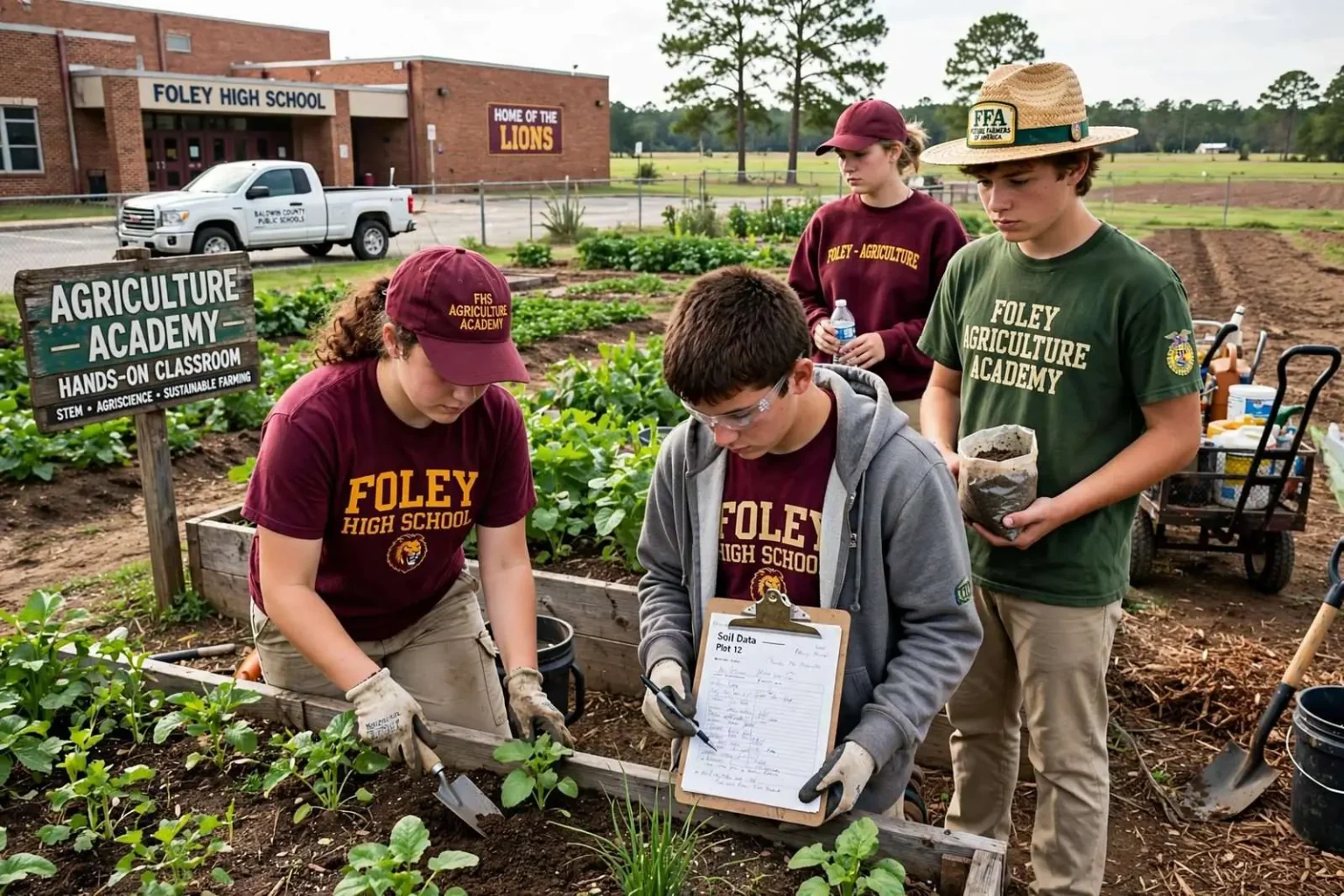
The Baldwin County school board is weighing a proposal to authorize negotiations for roughly 20 acres of land next to Foley High School, part of a plan to expand the school’s growing Agriculture Academy into a working outdoor classroom. Assistant Superintendent Russ Moore outlined the proposal for board members during a work session ahead of Thursday’s scheduled meeting. He said the parcel is attractive because it sits directly next to existing school property, and acquiring it would extend the district’s holdings all the way to Hickory Street. District staff have recommended a purchase price of no more than $300,000.
The land would become a hands-on farm site for students in Foley High’s Agriculture Academy, a STEM-focused program — covering science, technology, engineering and math — that currently enrolls more than 600 students under three teachers. Academy students have already begun developing roughly 20 acres of school-owned land, and the new parcel would roughly double that footprint, giving them room to apply classroom lessons to real agricultural work. The scale of enrollment relative to teaching staff makes the program one of the largest of its kind in south Alabama, and district officials have pointed to it as a model for how career and technical education can be woven into a comprehensive high school rather than housed at a separate technical center.
Why the Land Matters
Contiguity is the practical reason the parcel stands out. School farm programs depend on land that students can reach during the school day without transportation, and a tract adjoining the existing campus eliminates the busing, supervision and liability questions that come with off-site acreage. Extending district holdings to Hickory Street also simplifies long-term campus planning, giving Foley High a defined western boundary and room to grow as enrollment rises. At a recommended ceiling of $300,000 for roughly 20 acres, the price works out to no more than $15,000 per acre, a figure staff consider reasonable for land adjacent to an established school campus in one of the county’s fastest-growing corridors.
Any purchase, however, comes with a significant condition attached. Regardless of how the board votes on authorizing negotiations, the actual land buy depends on Baldwin County voters approving a proposed 8-mill property tax increase at a referendum scheduled for March 31. That structure allows the board to secure an option on the land and keep the project moving through the planning stages while protecting the district from committing funds it may not have. If the referendum fails, the purchase — and the expansion it enables — would not go forward.
A Campus Under Pressure
Foley High School is the largest high school in Baldwin County, with an enrollment of 1,819 students, and district officials say the campus has outgrown parts of its current footprint. Baldwin County as a whole is one of the fastest-growing school districts in Alabama, driven by the influx of families to the Gulf Shores, Orange Beach, Foley, Daphne and Fairhope areas, and the growth has been particularly intense in south Baldwin County where coastal development keeps adding rooftops. Managing that growth has dominated the board’s capital planning for years, and the March referendum is the centerpiece of the district’s answer.
If voters approve the tax increase in March, the agriculture land purchase would be just one piece of a broader package of construction projects planned for the Foley area. Those plans include an addition and renovation at Foley Intermediate School to accommodate grades K-6, an addition at Foley High School itself, a renovation of Elberta Middle School to reconfigure it as a 7-12 high school, an addition at Elberta Elementary School for grades K-6, and a possible addition to Foley Middle School along with a renovation of an old auditorium into a fine arts building. The list spans multiple communities in south Baldwin County and touches every grade band, from kindergarten through the senior year of high school.
The reconfiguration of Elberta Middle School into a 7-12 high school is among the most consequential items, since it would give the Elberta community its own full high school for the first time and relieve pressure on Foley High, which currently draws students from a wide swath of south central Baldwin County. Grade reconfiguration projects of this kind require careful sequencing — new space must come online before old alignments change — which is why the district has bundled the work into a single referendum-funded package rather than tackling it piecemeal.
The Agriculture Academy’s Role
The Agriculture Academy sits at the intersection of two priorities the board has emphasized: career and technical education and STEM instruction. Students in the program study plant and animal science, soil chemistry, agricultural mechanics and agribusiness, applying math and science concepts to projects on the farm site. Hands-on programs of this type also feed directly into Alabama’s career-readiness pipeline, with pathways toward postsecondary study at institutions such as Auburn University’s College of Agriculture and Alabama A&M, as well as straight into the workforce in a county where agriculture remains a significant part of the economy alongside coastal tourism.
Doubling the farm footprint would expand what the program can physically support — more acreage for crop plots, animal projects and equipment operations, and the ability to run larger class sections concurrently. With more than 600 students enrolled under three teachers, scheduling is already a challenge, and additional land gives instructors the room to run multiple projects at once rather than rotating every section through the same plots. The outdoor classroom model also aligns with the academy’s STEM mission: soil sampling, water management and crop data collection are applied science exercises that translate directly to laboratory skills.
Supporters of the tax increase argue the growth in south Baldwin County, particularly around Foley and the beach communities, has strained school facilities and that new revenue is needed to keep pace with enrollment. The 8-mill levy would apply to property across the county, and district leaders have made the case that decades of rapid growth have been funded largely through state allocations that follow students rather than through local capital revenue, leaving the system playing catch-up as campuses fill. An 8-mill increase in Alabama is a substantial but not unprecedented school levy, comparable to measures other fast-growing systems have adopted to fund construction programs.
The board’s vote on the land negotiation proposal is expected to be one of several agenda items addressed at Thursday’s meeting in Bay Minette, the county seat where the board regularly convenes. Authorizing negotiations is a routine but necessary step — it empowers staff and legal counsel to work out terms with the property owner, subject to board approval and the March referendum’s outcome. If the measure passes in March, the acquisition would rank among the most visible early dividends of the tax increase for south Baldwin County students, arriving just as the Agriculture Academy’s existing 20 acres reach their capacity.
The Foley land proposal also illustrates how the board approaches capital planning under uncertainty. By authorizing negotiations now and conditioning the purchase on the referendum, the district preserves its options: if the vote succeeds, the land is ready to close; if it fails, the district walks away without penalty beyond the negotiating effort. Similar contingency structures are likely to govern other projects in the package, with design and engineering work proceeding on the assumption that funding will materialize but construction lettings waiting on the vote’s outcome.
For the Foley community, the Agriculture Academy has become a point of pride, and the expansion proposal reflects the school’s effort to keep pace with both enrollment and the expectations of families who choose the program. Agricultural education has deep roots in Baldwin County, where family farms, sod operations, and produce growing have coexisted with the coastal economy for generations, and a working farm on a high school campus connects students to that heritage even as they train for modern careers in agriscience, veterinary technology and agricultural engineering. The board’s decision Thursday will determine whether the district can take the first formal step toward securing the land that expansion depends on.
Parents and students following the process can expect further updates as negotiations progress and as the March 31 referendum approaches. The district typically publicizes referendum details through its website, social media channels and community meetings in the affected feeder patterns, giving residents of Foley, Elberta and the surrounding communities direct access to the numbers behind the construction package. Thursday’s meeting in Bay Minette will be streamed and recorded as board work sessions and regular meetings routinely are, allowing families who cannot attend in person to follow the land purchase discussion and the rest of the agenda as the district moves toward the spring vote.
The proposal’s $300,000 recommended ceiling came out of district staff review of comparable land values in the Foley area, and Moore told board members that staff considered the figure a fair upper bound given the parcel’s location and access. Board members are expected to question the appraisal basis, the survey work needed to define the Hickory Street boundary, and any environmental or site-preparation issues before voting to authorize negotiations, part of the due diligence the district applies to all property acquisitions.