Spring Hill College Names Business Dean Christopher Puto Its 37th President
Spring Hill College has named alumnus Christopher Puto, a former Burger King strategist and business school dean, as its 37th president in west Mobile.
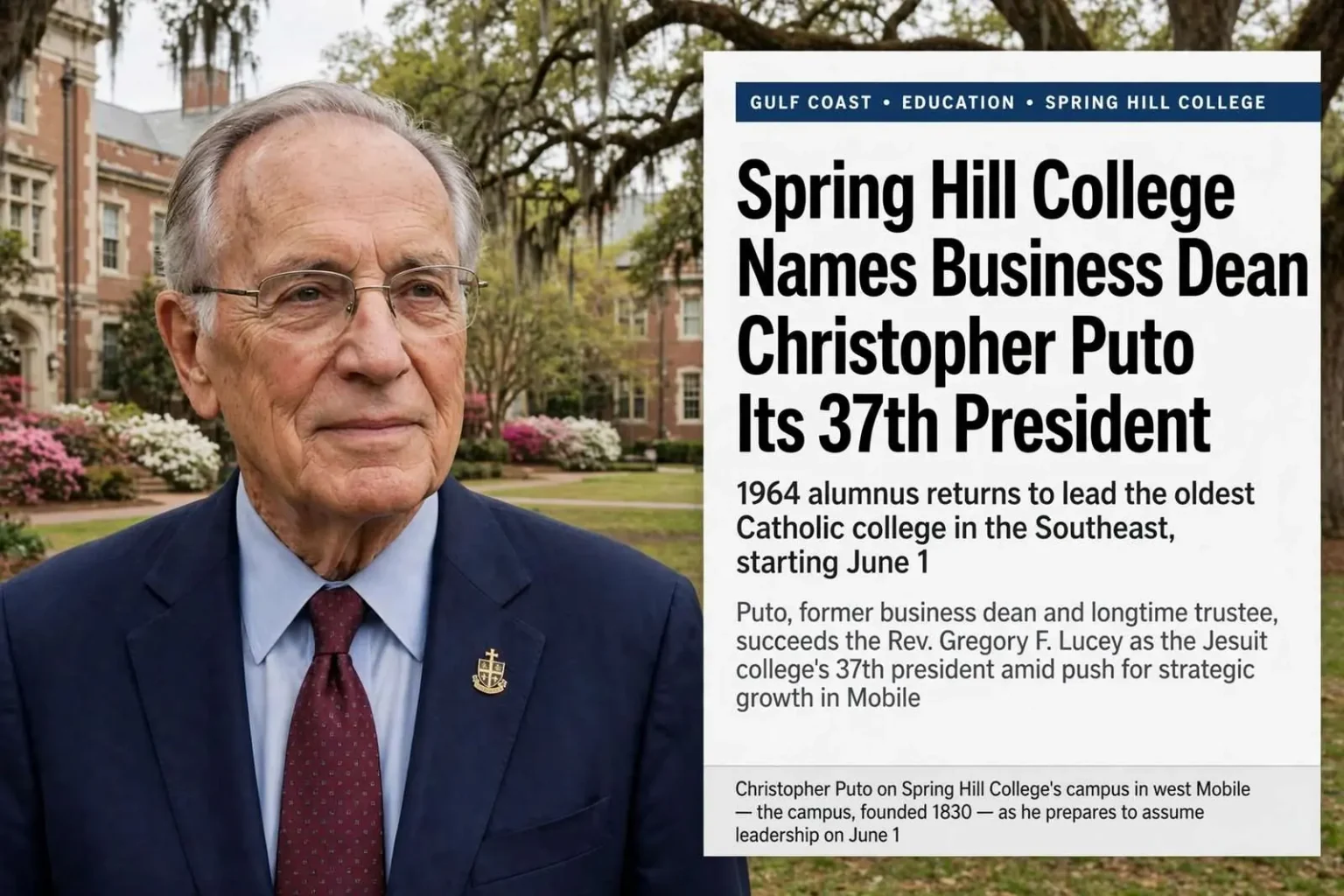
Spring Hill College has selected Christopher Puto, an alumnus with deep roots in business education, to serve as the 37th president of the west Mobile campus. Puto, who graduated from Spring Hill in 1964, will take over the role at the oldest Catholic college in the Southeast starting June 1, succeeding the Rev. Gregory F. Lucey, who plans to remain at the college in an administrative capacity.
The appointment returns a graduate to the top office of an institution he first knew as a student more than five decades earlier, a path that began on the campus along Mobile’s western edge and wound through corporate marketing, doctoral study and a career in business education. His selection places a seasoned academic administrator in charge of a small Jesuit college navigating the same pressures facing every private college in the region.
After Spring Hill, Puto earned an MBA from the University of Miami and went on to become the first person to receive a doctorate in business administration from Duke University. The combination — a Jesuit undergraduate education, a leading southern MBA and a pioneering doctorate — positioned him at the intersection of practice and scholarship that has defined his career since.
He served on Spring Hill’s board of trustees from 2003 to 2012 before returning to lead the institution outright. That decade of governance work gave him a view of the college’s finances, enrollment pressures and strategic debates from the board table, experience that incoming presidents who arrive from outside the institution typically need years to acquire.
A Career Across Academia And Industry
Puto’s career includes stints at the University of Arizona, the University of Michigan and Appalachian State University, along with consulting work for major companies including General Electric and Bank of America. The mix of flagship research universities, a public liberal arts campus and corporate consulting is an unusual resume for a small-college president, and it spans exactly the range of environments a private college competes against and cooperates with.
He also helped lead a strategic planning effort at Georgetown University’s McDonough School of Business that raised $80 million over three years by identifying the program’s competitive strengths and building support among key donors. That fundraising result — achieved by articulating what made the school distinctive rather than by generic appeals — is the credential Spring Hill’s trustees are banking on for a college that will need philanthropic support to fund its own future.
From Burger King To The Academy
Long before his academic career, Puto worked as a sales manager for Burger King, where he was part of the team credited with developing the company’s now-famous “Have It Your Way” campaign in the early 1970s. The campaign became one of the most studied marketing efforts of its era, and Puto’s role in it traces the beginning of a career built on understanding what customers actually want.
He said the idea grew out of research showing fast-food customers didn’t want mass-produced meals; if a customer wanted a burger without onions, the company found it could deliver that just as quickly as a standard order. The insight — customization as a competitive advantage rather than a cost — anticipated the personalization that now dominates consumer marketing, and it made the young salesman’s research practical at national scale.
The lesson translates directly to higher education, where prospective students increasingly behave like consumers comparing personalized value. A college president whose formative professional experience involved asking customers what they wanted and restructuring delivery around the answer brings a distinctly market-facing instinct to the enrollment challenges small colleges face.
What The New President Inherits
Spring Hill College, founded in 1830, is regularly ranked among the top colleges in the South by U.S. News and World Report. The institution holds its place as the oldest college in Alabama and the oldest Catholic college in the Southeast, with a campus in west Mobile that anchors the city’s educational landscape alongside the University of South Alabama and Bishop State Community College.
The incoming president said he plans to bring the same kind of strategic, identity-driven thinking he used in the corporate and university worlds to his new role, starting with an assessment of what sets the small Jesuit college apart in a crowded higher education market. For a college of Spring Hill’s size, the answer to that question — delivered through marketing, admissions and academic programing — determines whether it thrives or merely survives.
The Transition From Father Lucey
Puto succeeds the Rev. Gregory F. Lucey, a Jesuit priest whose presidency oversaw significant growth at the college and who plans to remain at Spring Hill in an administrative capacity. An outgoing president staying on in a supporting role smooths the leadership transition, giving the incoming president access to institutional memory and established donor relationships during his first critical years.
Leadership continuity matters especially for small colleges, where a president is simultaneously chief executive, chief fundraiser and public face of the institution. Donors, accreditors and the Jesuit order all track presidential stability closely, and a transition that preserves relationships rather than resetting them is a genuine asset.
The Jesuit Tradition As An Asset
Spring Hill’s identity as a Jesuit institution is central to the market position the new president will refine. The Jesuit educational tradition emphasizes ethics, service and the formation of the whole person — values that distinguish small Catholic colleges from both public universities and secular private institutions, and that resonate with families seeking an education framed by more than credentials.
The college’s Mobile location adds its own strengths and challenges. The Gulf Coast region’s growing economy — aerospace, shipbuilding, healthcare and the port — creates internship and employment pipelines for graduates, while the region’s price-sensitive market makes tuition-dependent private education a harder sell without clear differentiation and financial aid.
Puto’s own story is part of that differentiation case: a Mobile campus graduate who went on to a Duke doctorate, a Burger King campaign that entered the marketing textbooks, an $80 million strategic victory at Georgetown, and a decade on Spring Hill’s own board of trustees. His task as the 37th president is to convince the next generation of students and donors that the college that shaped him can do the same for them — starting June 1, with an assessment of exactly what makes the institution unlike anything else in the crowded higher education market.
The founding history gives Spring Hill a distinction few institutions can claim. Established in 1830 by the Catholic church, the college predates Alabama’s major universities and grew up alongside the port city itself, educating generations of Gulf Coast families on a campus known for its azalea-lined grounds and historic core. That longevity is itself a marketing asset — an institution that has survived recessions, wars and a century and a half of educational change carries an argument for permanence that newer colleges cannot match.
The higher education market Puto enters is unforgiving to institutions without a clear answer to the question he plans to ask first. Small private colleges across the country have faced enrollment declines, tuition-discount escalation and pressure on their business models, and the ones that thrive are typically those that name their distinctive strengths — honors programs, Catholic identity, tight faculty-student ratios, professional pipelines — and build recruitment and fundraising around them.
His academic credentials speak directly to that work. A doctorate in business administration, professorships at major research universities and deanships in business education mean the incoming president understands both how universities are run and how the disciplines that drive regional economies are taught — a combination relevant to a college building partnerships with Mobile’s employers.
The corporate consulting history adds a practical dimension. Institutions that consult for companies like General Electric and Bank of America learn how large organizations make decisions, allocate capital and evaluate performance, and presidents who bring that literacy can speak the language of the business community whose boards and donor rolls small colleges increasingly depend on.
The “Have It Your Way” story remains a staple of marketing education decades later, and Puto’s position inside it gives him a signature anecdote with real substance. The campaign repositioned Burger King against a larger rival by promising customers the ability to hold the pickles or skip the onions, and the operational finding Puto described — that customization cost the company no speed — became the template for service personalization across the restaurant and retail industries.
That research-driven instinct is what he says he will apply to Spring Hill. Rather than importing a strategy from another campus, his stated first move is an assessment of what the college actually does better than its competitors, then building messaging, programing and investment around those findings. It is the same sequence he described at Georgetown: identify the genuine competitive strengths, then raise the money by making the case for them.
For Mobile, the appointment also restores a local thread to the college’s leadership. Puto’s 1964 graduation placed him among the Gulf Coast alumni whose careers spread the college’s reputation across the region, and his return gives Mobile’s business and philanthropic community a president with personal history in the city’s civic networks.
Spring Hill’s trustees will formally pass the office to him on June 1, when he becomes the 37th president in an unbroken line reaching back to 1830. The challenges waiting — enrollment, tuition pressure, the competitive higher education market — are the same ones every small college president faces; the difference is an incoming leader who has seen those problems solved at institutions of every size, and who first learned the value of the place he now leads as a student on its west Mobile campus.