Spring Hill College Sets Inauguration Dates for New President
Spring Hill College will hold a two-day inauguration celebration this September for new campus president Christopher Puto, a 1964 college alumnus.
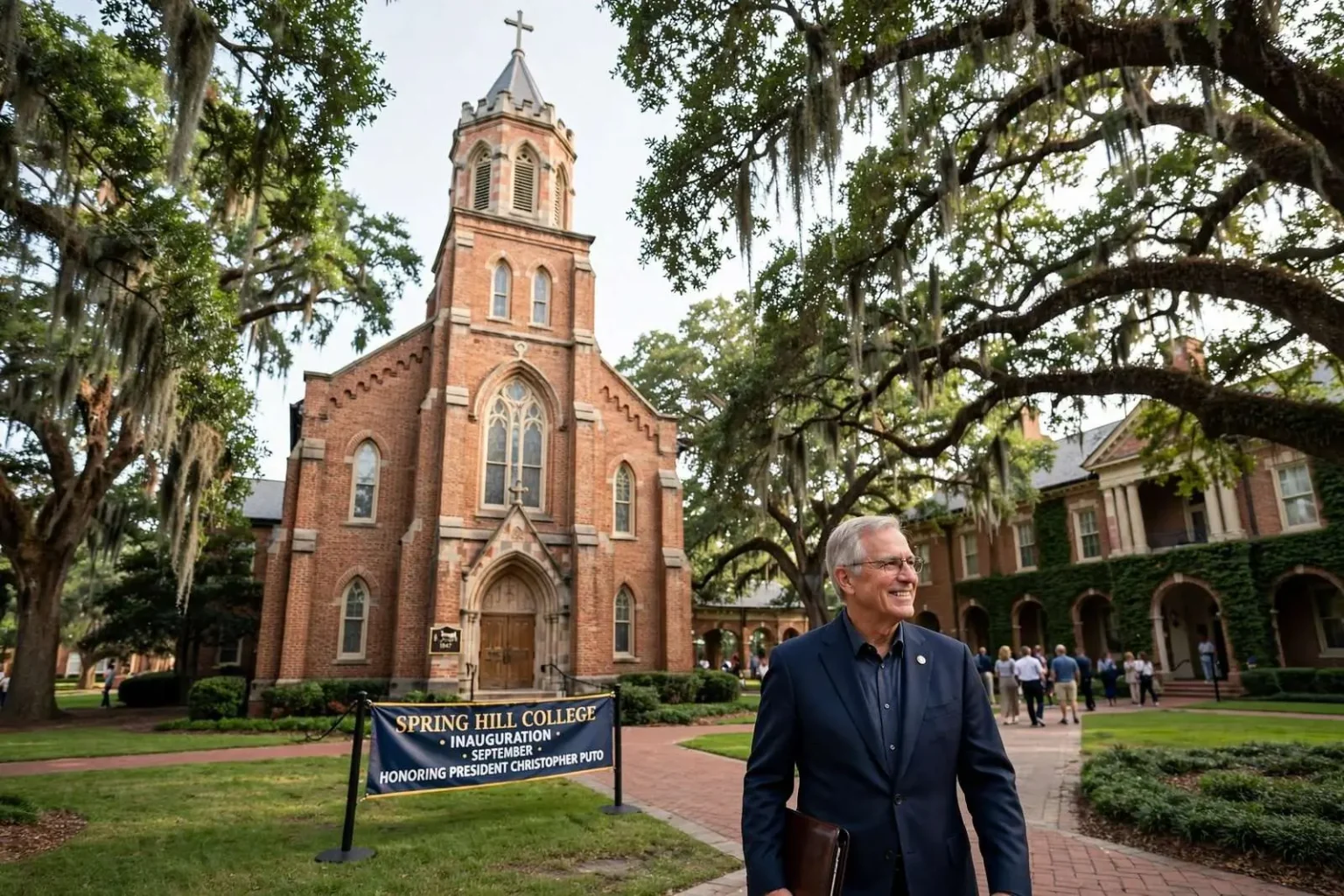
Spring Hill College has set dates for a two-day inauguration celebration honoring Christopher Puto, the Mobile campus’s new president, who officially took office earlier this summer. Puto assumed leadership of the private Catholic college on June 1, succeeding the Rev. Gregory F. Lucey, who is remaining involved with the college in an administrative role. School officials say the transition has been closely coordinated to keep major campus initiatives moving during the change in leadership, an approach the college describes as deliberate stewardship rather than a hard reset.
The inaugural festivities will open with an Inaugural Mass of the Holy Spirit at St. Joseph Chapel on campus, followed immediately by a community picnic intended to bring together students, faculty, alumni and neighbors for an informal welcome. The Mass of the Holy Spirit is a centuries-old tradition in Catholic education, celebrated at the start of an academic year or a new administration to ask blessing on the work ahead. Hosting it at St. Joseph Chapel places the ceremony at the spiritual center of the campus, where generations of Spring Hill students have marked the great occasions of college life.
The following day’s program centers on a formal inauguration ceremony at the Arthur R. Outlaw Recreation Center, capped by a reception for attendees. The recreation center, named for the former Mobile mayor, offers the seating and flexibility the college needs for a ceremony expected to draw not only the campus community but alumni and civic guests from across the region. The reception afterward is designed as the working portion of the celebration, where introductions and conversations carry the relationship-building that a new presidency requires.
A son of Spring Hill returns
Puto’s ties to Spring Hill run deep. He graduated from the college in 1964 before building a long career in business, work that eventually brought him back to Mobile to lead his alma mater. Few college presidencies begin with a graduate returning to lead the institution that shaped him, and the college has leaned into that story as it introduces Puto to the wider community. Alumni have followed the transition with particular interest, seeing in it a confirmation of the lifelong bond the college cultivates with its graduates.
Among the career highlights supporters point to is his role in helping shape Burger King’s “Have It Your Way” advertising campaign early in his career as a sales manager, an example college officials say reflects the kind of practical, results-driven experience he brings to campus leadership. The campaign became one of the most recognizable in American marketing, and its emphasis on giving customers what they ask for is a theme Puto’s supporters have carried into his presidency, framing customer focus as a virtue in higher education as much as in commerce.
A business career of that length brings a network as well as a skill set. Presidents of small private colleges spend a substantial share of their time raising money and cultivating boards, foundations and community partners, and a president who has spent decades in the commercial world arrives with contacts beyond the usual academic circles. College officials have suggested that experience is precisely what the moment calls for as Spring Hill works to strengthen its financial position in a difficult era for small liberal arts institutions.
Continuity through the handoff
College officials say the inauguration is designed to be more than a ceremonial event, framing it instead as an opportunity to introduce Puto’s vision for the college to the wider Mobile community, including local alumni, donors and civic partners who have long supported the campus. Inaugurations at small colleges often serve as the new president’s first extended statement of priorities to off-campus audiences, and the two-day format gives the college room for both formal ceremony and the informal conversations where those priorities take root.
Spring Hill, one of the oldest Catholic colleges in the country, has emphasized continuity through the leadership change, with Lucey’s continued administrative role intended to help maintain momentum on ongoing academic and campus initiatives while Puto settles into the presidency. Lucey led the college through years of campus construction and program development, and his continued presence gives the incoming president an experienced guide to the projects already underway. The arrangement reflects a broader trend in Catholic higher education, where outgoing presidents increasingly remain engaged rather than departing abruptly.
The Jesuit tradition that shapes Spring Hill places strong emphasis on reflection and discernment, values that inform how the college approaches leadership transitions. The days of prayer, celebration and ceremony that mark an inauguration are not merely ornamental in that context; they express the institution’s understanding that a change in leadership is a communal event, belonging to students and alumni as much as to the board that hired the president.
An invitation to Mobile
Members of the public interested in attending portions of the inauguration festivities are asked to RSVP through the college’s website ahead of the September events, as seating for the formal ceremony and related gatherings is expected to be limited. The request underscores how much of the college’s relationship with the city flows through events like this one, where neighbors, parishioners and civic leaders join the campus community on Spring Hill’s grounds.
The campus itself occupies a distinctive place in Mobile. Set on a wooded hill in the city’s western reaches along Spring Hill Avenue, the college has been part of the city’s landscape since the early nineteenth century, when it was founded as the first institution of higher learning in Alabama. Its tree-shaded quadrangle and historic buildings give the campus a physical separation from the bustle of the city while its students, employees and visitors remain woven into Mobile’s daily life.
A presidential transition arrives at a consequential time for institutions like Spring Hill. Small private colleges across the country are navigating demographic headwinds, pressure on tuition revenue and heightened expectations for career preparation, and the president sets the tone for how an institution responds. The college’s decision to pair a new president’s arrival with continuity in the previous administration’s initiatives signals an intention to change leaders without changing course abruptly.
For alumni, the return of a classmate to the presidency carries its own symbolism. Graduates of the 1960s era remember a smaller, more insular campus, and the story of a member of that era returning to lead a far larger institution links the college’s past to its present in a way no outside hire could. The inauguration program gives alumni a formal occasion to witness that handoff, and the college has encouraged graduates near and far to take part.
The two-day celebration concludes with the college’s attention turning fully to the academic year ahead, with a new president in place and the initiatives of the previous administration still moving. However the pressures on higher education evolve, the college has framed this transition as evidence of institutional health: a governing board that planned the succession, a predecessor willing to stay on, and a graduate willing to come home. The September dates on the calendar mark not the beginning of that story but the public confirmation of it.
The college draws students from across the Gulf Coast region and beyond, with a mix of Alabama residents, out-of-state students and international enrollees that gives the small campus a reach disproportionate to its size. Class sizes remain deliberately small in the liberal arts tradition, and faculty mentorship is a point of institutional pride. Prospective students and their families visiting the hill for the first time often arrive for an inauguration or a campus tour and leave with a picture of a college that operates at a personal scale.
Jesuit institutions describe their educational mission in terms of educating the whole person, pairing rigorous academics with service to others and attention to ethical formation. At Spring Hill that mission takes practical shape in service-learning requirements, campus ministry programs and volunteer work in Mobile neighborhoods, commitments that connect students to the city beyond the campus gates. A new president’s embrace of that mission, rather than a departure from it, has been the consistent message of the transition.
The Mobile area’s Catholic community has long been intertwined with the college, from the parishes that feed its enrollment to the families whose members have attended across generations. Campus events draw parishioners from across the Archdiocese of Mobile, and the college’s chapel, theater and athletic venues host gatherings that bring the wider Catholic community onto the hill. The inauguration’s opening Mass extends that relationship, inviting the community that has sustained the college to bless its next chapter.
Inauguration ceremonies in American higher education follow a common grammar: the academic procession, the delegates from other institutions, the presentation of the presidential seal and the new president’s inaugural address. For a college like Spring Hill, the ritual also communicates continuity with an academic tradition older than the republic, echoing ceremonies that European universities have performed for centuries. Guests unfamiliar with academic pageantry often find the formal elements the most memorable part of the program.
The choice of the Arthur R. Outlaw Recreation Center for the formal ceremony reflects practical planning as much as symbolism. Named for the Mobile mayor who led the city through significant modernization, the facility can accommodate the large and varied audience an inauguration attracts, from students in regalia-free dress to trustees and visiting dignitaries. Colleges typically reserve their chapels for the liturgical elements of such programs, as Spring Hill has done by opening the celebration at St. Joseph Chapel.
Community picnics have become a signature element of college celebrations in recent years precisely because they lower the formality barrier for local families. Mobile residents who might feel out of place at an academic ceremony will happily attend a picnic on the lawn, and the conversations that happen over food often do more for town-gown relations than any formal address. The college’s pairing of the two formats shows an understanding that a private college’s health depends on being a good neighbor.
Financial stewardship will inevitably be among the expectations placed on the incoming administration. Like many small colleges, Spring Hill depends on tuition, philanthropy and careful management of its endowment to fund its operations, and alumni giving follows the confidence graduates have in leadership. A president with a business background and an emotional attachment to the institution arrives with tools for that work that career academics must develop on the job.
As the September dates approach, the college’s staff will manage the logistics that such celebrations require, from seating charts to parking plans to the catering for the reception. The work happens largely out of view, but its quality shapes how guests experience the institution. For a college marking the start of a new presidency, even the details of hospitality become a statement about the community the new leader is inheriting.