Saraland Schools Chief Named Finalist for State Superintendent Honor
Saraland City Schools Superintendent Aaron Milner is a finalist for Alabama Superintendent of the Year, capping a run of growth for the district.
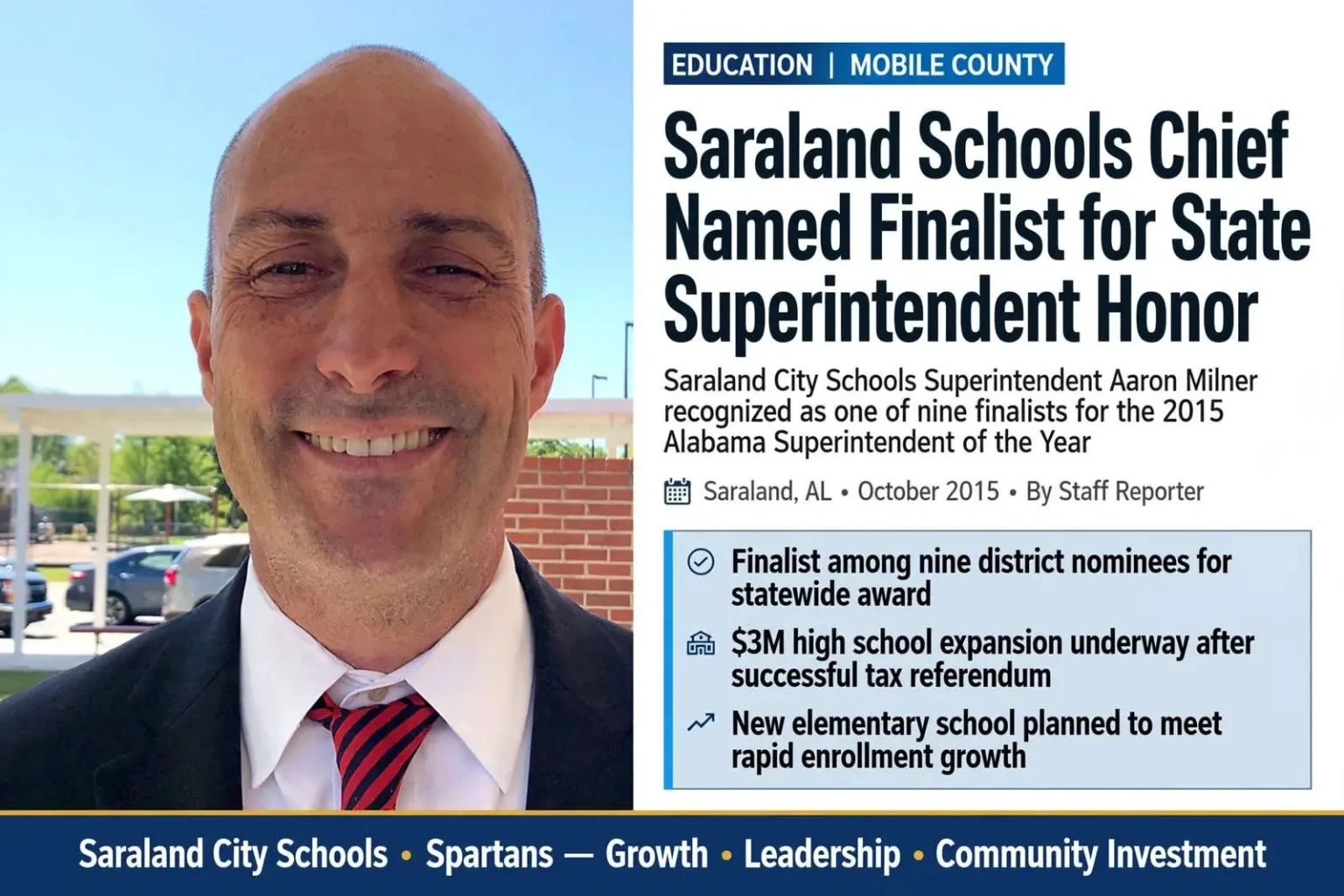
Saraland City Schools Superintendent Aaron Milner has been named a finalist for the 2015 Alabama Superintendent of the Year award, recognition that comes as the young school system continues an ambitious run of growth and community investment. The honor places the leader of one of Mobile County’s newest city school systems alongside the most widely recognized education executives in the state. It also caps a stretch in which Saraland’s schools have moved quickly from survival to expansion, adding classrooms, programs and community backing at a pace few newly independent districts in Alabama have matched.
Milner is one of nine finalists set to be announced statewide, representing each of Alabama’s education districts. Each of the state’s multi-county education districts nominates one sitting superintendent for the annual honor, and the finalists drawn from that group are considered for a statewide award that recognizes leadership, community engagement and student achievement. The finalists are typically honored at a statewide gathering of school leaders before a single winner is selected to represent Alabama in the national Superintendent of the Year program.
A young system on a fast track
Since taking the helm of Saraland’s system in 2013, Milner has overseen a period of rapid expansion, including a successful property tax referendum that voters approved earlier this year to fund the district. The referendum stands out in a state where school tax measures routinely fail, and its passage gave the district a dedicated local revenue stream at a moment when enrollment growth was straining existing buildings. District leaders have pointed to the vote as evidence that the community sees the schools as a shared civic project rather than simply a line item on a tax bill.
That tax measure, which redirects roughly $1 million annually to the school system, has already helped fuel a $3 million expansion of Saraland High School. The high school project addresses a campus that has absorbed successive waves of growth as families have moved into the Saraland city limits and into neighborhoods annexed into the school district’s boundaries. The addition gives the school more instructional space and relieves pressure on core facilities that were designed for a considerably smaller student body.
Bids are expected soon on construction of a new elementary school to accommodate the growing district. Elementary capacity has been among the most pressing needs in the system, where early-grade classrooms have filled as Saraland’s residential growth has continued northward from Mobile. A new elementary campus would allow the district to balance enrollment across its existing schools and preserve the class sizes that parents have come to expect.
Board praise for a master communicator
Saraland Board of Education President Bill Silver praised Milner as a master communicator capable of connecting with everyone from staff and parents to students of every age. Silver said Milner has been effective at translating the board’s long-term vision into day-to-day decisions while still maintaining what he called his own distinct leadership style. In city school systems like Saraland’s, where the board sets policy for a small, closely watched operation, that ability to move between boardroom priorities and classroom realities is often the difference between a plan and a finished project.
Silver’s assessment reflects the working relationship the superintendent has built with the board since arriving in Saraland. The board has backed a series of capital and academic initiatives during Milner’s tenure, from the high school expansion to new program offerings, and the superintendent has returned that support by keeping board members informed and involved in major decisions. Observers of the district note that the absence of public friction between the board and the administration has been a quiet but consistent feature of the system’s early years.
From Enterprise to Saraland
Milner, who previously led the Enterprise City School System before coming to Saraland, brought with him experience running a district in one of the fastest-growing corners of southeast Alabama. Enterprise, anchored by the Fort Rucker military community, has long dealt with enrollment surges and facility demands similar to those now shaping Saraland. That background showed early in his Saraland tenure, when the district moved to plan for growth rather than react to it.
Among his personal trademarks, Milner said he interviews every employee hired by the board personally. The practice, unusual in larger districts where hiring is typically delegated to principals and department heads, gives the superintendent direct contact with every teacher, aide, bus driver and custodian who joins the system. Milner has described it as a way of protecting the culture of a district small enough for every hire to matter.
He credited the broader community — including parents, staff and the Saraland City Council that helped create the standalone school system — for the recognition. Saraland’s split from the Mobile County Public School System was years in the making, requiring a local vote, legislative action and a substantial financial commitment from the city before the district could stand on its own. Milner has consistently framed the system’s achievements as the payoff of that original civic investment.
A referendum as a measure of support
Milner pointed to the recent tax referendum as one of the clearest signs of community support, noting that few systems in Alabama have seen residents vote to direct additional property tax revenue specifically toward their public schools. Property tax measures earmarked for schools require broad coalitions of homeowners, businesses and civic leaders to succeed, and they frequently fail even in systems with strong academic reputations. The Saraland vote placed the district among a small group of Alabama systems that have convinced their residents to tax themselves for the schools’ benefit.
Milner said that backing, paired with the high expectations parents hold for both the district and their own children, has been central to the system’s early success. In Saraland, the same families who approved the tax increase also fill the bleachers at ballgames, attend award programs and monitor test scores closely, creating a level of engagement that administrators describe as demanding but energizing. The superintendent has argued that this combination of resources and scrutiny is what allows a small system to move quickly where larger ones must deliberate for years.
What comes next
The full slate of Alabama Superintendent of the Year finalists was expected to be finalized in the weeks following the announcement, with a statewide winner chosen from among the district representatives. The winner advances to represent Alabama in the national Superintendent of the Year program, where state honorees are evaluated on leadership for learning, communication, professionalism and community involvement. Regardless of the final result, a finalist designation puts Saraland’s name in front of education leaders across the state.
For Saraland, a system still in just its second full decade of independent operation, Milner’s nomination adds to a growing list of milestones for the Mobile County suburb’s schools. The district that began as an ambitious breakaway from a larger county system now counts a passed tax referendum, a high school expansion, a planned elementary campus and a state superintendent finalist among its early achievements. For a city that gambled on running its own schools, the recognition is another sign that the bet is paying off.
The nomination also arrives as Saraland’s rapid growth continues to reshape the city itself. The suburb along U.S. Highway 43 north of Mobile has been among the fastest-growing municipalities in Mobile County for much of the past decade, annexing new neighborhoods and attracting families drawn by the promise of a small, high-performing school system. City officials have long treated the schools as the community’s calling card, and the reputation of the district feeds directly into residential development, commercial growth and property values across the city limits.
That growth loop — more homes, more students, more investment, better schools — is exactly the cycle the district’s recent building projects are designed to manage. The high school expansion and the planned elementary campus are not one-time fixes but pieces of a longer capital strategy that district leaders expect to revisit as enrollment data comes in. Having a superintendent recognized at the state level strengthens Saraland’s hand when the district returns to taxpayers or state officials for the next round of projects.
The Alabama Superintendent of the Year program has historically spotlighted leaders from systems of every size, from small rural districts to some of the state’s largest city systems. A finalist nod for a district of Saraland’s size underscores how far the system has come in a short period. Peers who judge the award look for evidence that a superintendent has improved instruction, managed finances responsibly and earned public trust, categories in which Saraland’s recent record offers ready examples.
For parents and taxpayers in Saraland, the recognition is also a measure of stability. The district has kept its founding leadership in place through the critical early years, avoiding the turnover that has unsettled other young systems around the state. Milner’s continued presence — and the state-level visibility that comes with the award — gives the community reason to expect that the plans approved in this year’s referendum will be carried out by the same administration that made the case for them.
District officials said the focus now returns to the work the nomination highlights: completing the high school expansion, moving the new elementary school from bids to construction, and keeping class sizes and program offerings strong as the city grows. If the coming months bring a state title as well, Saraland will have earned it with the same record of growth and community support that already made the system one of the notable young districts in south Alabama.