New Guide Helps Coastal Alabama Events Go Green
A new planning guide gives Mobile and Baldwin County event organizers practical, step-by-step ideas for recycling and reducing festival waste.
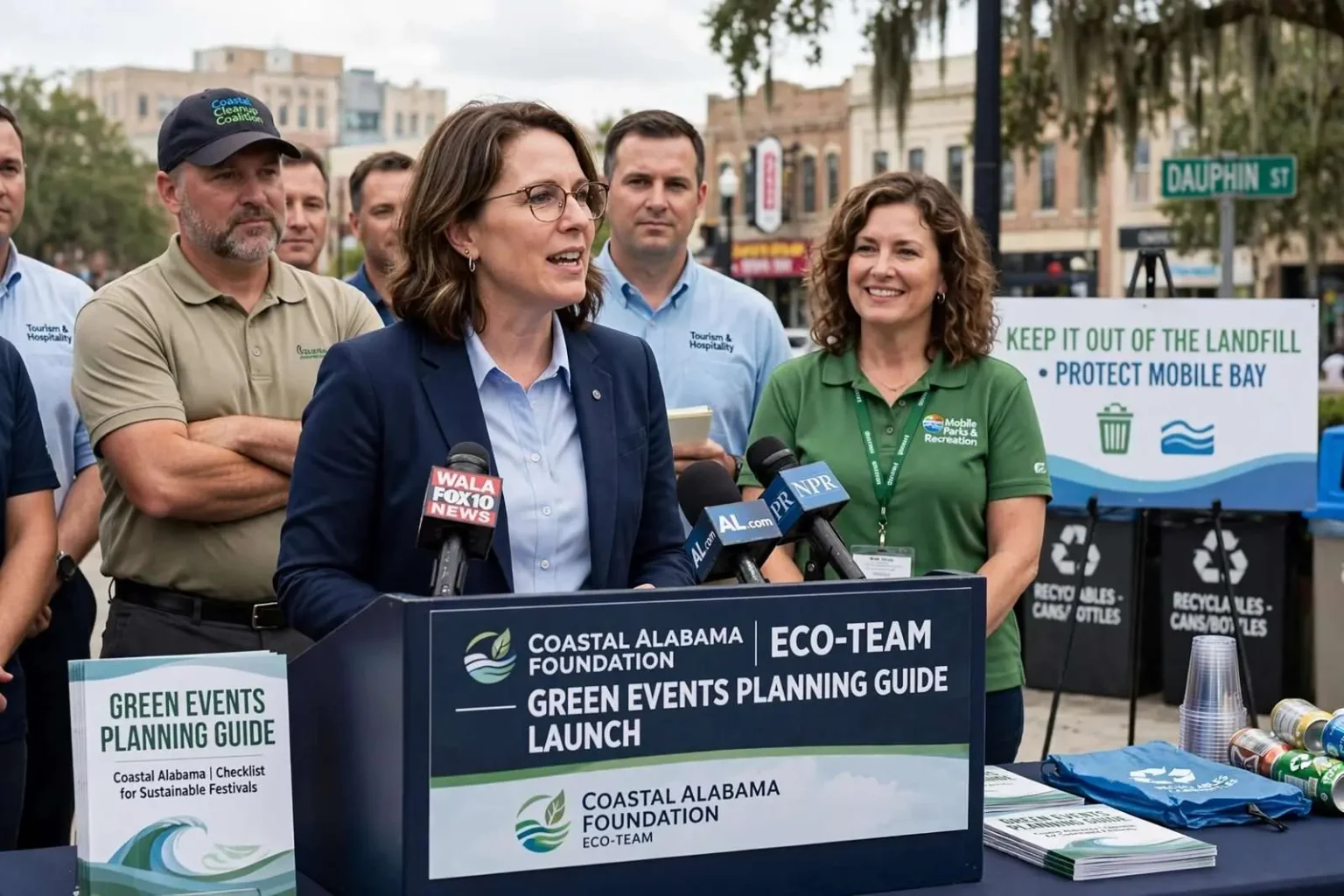
Large festivals and gatherings across the Mobile area leave behind mountains of bottles, cans and other recyclable trash, and a new planning resource aims to help organizers keep more of it out of the landfill. The Coastal Alabama Foundation’s Eco-Team unveiled a Green Events Planning Guide during a news conference in downtown Mobile, offering a step-by-step approach for hosting more sustainable festivals, fairs and community gatherings — and giving the region’s event planners a single playbook built from years of on-the-ground cleanup experience.
The effort grew out of years of hands-on cleanup work at major regional events, where volunteer crews have collected recyclable material left behind by tens of thousands of attendees. Those crews learned the hard way what works: where bins must stand to actually get used, how signage changes what people throw away, and how a festival’s layout can make recycling effortless or impossible. The guide distills that field knowledge into a form any organizer can put to work, whether the event draws a neighborhood or a city.
The stakes are visible every festival season. Mobile’s event calendar runs from Mardi Gras — the oldest in the country — through spring festivals, waterfront concerts and ball tournaments that fill parks and downtown streets for days at a stretch. Each weekend of celebration generates its own tide of cups, bottles, cans, food containers and promotional handouts, and what volunteers do not catch ends up in storm drains that empty straight into Mobile Bay.
What the Guide Contains
Eco-Team coordinator Valerie Longa said the goal was to compile everything organizers need into a single, practical document rather than leaving each group to figure out sustainability practices on its own. The roughly 15-page guide includes a checklist for planning a greener event, along with a directory of recycling centers and partner organizations throughout Mobile and Baldwin counties. The checklist walks organizers through the decisions that determine an event’s environmental footprint — from ordering recyclable service ware to placing stations where foot traffic actually passes — and the directory tells them exactly where materials can go afterward.
Longa described it as a living resource that will be updated as new information and partners become available, rather than a one-time publication. That approach treats the guide as infrastructure rather than literature: a document maintained the way a festival maintains its stage plot, revised each season as new vendors, haulers and recycling options appear on the coast. Organizers who use it are invited to report what worked, which means each event that follows the guide improves the guide itself.
The news conference in downtown Mobile set the tone. Rather than launching the guide at one of the events it is meant to improve, the Eco-Team presented it in a civic setting, with the partners who helped build it standing behind the message: sustainability at large events is a solved problem elsewhere, and Mobile now has the local map for solving it here.
Why Timing Matters
Organizers say the timing matters. Coastal Alabama’s festival calendar draws enormous crowds every year, and the litter left behind after a big weekend can overwhelm city cleanup crews and blemish public spaces long after the music stops. A single major weekend can push a city’s sanitation operation past its routine capacity, with parks crews working extra shifts to clear fields and streetscapes before the next event arrives.
Supporters of the guide argue that better recycling planning does more than tidy up after an event — it also helps the region compete for future festivals and gatherings that want to be seen as environmentally responsible. Event promoters and national touring festivals increasingly screen host cities for sustainability infrastructure, from recycling programs to green vendor requirements, and a city that can document its practices gains an edge in the bidding. In that light, the guide is an economic development tool as much as an environmental one.
Built by a Coalition
The guide was developed with input from a broad coalition of local partners, including hospitality, tourism and parks officials, along with several nonprofit and civic groups already active in coastal cleanup work. That collaboration reflects a broader push in the Mobile area to blend event planning with conservation goals, particularly along the waterfront, where the region’s biggest gatherings meet the waters that define its economy. The partners contributed different pieces: parks departments supplied the logistics knowledge of what cleanup crews actually face, hospitality and tourism officials translated it into visitor experience, and the cleanup groups brought the volunteer networks and the data from years of collection days.
The Eco-Team’s own cleanup record gave the project its credibility. Volunteers who have waded through festival grounds the morning after an event can say precisely which bins overflowed, which materials filled the bags and which items — beads, foam cups, single-use containers — dominate the haul. Turning that observation into a checklist is the difference between advice that sounds good and advice that works on a crowded Saturday night downtown.
Mobile’s Mardi Gras tradition illustrates both the challenge and the opportunity. The city’s celebrations, which predate New Orleans’, generate tons of discards each season — from concession cups in the streets to the beads and throws that drift from floats into storm drains. Civic groups have organized post-parade cleanups for years, and the city has experimented with bead recycling and public education campaigns. The guide extends that improvisational effort into a system, applying to every festival on the calendar the lessons the city has absorbed one parade at a time.
The Waterfront Connection
Conservation groups emphasize that event litter in Mobile is not just an aesthetic problem. Storm drains across the downtown core discharge into Mobile Bay, which means a cup dropped near a festival stage can travel — by way of the first heavy rain — into waters that support the region’s fisheries, seafood industry and beach tourism. Coastal cleanup organizations have documented the flow for years: the same items found in festival litter reappear in bay-side and shoreline collections, carried by runoff from the streets where the crowds gathered.
That hydraulic reality gives the guide its urgency. Every bottle that goes into a recycling trailer at a festival is a bottle that will not be fished out of a drain or a bayou a week later, and every organizer who plans bin placement carefully is making a small decision about the bay’s water quality. The coalition behind the guide built it around that connection — events are temporary, but their litter, if it reaches the water, is not.
The directory of recycling centers and partner organizations addresses the other half of the problem: what happens to material after it is collected. Recycling works only when there is a destination for the load, and organizers in the past have been stymied by the gap between collecting material and finding a hauler who will take it. By listing the centers and partners active in Mobile and Baldwin counties, the guide closes that loop for organizers who want recycling to mean something more than a labeled bin.
For the Eco-Team, the guide marks a shift from cleaning up after events to changing how events are planned — moving the effort upstream, where a single decision about cups or bin placement prevents work for dozens of volunteers. Longa’s team plans to keep refining the document each season, and the coalition that built it intends to bring more of the region’s festivals into the fold. If it succeeds, the evidence will be quiet: cleaner parks on Monday morning, lighter loads for city crews, and a festival season that leaves Mobile Bay no worse for the celebration.
What Organizers Are Being Asked to Do
The practical steps in the guide start well before gates open. Organizers are walked through committing to recycling in the planning phase, budgeting for bins and signage, recruiting volunteers to staff collection stations, contracting with vendors who use recyclable or reusable service ware, and arranging in advance for the collected material to be hauled. The document pairs each step with the local names and numbers that make it executable — which centers accept what materials, which partners loan equipment, where volunteer help can be found on the coast.
The checklist also covers the details that decide whether recycling succeeds in the field: bin placement clustered where food and drink are sold, clear and consistent labeling at eye level, stations paired so that a recycling bin always sits beside a trash bin, and volunteers positioned to direct the flow when crowds peak. Those field-tested touches come directly from the Eco-Team’s cleanup experience, and they cost almost nothing beyond attention — which is precisely why the guide argues that most events can go greener without expanding their budgets.
The coalition intends to follow up with organizers directly, offering help applying the guide to individual events and collecting feedback for future editions. Larger events are the natural first audience, since the volume of material makes the savings most visible, but the document is written for gatherings of any size, and civic groups hope neighborhood festivals and school events adopt it as readily as the headline attractions. Each event that participates adds a data point to the region’s growing record of what sustainable event planning looks like on the Gulf Coast.
The guide’s debut adds Mobile to a movement already visible in other host cities, where green event certification has become a badge festivals display alongside their lineup posters. For a region whose brand is built on its water — the bay, the beaches, the rivers that feed them — the logic is hard to argue with: the celebrations that define coastal Alabama should not be the same forces that foul it, and now the region has a document that shows, page by page, how to make sure they are not.