Mobile Council Forms Tax Reform Panel, Tables Animal Sale Ban
Mobile's city council created a committee to study restructuring city taxes and fees, while postponing a proposed animal sale ban and new noise ordinance.
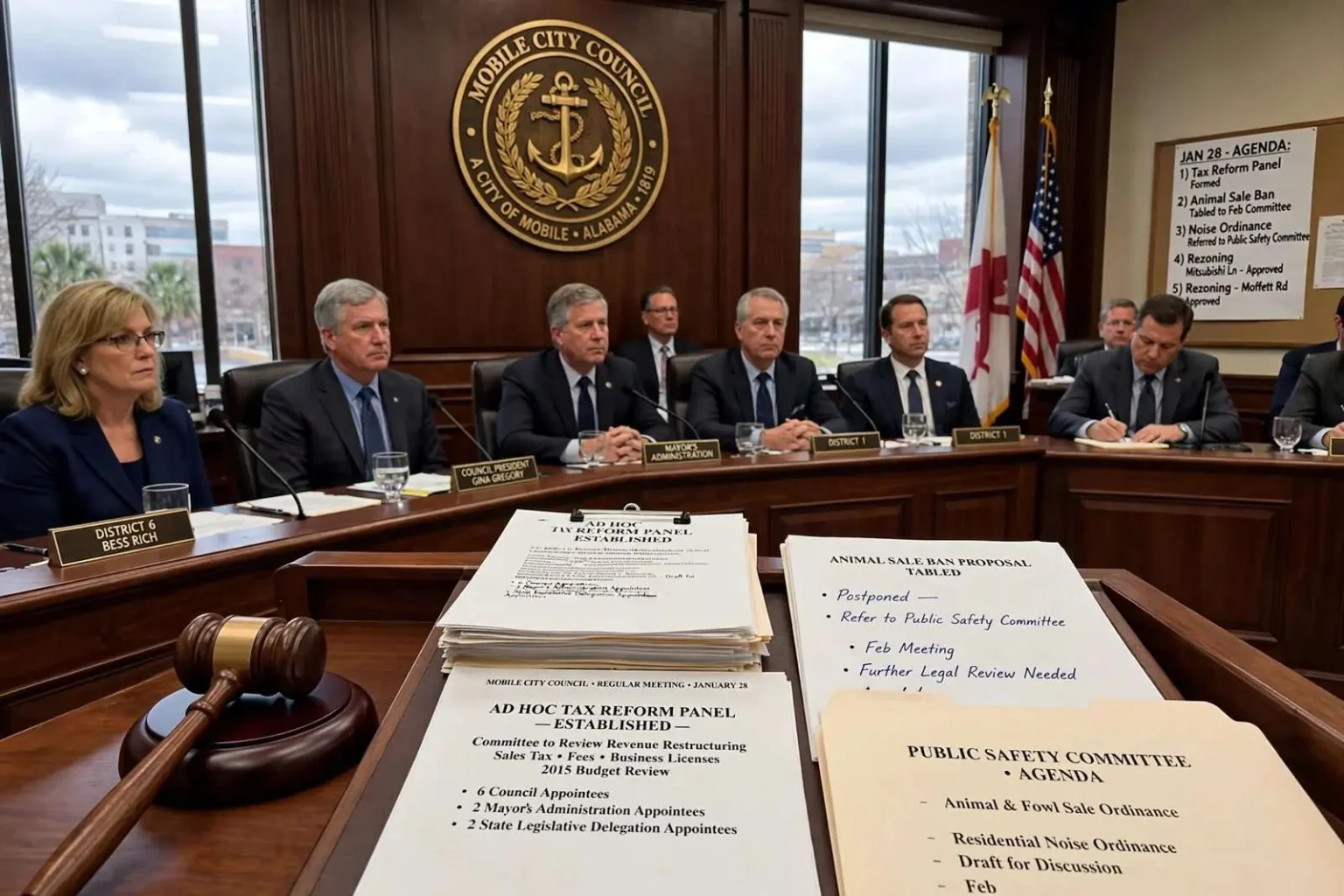
The Mobile City Council voted to form a new ad hoc committee tasked with studying and recommending changes to the way the city raises revenue, marking one of the more significant actions to come out of a late-January regular meeting that otherwise saw two contested proposals pushed back for further review.
The newly formed panel will examine restructuring city taxes, fees and other revenue sources, an idea first floated during the 2015 fiscal year budgeting process. Each council member will appoint a representative to the committee, along with two appointees from the mayor’s administration and two more from the city’s state legislative delegation, the latter included in case any eventual recommendations require a public referendum.
The committee’s composition tells you what it is actually for. Revenue restructuring in Alabama cities is constrained by state law — municipalities levy only the taxes and fees the Legislature authorizes, and some changes require local votes — so a panel weighted with council representation, administration input and legislative delegation seats is built to produce recommendations that can actually navigate that gauntlet rather than idealized proposals that die in Montgomery.
The review grew out of a familiar municipal squeeze. Mobile, like most Alabama cities, depends heavily on sales tax and user fees, revenue sources that fluctuate with the economy and rise more slowly than the cost of delivering services. The 2015 budget process exposed those pressures, and the idea of a comprehensive look at the city’s revenue structure — everything from business licenses to occupational taxes — gained support as an alternative to year-after-year patching.
Animal sale ban postponed
Council members postponed a separate proposal that would have significantly altered how animals and fowl can be sold within city limits. District 6 Councilwoman Bess Rich, who has led the effort, said logistical hurdles, including securing legal representation for all parties affected, meant the measure needed more time.
The change is expected to have a notable impact on Flea Market Mobile, and Rich set a public safety committee meeting for early February to work toward a final recommendation. The flea market, a weekend fixture in the city, has long been among the venues where animals are offered for sale — a practice that animal welfare advocates have sought to regulate across the country, citing concerns about the conditions animals endure at high-volume sales.
Proposals like this one typically draw fire from both directions. Advocates for stricter animal welfare rules argue that unregulated sales facilitate neglect and impulse purchases, while sellers and market vendors counter that regulation threatens legitimate livelihoods and that existing state cruelty statutes already cover abuse. The question of legal representation for affected parties — everyone from the flea market’s operators to individual sellers — reflected the council’s awareness that any ordinance it passes will face both legal scrutiny and practical enforcement questions.
Also delayed was a proposed noise ordinance affecting residential districts, introduced by Mayor Sandy Stimpson. Council President Gina Gregory referred the measure to the public safety committee for further discussion at the same February meeting, pairing the two deferred items on one agenda.
Noise ordinances are perennially contentious because they sit at the collision of two legitimate interests: residents’ right to quiet in their homes and the everyday sounds of commerce, worship, music and yard work. Drafting one that police can enforce consistently — with measurable standards rather than an officer’s subjective ear — is the technical challenge, and the committee referral gave the city time to get the measurements and exemptions right before imposing a rule on the whole city.
Street closure objections heard
Elsewhere on the agenda, the council heard renewed objections from residents opposed to a previous vote closing a portion of Montclaire Way near Airmont Drive, though members did not comment further on the matter per advice from legal counsel.
Street closures — often requested by neighborhoods seeking to cut through traffic or deter crime — are among the council’s more legally delicate decisions, because closing a public right-of-way affects access rights that run to every citizen, not just the adjacent homeowners. The advice of counsel explaining the members’ silence suggested the matter may yet end up in court, where anything said in a council meeting could become part of the record.
Rezonings approved
In other business, the council approved a rezoning request tied to a new concrete manufacturing facility on Mitsubishi Lane, along with a separate rezoning near Moffett Road to allow expansion of a water treatment facility parking lot.
The Mitsubishi Lane approval fit the character of its corridor — an industrial area west of the city’s core, named for the manufacturing presence that has long occupied it — where heavy industrial operations belong under the zoning map and neighbors are fewer. Concrete manufacturing brings the standard trade-offs of such facilities: truck traffic and dust against construction jobs and a steady industrial tax base. Zoning decisions on corridors like this one determine whether Mobile’s industrial economy expands in appropriate places or spills into residential areas.
The Moffett Road rezoning addressed a plainer need. U.S. Highway 45, known locally as Moffett Road, carries traffic northwest out of the city, and the water treatment facility’s parking expansion reflected the unglamorous infrastructure work that keeps utility operations functioning — treatment plants need crews, and crews need somewhere to park. For the surrounding area, the expansion signaled continued investment in the utility infrastructure serving west Mobile.
Appointments and smaller items
Members also appointed three residents to the city’s newly created Citizens’ Advisory Committee on Contracting Opportunities for Small Business and Minority Owned Firms, with additional appointments expected in early February.
The new committee takes on a question Mobile has wrestled with for decades: how the city’s construction contracts and professional services spending flow to the small and minority-owned firms in its own business community. Advisory committees of this kind typically review contracting practices, recommend outreach and mentorship programs, and monitor where the dollars actually go — a watchdog and advisory role that advocates for equity in city spending have long requested.
The council additionally approved several smaller funding measures, including money earmarked for Public Safety Memorial Park, an assessment of the historic Church Street Graveyard, lighting improvements at Cooper Riverside Park’s amphitheater and tennis court resurfacing at Medal of Honor Park.
Each item maps to a distinct piece of the city’s civic landscape. Public Safety Memorial Park honors Mobile’s fallen police officers and firefighters, making its upkeep a matter of respect as much as maintenance. Church Street Graveyard, the city’s historic burial ground dating to the colonial era and filled with centuries-old tombs, needs periodic professional assessment to preserve its aged walls and markers. Cooper Riverside Park, on the downtown waterfront, serves festival crowds and riverfront strollers, and lighting its amphitheater extends its usable hours. Medal of Honor Park in west Mobile is the city’s largest recreation complex, and resurfacing its tennis courts is the routine reinvestment that keeps public facilities playable.
Lighthouse relocation tabled
A resolution supporting the relocation of the historic Middle Bay Lighthouse to Battleship Park was postponed indefinitely, though officials noted ongoing discussions with private partners could bring the idea back for consideration later this year.
The Middle Bay Lighthouse is one of coastal Alabama’s most recognizable relics — a screw-pile style structure standing in the waters of Mobile Bay since the late nineteenth century, guiding shipping traffic through the bay’s shallows and surviving more than a century of hurricanes that leveled newer structures around it. Decommissioned decades ago, it has deteriorated steadily, and preservationists have debated its fate for years: restore it in place at enormous cost and technical difficulty, or bring it ashore where it can be protected and interpreted.
Battleship Park, the Memorial Parkway attraction anchored by the USS Alabama, has long served as the resting place for the region’s military and maritime artifacts, and relocating the lighthouse there would give the weathered structure a stable home and a visitor audience measured in hundreds of thousands a year. The indefinite postponement reflected the arithmetic that stalled the plan — relocation of a structure its size, even with private partners sharing the cost, requires engineering studies, permits and money that had not yet lined up.
The council’s handling of the day’s calendar — a significant revenue committee created, two contentious ordinances deferred to committee, rezonings passed without drama, and a symbolic lighthouse resolution tabled — offered a picture of how the city’s legislative body actually works. The headline items were the ones pushed forward carefully, while the ones needing more time were pushed aside honestly rather than rushed to a vote that would not survive scrutiny.
What to watch this year
The ad hoc revenue committee is the item with the longest reach. Its recommendations could touch every household and business in the city, and its inclusion of the legislative delegation signals that members already anticipate changes requiring permission from, or approval by, the state. Residents should expect public meetings, and the committee’s final report will likely frame the city’s budget debates for years.
The February public safety committee meeting will resolve the two deferred ordinances — the animal and fowl sales measure and the residential noise ordinance — in a single session. For the vendors and animal welfare advocates watching the first issue, and for the residents of quiet streets watching the second, that meeting is the next real opportunity to influence the outcome.
For a city entering a year of budget pressure and growth decisions, the late-January meeting set the terms: revenue reform is officially on the table, neighborhood quality-of-life rules are being drafted deliberately rather than hastily, and the city’s historic treasures — whether a graveyard, a park or a lighthouse standing in Mobile Bay — are being assessed for the investment they need. The council returns to each thread in the weeks ahead, and the public’s input, as always in Mobile’s council-chamber government, will help decide where each one lands.