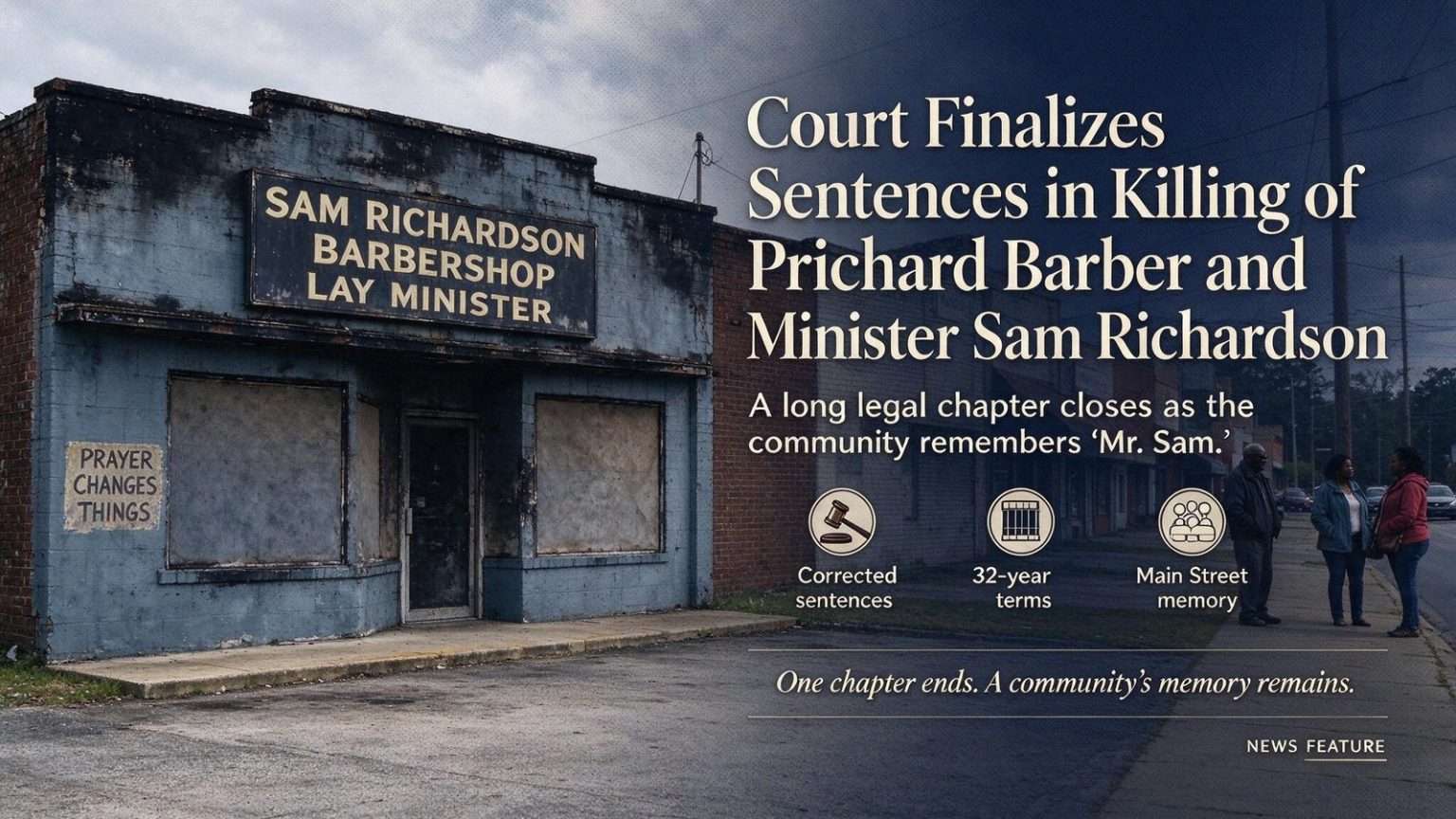
A Mobile County judge has closed out a long-running legal saga tied to the 2011 killing of a well-known Prichard barber and lay minister, handing down new, single sentences to the two men convicted in his death after an appellate court found their original sentencing improper.
Sam Richardson, 60, widely known around Prichard as “Mr. Sam,” was shot to death on Nov. 22, 2011, inside the small Main Street barbershop where he had cut hair and preached to neighbors for years. Investigators said the shooting happened during a robbery attempt. Testimony from residents who lived and worked near the shop proved central to identifying and convicting his killers.
The loss landed hard in Prichard, a city of roughly 2,200 people where businesses and civic institutions are few enough that each one carries outsized weight. A barbershop on Main Street functioned as far more than a place to get a haircut — it was one of the neighborhood’s regular gathering points, and Richardson’s role as a lay minister made it a place where advice, prayer and community news changed hands alongside the small talk. Residents who witnessed the aftermath of the shooting and spoke with investigators became the backbone of the prosecution, a reminder that in small cities, cases often turn on neighbors willing to testify.
The convictions and the appeal
Broderick Brown, now 23, and Andrew Amison, now 20, were tried separately, in October 2013 and January 2014 respectively, and each was found guilty of two counts of felony murder in Richardson’s death. Mobile County Circuit Judge Robert Smith initially sentenced both men to concurrent 32-year prison terms.
Late last year, however, the Alabama Court of Criminal Appeals set aside those dual convictions, citing an Alabama Supreme Court ruling that bars multiple convictions and multiple sentences for felony murder when both charges stem from a single killing. The appellate panel sent the cases back to Judge Smith with instructions to adjudicate each man guilty of a single count of felony murder and resentence him accordingly.
The appellate ruling addressed a technical but consequential point of Alabama criminal law. felony murder charges are often brought in overlapping counts — one count for the underlying felony of the robbery, another tied to the killing itself — and for years prosecutors routinely sought convictions and sentences on each. The state’s highest court shut that door, holding that a single death cannot support multiple felony murder convictions no matter how the charges are structured. The practical effect in cases like this one is usually modest: the single remaining count still carries the same sentencing range, and defendants end up serving the same effective term. But the corrections matter to the record, to appellate review down the road, and to the principle that punishment should track the number of victims rather than the number of charges a prosecutor files.
For the district attorney’s office, the appellate decision required reworking the disposition of two cases that had been considered final for months. Prosecutors had obtained what they viewed as appropriate sentences for both defendants in 2013 and 2014, and the mandate from the Court of Criminal Appeals meant returning to Circuit Court to formally amend the judgments. Neither the convictions themselves nor the 32-year terms were in jeopardy under the ruling — only the duplication — which is why the resentencings moved through the docket without contest.
Smith complied with that order for Brown on Nov. 7, issuing one 32-year sentence. Brown is now serving that time at Bullock Correctional Facility in Union Springs. Amison, who investigators have suggested may have been the one who fired the fatal shot, received his amended single sentence of 32 years more recently and is serving it at Kilby Correctional Facility in Mount Meigs.
The distinction investigators drew between the two defendants — the suggestion that Amison pulled the trigger — was part of the record from the early stages of the case, and it shaped how each trial unfolded. Separate trials allowed prosecutors to tailor the evidence to each defendant’s role, and separate juries returned identical verdicts. Under Alabama’s felony murder doctrine, a participant in a robbery that ends in a death is legally responsible for the killing whether or not he fired the shot, which is why the theory of each man’s culpability mattered to the narrative but not to the elements the state had to prove.
Bullock Correctional Facility, a state prison in Bullock County, houses medium- and close-custody inmates and provides educational and vocational programming, while Kilby serves as one of the state’s primary intake and classification facilities and holds inmates across custody levels. Both men will remain eligible for parole review in the years ahead, as any inmate serving a determinate sentence in Alabama does, though a 32-year term for a killing committed in 2011 means neither will see a parole board soon.
Neither man’s family, nor Richardson’s relatives, attended the brief resentencing hearing. When the judge asked Amison if he wished to address the court, he declined.
The empty courtroom said something about where the case stood three years on. Resentencing hearings held purely to conform a sentence to an appellate mandate rarely draw the emotion of the original trial; the outcome is largely predetermined by the appellate instructions, and both sides treat the proceeding as paperwork. For Richardson’s family, who had already sat through two trials and the original sentencing, the hearing offered no new answers — only a corrected record and the same effective punishment.
A neighborhood’s long goodbye
The case left a lasting mark on the Prichard community. Richardson had operated his barbershop for decades and was remembered as much for his ministry as for his haircuts.
In the months after his death, a local Christian outreach group tied to a nearby inner-city ministry helped repaint and spruce up the shuttered shop as a small tribute. That effort was undercut, though, when a fire later damaged the structure.
The volunteer cleanup was the kind of gesture communities make when a loss is too large for anything else — a fresh coat of paint on a storefront that had anchored the block for decades, an acknowledgment that the shop mattered to people who had never even been customers. The later fire deepened the sense of loss, taking what remained of the physical place and leaving only the memory of what happened there.
Richardson’s daughter has said the family hopes to eventually convert the site into some form of community or cultural space in her father’s memory, though no timeline for that project has been announced.
Plans of that kind face the practical realities that follow any fire-damaged structure — insurance questions, debris clearance, rebuilding costs — and the family has set no date. But the idea itself reflects how Prichard remembers Mr. Sam: not as the victim of a crime file, but as a man whose shop should be something again. A community space bearing his name would restore to Main Street a piece of what the barbershop provided in life, a place where neighbors could gather without needing a reason.
Those who knew him describe a man who treated the shop as an extension of his ministry, offering counsel to young men who came in for a haircut and a prayer for anyone carrying trouble on their shoulders. That reputation is why the case never faded locally the way many prosecutions do. In neighborhoods like his, a killing that takes a mentor as well as a businessman takes something the courts cannot restore, and the community’s attention to the resentencing, however quiet, reflected that arithmetic.
The resentencing also closes a chapter in how the courts handled the case, but it does not settle every question the crime raised. Prichard, like many small cities in southwest Alabama, has spent years contending with economic decline, an eroded tax base and the public safety strain that follows both. The killing of a beloved figure in broad daylight on Main Street became a symbol of those pressures, discussed at city council meetings and in churches long after the trials ended.
For a community still processing the loss of a figure many considered a fixture of daily life on Main Street, the resentencing closes one chapter of a case that stretched across more than three years of trials and appeals, even as questions about the future of Richardson’s longtime shop remain unresolved.
What remains now is the quieter work of memory. Two young men are serving out their sentences in state prison facilities far from Prichard, the appellate record has been corrected, and the Main Street storefront stands as it has since the fire — a shell waiting on a family’s plan. The barbershop chairs, the porch conversations and the Sunday visits are gone, but the habit of speaking Mr. Sam’s name has not left the neighborhood, and in Prichard that may be the most durable verdict of all.