Mobile BayBears Push for Hank Aaron Stadium Upgrades, Citing Player Safety
BayBears officials asked Mobile leaders to fund stadium upgrades at Hank Aaron Stadium, starting with lighting that has not met league standards for years.
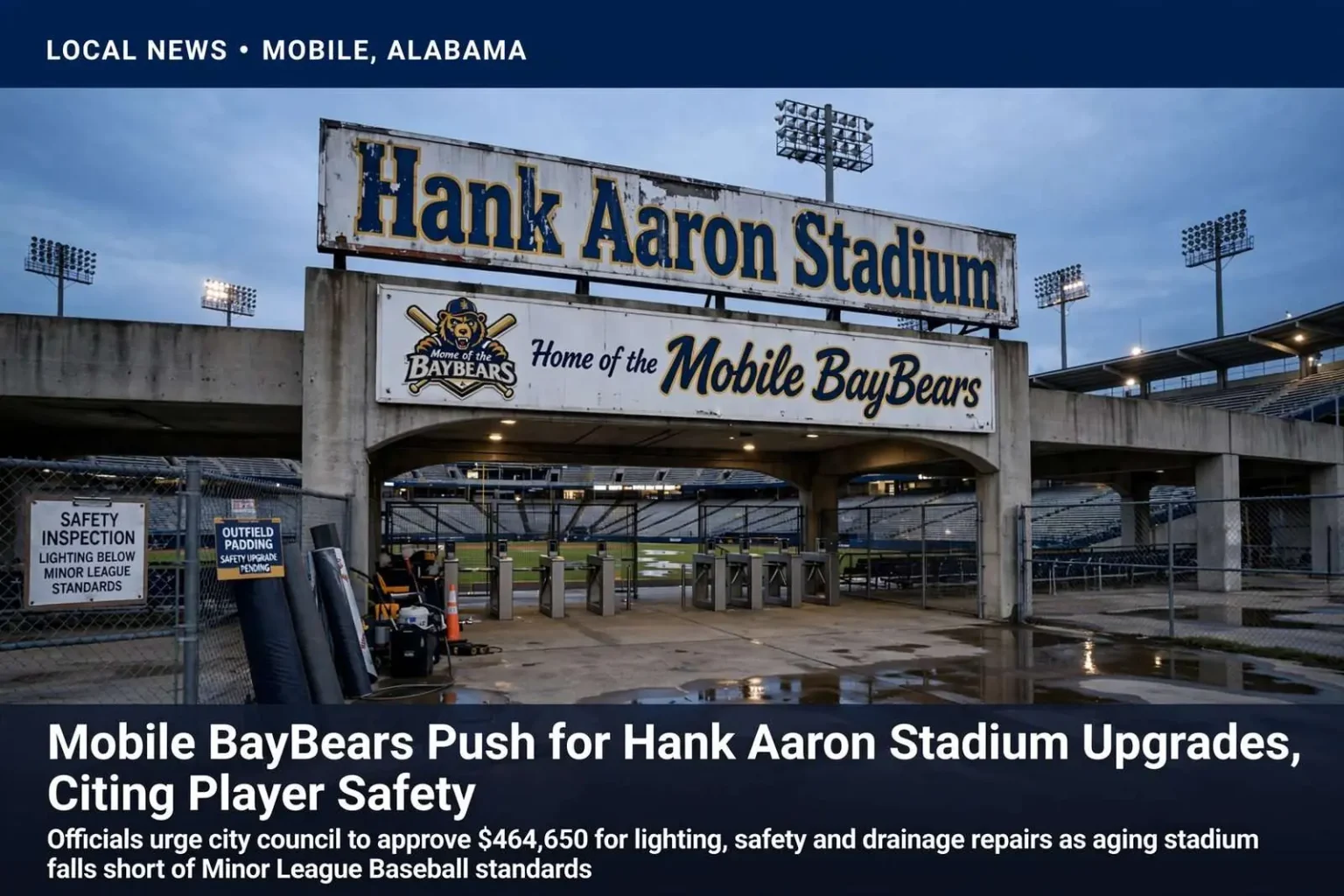
Mobile BayBears officials made the case to city leaders that Hank Aaron Stadium is overdue for significant upgrades, arguing that decades-old lighting and other infrastructure issues have fallen out of compliance with Minor League Baseball standards and pose real safety concerns for players. The appeal set up a test of how Mobile values one of its most recognizable sports venues, a ballpark that has anchored the city’s professional baseball scene for a generation.
BayBears general manager Chris Morgan told city officials the improvements amount to a genuine need rather than a luxury request. His message was blunt: the facility that bears the name of baseball’s home run king no longer measures up to the standards the sport expects of a Double-A venue, and the gap shows up in everything from the quality of play to the experience of the fans in the seats.
Mobile Mayor Sandy Stimpson has backed allocating roughly $464,650 in excess capital improvement funds toward the project, with the city council expected to weigh in on the funding. The figure is modest by the standards of stadium construction — a fraction of what a new ballpark would cost — but represents a meaningful down payment on the most pressing needs at a facility the city owns and the BayBears lease as their home.
Lighting tops the list of priorities
Lighting tops the list of priorities. According to Morgan, the stadium’s current lighting system has never fully complied with Major and Minor League Baseball standards since the facility was built, and falls noticeably short when compared with other stadiums in the Southern League. The shortfall matters most as the evening wears on: as daylight fades, players track fly balls and breaking pitches under conditions that improve ballparks simply do not ask them to endure.
Beyond compliance concerns, Morgan framed the issue squarely as one of player safety. Fielders chasing balls into the twilight, batters picking up pitches out of an imperfectly lit backdrop and grounds crew members working on the field all face added risk when a lighting system performs below the sport’s benchmarks. For a league whose players are, in many cases, rising through the systems of their major league parent clubs, those conditions are not a technicality.
The rest of the upgrade list follows the same theme of catching up rather than keeping up. Other planned improvements include additional padding along the outfield rail to protect players who might collide with it during play, along with repairs to the field-level audio system, which Morgan said has been out of service for some time. The padding brings the ballpark in line with facilities that have already made similar changes, and a working audio system affects everything from announcements and walk-up music to emergency communication on the concourse.
Drainage and the rainout problem
Longer term, the team hopes to address drainage problems that have plagued the facility. Standing water has led the BayBears to lead the Southern League in rainouts, and the poor drainage has forced the team to play some games on fields that weren’t fully dry. In a Gulf Coast climate where afternoon thunderstorms are a routine part of the season, a ballpark that cannot shed water efficiently loses games, revenue and goodwill with fans who drive to the stadium only to find the night washed out.
Playing on wet ground carries its own costs. Outfields that hold water slow ground balls, soften footing and add to the wear and tear on players across a 140-game schedule. Drainage work is among the least glamorous investments a stadium can receive — invisible on game day when it functions — but it sits near the top of any honest list of what keeps a ballpark playable through a Mobile summer.
An attendance story in decline
Morgan, who previously worked for the BayBears in the late 1990s before a stint with the Senior Bowl, pointed to a steep decline in attendance as another reason to invest in the facility. He said average crowds have fallen from roughly 4,700 per game in 1997 to about 1,700 last season, and said upgrading the fan experience is part of a broader plan to reverse that trend.
The numbers tell a story familiar to minor league baseball markets across the country. The mid-1990s represented something of a golden age for Double-A baseball in Mobile, when a new ballpark, a winning product and a novelty factor packed the stands. Two decades later, competing entertainment options, changing habits and an aging facility have combined to erode the base. The BayBears’ response, under Morgan’s plan, is to make the stadium a place worth coming to — comfortable, well-lit, audible and dry — rather than simply a place where baseball happens.
Morgan’s own career gives the argument a personal note. He watched the ballpark in its heyday from inside the organization in the 1990s, and after his time with the Senior Bowl he returned to find a facility that had not kept pace with the league around it. His case to city leaders blended nostalgia with arithmetic: the franchise cannot rebuild its crowd without a venue that meets modern expectations, and the venue cannot get there without investment from the city that owns it.
Not just baseball: the stadium as a community venue
Not every recent attempt to draw a crowd to the stadium has involved baseball. A holiday lights display called Christmas Nights of Lights brought thousands of visitors through the stadium parking lot last year, though Morgan said most proceeds went to the third-party company that produced the show rather than to the ballpark itself.
Still, he said the event proved the facility could function as a multiuse venue for the community. A stadium parking lot that can host a seasonal attraction drawing thousands is an asset well beyond the baseball calendar, and the experience offered a preview of how Hank Aaron Stadium and its grounds could serve Mobile through more of the year — concerts, festivals, community runs and other gatherings that put people on the site and money in the neighborhood economy.
That multiuse pitch matters in the funding conversation. A city deciding how to spend capital dollars weighs more than one tenant’s wish list; it weighs how many residents benefit. A ballpark that hosts fifty-plus home games a season plus community events touches far more Mobile families than a single-purpose facility, which strengthens the case that the $464,650 allocation serves the whole city rather than a baseball franchise alone.
The city’s decision
City council members were expected to take up the proposed fund allocation at a subsequent meeting, as officials weigh how to balance investment in the aging stadium against other capital priorities across Mobile. The discussion arrives with the usual tensions of a tight municipal budget: every dollar directed to the ballpark is a dollar not spent on streets, drainage or public safety elsewhere in the city.
The Stimpson administration’s support for using excess capital improvement funds — money already set aside for capital purposes rather than new taxation — shaped the proposal as a relatively low-cost answer to a growing compliance problem. Waiting, city leaders were told, risks a future in which Minor League Baseball’s standards become a crisis rather than a conversation, and in which the cost of catching up far exceeds the cost of the current request.
For the BayBears, the stakes are straightforward: a stadium that meets league standards keeps the franchise viable in Mobile, and a venue that fans enjoy gives the organization a path back toward the attendance figures it once knew. For the city, the decision is about stewardship of an asset named for one of baseball’s greatest figures and rooted in a community’s identity. The council’s vote was set to determine which description of the ballpark — aging liability or community investment — wins out for the seasons ahead.
The ballpark’s place in Mobile’s story
Hank Aaron Stadium opened in the late 1990s as the home of the BayBears and immediately gave Mobile a modern home for professional baseball, replacing a tradition of minor league baseball that stretched back generations in the city. Its name honors the Mobile native who holds baseball’s all-time home run record, a connection that makes the ballpark more than a sports facility — it is a monument to the city’s outsized contribution to the sport.
Mobile’s baseball pedigree is difficult to overstate. The city produced Aaron, Satchel Paige, Willie McCovey, Ozzie Smith and a remarkable list of Hall of Famers, and the ballpark carries that heritage in its name and its identity. When BayBears officials argue that the facility should meet the standards of the sport, they are arguing from that history: a city that gave baseball so much, the reasoning goes, should not let its ballpark fall behind the standards of the league it hosts.
The Southern League context sharpens the point. Double-A baseball across the Southeast has seen steady facility investment, with communities across the region building or renovating ballparks to attract and keep affiliated teams. A stadium that lags its peers on lighting, padding and drainage risks more than comparisons — over time, facilities are among the factors that determine whether franchises stay put or follow better offers elsewhere. BayBears leadership made the case that modest, targeted investment now is the alternative to a far more expensive reckoning later.
What the money would buy
The roughly $464,650 allocation, drawn from excess capital improvement funds, is targeted at the most consequential items rather than cosmetic ones. New lighting that meets Major and Minor League Baseball standards protects players and preserves the league’s confidence in the venue. Outfield rail padding answers a specific safety concern that modern ballparks address as a matter of course. Repairing the field-level audio system restores a basic function fans expect on any game day.
The drainage work, planned on a longer horizon, may prove the most transformative item of all for a Gulf Coast venue. Reducing rainouts protects the schedule, the season-ticket experience and the team’s revenue, and it ends the practice of playing games on sodden ground that no amount of grounds-crew effort can fully correct.
Morgan’s framing of the request as need rather than luxury was aimed directly at the council’s cost-conscious instincts. Compliance failures, safety gaps and a drainage problem that leads the league in rainouts are not amenities; they are deficiencies, and deficiencies compound. Every season the lighting stays below standard is another season of risk for players and another mark against the venue in the league’s eyes.
The vote ahead and the season after
With Mayor Stimpson’s endorsement in hand, the proposal moved to the city council, where members were expected to weigh the allocation at a subsequent meeting. The outcome will shape not only the ballpark’s physical condition but the tone of the city’s relationship with the BayBears, a tenant whose lease and finances have been recurring subjects of civic discussion.
For fans, the practical meaning is simple: brighter nights, a dry field more often, a ballpark that sounds and plays the way a Double-A stadium should. For the organization, the investment is the foundation of a plan to rebuild attendance from last season’s average of about 1,700 per game toward the kind of crowds the ballpark drew in 1997. And for Mobile, the decision is a statement about whether a venue tied to the city’s greatest baseball legacy gets the care its name and history demand.
The coming council meeting will answer the funding question. The seasons that follow will answer whether the investment did what the BayBears promised it would.