Alabama Gulf Coast Council Advances $315 Million in RESTORE Act Projects Across Mobile and Baldwin Counties
The Alabama Gulf Coast Recovery Council approved 46 projects worth $315 million for its draft BP plan, funding road, sewer and restoration work.
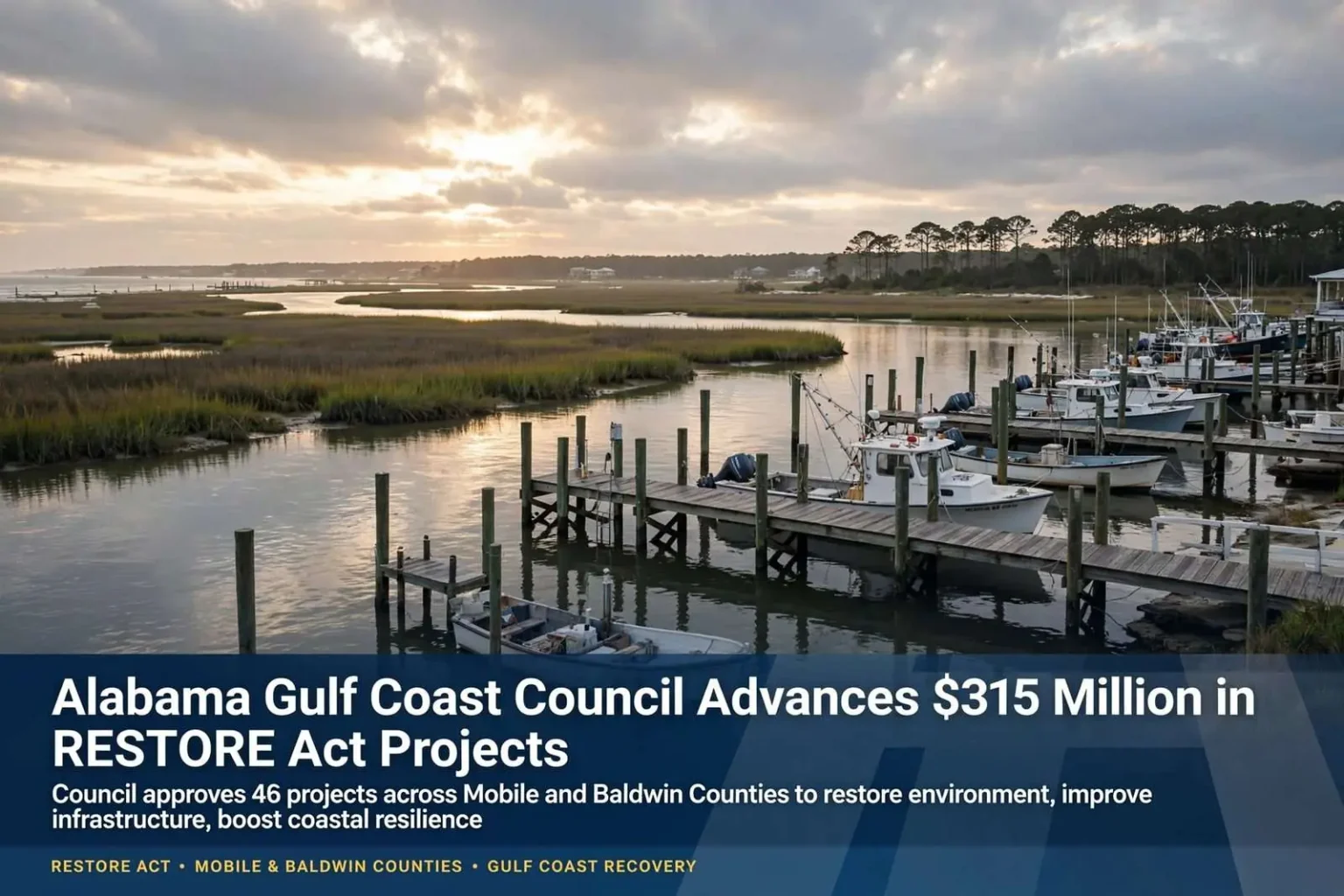
The Alabama Gulf Coast Recovery Council, the 10-member body tasked with distributing $708 million in civil penalties BP owes for the 2010 Deepwater Horizon oil spill, met recently to approve 46 projects for inclusion in a draft multi-year implementation plan worth a combined $315,358,331. The projects, largely economic or environmental in nature, will draw funding from the Gulf Coast Restoration Trust Fund once the council finalizes its plan following a public comment period and secures approval from the U.S. Department of the Treasury and, in some cases, the federal Gulf Coast Ecosystem Restoration Council.
All but one of the projects in the draft plan were approved unanimously by the council, which includes Baldwin County Commissioner Frank Burt, Dauphin Island Mayor Jeff Collier, Bayou La Batre Mayor Terry Downey, Gulf Shores Mayor Robert Craft, Orange Beach Mayor Tony Kennon, Fairhope Mayor Karin Wilson, Mobile Mayor Sandy Stimpson, Mobile County Commission President Merceria Ludgood, Alabama State Port Authority Executive Director Jimmy Lyons, and former U.S. Rep. Jo Bonner, who serves as a liaison to Gov. Kay Ivey. The draft plan represents the culmination of four years of work for the council, which selected this round of projects from roughly 370 submissions.
"If we can get the draft written in two to three weeks, then allow another 45 days for public comments, then a few weeks to review the comments … we're probably in the vicinity of four to six months before we see any of the funds," said council Chairman Jimmy Lyons, who noted the state currently has access to about $183 million from BP and expects annual payments of around $40 million through fiscal year 2031. "We had a lot of work sessions and there was a lot of discussions back and forth," Lyons said of the selection process. "I think we have a good array of projects, everybody is not going to be happy with every project, but we have some good projects and we think all of them provide significant benefits to the Gulf Coast region."
Each council member secured several projects directly benefiting the areas they represent, while all members agreed to jointly pursue funding for six proposals considered "regional" in scope. Those include $28.7 million toward the planned $52 million automotive shipping facility at the Port of Mobile and $11.3 million toward the $19.8 million cost of acquiring rights of way for the planned extension of the Foley Beach Express to Interstate 65.
Other major allocations include $56.8 million for the Baldwin County Commission to improve road infrastructure across five heavily trafficked areas between Spanish Fort and Orange Beach, $29 million for the city of Bayou La Batre to rebuild its aging docks, $14 million for the town of Dauphin Island to develop a business district along Aloe Bay, $11.7 million for the city of Mobile's Three Mile Creek restoration, and $10 million for the city of Fairhope to begin the first phase of upgrades to its aging sewer system.
Sewer projects on both sides of Mobile Bay are tentatively funded in the draft plan, alongside other water quality initiatives such as $10 million to pave dirt roads in South Mobile County, $1.1 million for stormwater improvements in West Mobile County, and $3 million for stormwater mapping and resiliency planning in the city of Mobile. Under rules established by the federal Gulf Coast Ecosystem Restoration Council, every project had to demonstrate some element of economic development, environmental restoration or tourism promotion. Speaking after the meeting, Mobile Baykeeper Executive Director Casi Callaway said she had mixed feelings about the selections. "There are some really, really good [projects], then there are a lot of roads," she said.
Callaway had previously compared road and port projects to political "pork," suggesting they would be better suited for federal transportation funding or private investment. "All of the blueway projects, the greenway, the restoration projects, they are fabulous," she said. "But it seems they missed some really good opportunities. There are some really good projects that didn't make the cut that seem like no-brainers" — pointing to a $10 million proposal to purchase private land on the west end of Dauphin Island as one example. Callaway acknowledged some projects left out of the initial draft plan could still be funded through other sources or considered by the council again once additional funding becomes available. But she said she remains "disappointed" with the council's level of public engagement throughout the process.
Projects by location
In Baldwin County, approved projects include a new stream-gaging station on the Fish River at County Road 32 ($87,250), the Lillian Park Beach Habitat and Shoreline Protection project ($626,460), longevity, stability and water quality improvements for the Bon Secour Damage and Mitigation District Authority ($340,744), Baldwin County ALDOT capacity improvements ($56.8 million), the Fort Morgan Parkway Trail Extension ($4,433,600), and Meaher Park improvements ($3.45 million). In Bayou La Batre, funded projects include redevelopment of the city docks ($21,028,000), extension of an effluent force main from the wastewater treatment plant ($15.6 million), water distribution system upgrades ($5,306,000), and collection system and lift station upgrades ($12,805,000). Chickasaw will receive $1.25 million for a sewer rehabilitation project.
Dauphin Island's allocations include Aloe Bay Harbor Town development ($14,346,382), the Aloe Bay/Mississippi Sound Water Quality Enhancement Project ($11.5 million), water distribution system upgrades ($5,306,000), and collection system and lift station upgrades ($12,805,000). The Eastern Shore will receive $1 million toward a sanitary sewer overflow prevention plan. Fairhope's projects include a community-based comprehensive land use plan ($650,000), the Working Waterfront and Greenspace Restoration Project ($6.2 million), and Phase I of a sewer system upgrade ($10 million). Gulf Shores' allocations include the Ambassadors of the Environment program ($9,748,254) and the Little Lagoon Restoration Project ($5,995,686). Mobile's projects include the Historic Africatown Restoration Center ($3,581,762), sanitary sewer trunk line rehabilitation for the Perch Creek area through the Mobile Area Water and Sewer System ($3,548,590), the Innovating St. Louis Street technology corridor project ($5,885,500), stormwater mapping and resiliency planning ($3 million), the Mobile Greenway Initiative ($9.7 million), the Three Mile Creek Watershed Restoration ($11.73 million), and the "One Mobile" complete streets initiative ($1.25 million). Broader Mobile County allocations include the Mobile County Blueway Trail Development ($8 million), a dirt road paving and sediment reduction program ($10,093,120), and stormwater management improvements for the Toulmin Springs Branch and Gum Tree Branch ($1,187,130). Mount Vernon will receive $1.5 million for a water treatment plant upgrade.
Orange Beach's projects include environmental restoration of Cotton Bayou and Terry Cove canals ($500,000), a feasibility and design study for the Gulf Coast Wildlife Recovery and Interpretive Center ($275,000), the Gulf Coast Engineering Research Station with Auburn University ($9 million), expansion of the Orange Beach Wildlife Rehabilitation and Education Center ($183,500), Alabama Point Seawall repairs ($2,488,000), Canal Road improvements ($1,842,270), and the North Sewer Force Main Upgrade ($5,195,000).
Regional projects include characterization of sand resource areas essential for beach restoration through the Geological Survey of Alabama ($922,500), a regional strategic plan for coastal Alabama developed with the Coastal Alabama Partnership ($562,500), the Alabama Gulf Seafood Marketing Program ($2,852,135), right-of-way acquisition for the Baldwin Beach Express extension from I-10 to I-65 ($11.34 million), replacement of substandard facilities at ADEM's coastal and Mobile field offices ($5,862,717), and the Alabama State Port Authority's automotive logistics roll-on/roll-off terminal ($28,767,710). Satsuma will receive $1,760,700 for a northwest water and sewer project.
How RESTORE Act money reaches coastal Alabama
The RESTORE Act, passed by Congress in 2012, directs 80 percent of the Clean Water Act civil penalties paid by the parties responsible for the Deepwater Horizon spill into the Gulf Coast Restoration Trust Fund instead of the general federal treasury. The Alabama Gulf Coast Recovery Council plans how the state’s share of two of the act’s funding streams is spent: the Direct Component, which is administered by the U.S. Treasury, and the Spill Impact Component, which requires a state expenditure plan approved by the Gulf Coast Ecosystem Restoration Council.