80,000 Tons of Rock: Nature Conservancy Builds Two-Mile Breakwater to Shield Coffee Island, Eyes Bayou Coden
The Nature Conservancy is building a two-mile, 80,000-ton limestone breakwater to protect Coffee Island in the Mississippi Sound and is working on a restoration plan for the Bayou Coden waterfront in south Mobile County.
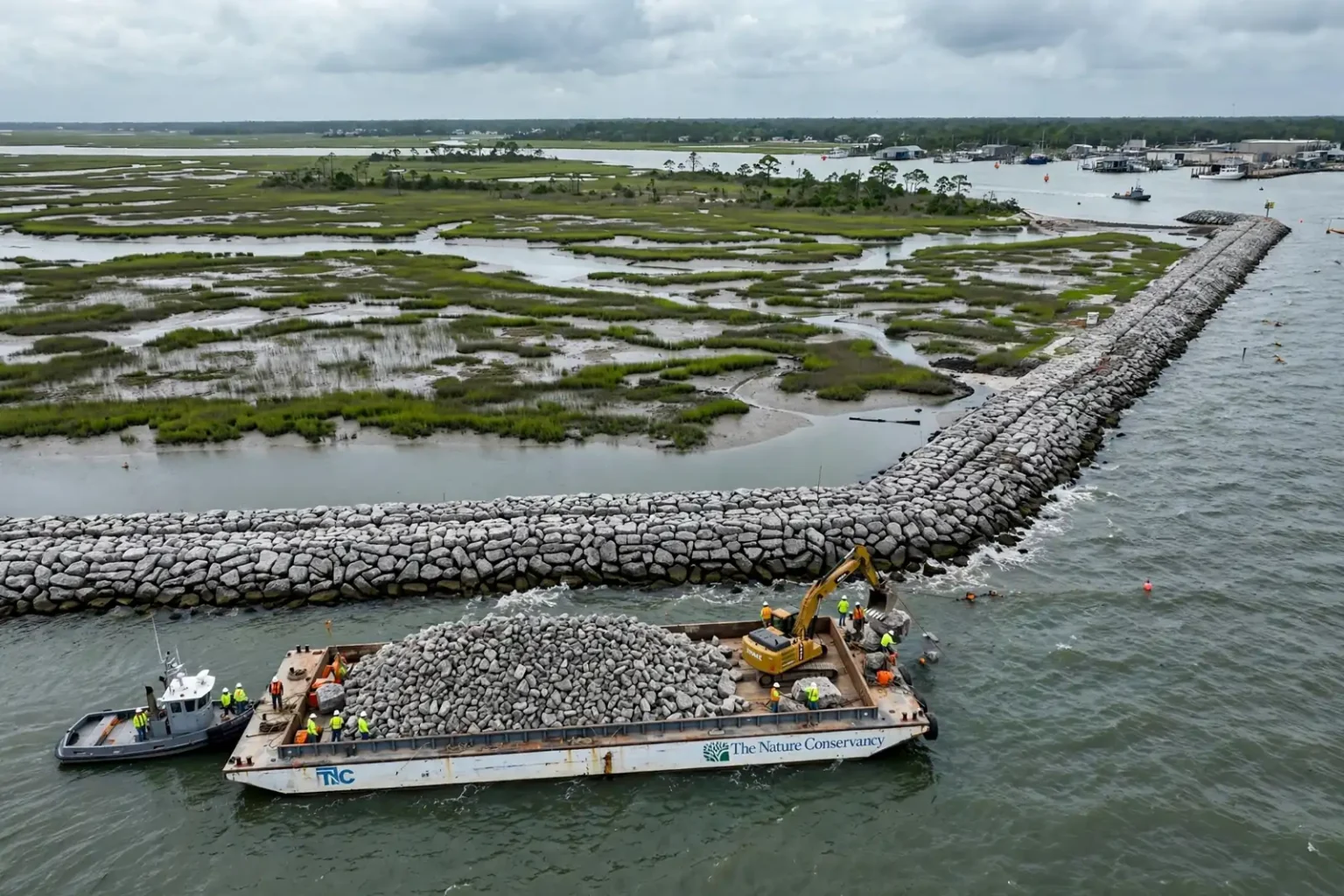
BAYOU LA BATRE, Ala. — Along a stretch of the Mississippi Sound where rising water, strong storms and relentless waves have been eating away at marsh and shoreline, The Nature Conservancy is building a new line of defense. The organization is constructing a two-mile Coffee Island breakwater made of roughly 80,000 tons of limestone rock, part of an expanded push to protect vulnerable coastal communities, wildlife habitat and the fishing and maritime industries that depend on the south Mobile County coast.
The work at Coffee Island is one of two related projects The Nature Conservancy, known as TNC, is pursuing in the area. Nearby, the organization is also working on a proposed restoration of the Bayou Coden waterfront. Both build on more than a decade of TNC restoration work in the region and aim to strengthen natural storm barriers, restore marsh habitat and protect the working waterfront.
Why Coffee Island matters
Coffee Island, also known as Isle aux Herbes, is a 29-acre barrier island in the Mississippi Sound off the Bayou La Batre and Coden area. It is the second-largest barrier island in the sound, according to TNC, and it provides nesting habitat that is essential for migratory birds and shorebirds.
The island also serves as a natural buffer against storms, helping blunt storm surge and waves before they reach nearby communities on the mainland. In a part of Alabama where seafood processing, shrimping and shipbuilding are the backbone of the local economy, that protection extends to docks, boat yards and homes along the shore.
Lessons from the first reefs
TNC has been working around Coffee Island since 2010. Its first efforts involved installing experimental reefs along the island’s shoreline to reduce wave energy and encourage habitat growth. Those reefs did provide habitat for fish and shellfish, but they were not as effective as hoped at protecting the shoreline from persistent waves and storm surge.
Judy Haner, marine and freshwater programs director for TNC, said the organization learned valuable lessons from those early efforts and applied them to the new design.
“What we learned from all of that is what we’re doing now; frankly we use rock because rock stays in place,” Haner said.
How the new breakwater is designed
The new project will use approximately 80,000 tons of limestone rock to build 10 overlapping breakwater segments along roughly two miles of shoreline. Construction is expected to take about six months.
Key features of the design include:
- Overlapping segments: Unlike the original reefs, which were separated by larger openings, the new structures overlap to provide more continuous protection.
- Room for marine life: The overlap still allows water and marine life to move between the segments and reach the marsh behind them.
- Wave reduction: The breakwaters are designed to knock down wave energy before it reaches the island’s marshes, helping preserve habitat that is especially vulnerable to sea-level rise.
- Adaptability: Haner said the rock structures can be reinforced with more rock as conditions change over time.
Breakwaters like these are placed offshore and parallel to the shoreline. Rather than walling off the coast, they absorb and break up incoming waves, creating calmer water behind them where sediment can settle and marsh grasses can hold their ground. The approach is a common tool in living shoreline projects along the Gulf Coast.
The Coffee Island shoreline work has drawn federal support. The National Oceanic and Atmospheric Administration has announced a $14.6 million award to The Nature Conservancy for Coffee Island shoreline implementation.
Restoring the Bayou Coden waterfront
Close to Coffee Island, TNC is working with engineers, local property owners and government partners on a proposed restoration of the Bayou Coden waterfront. The plan would rely on nature-based solutions, including breakwaters and newly created marsh habitat, to protect the shoreline and support the area’s working waterfront.
A key part of the Bayou Coden effort involves finding beneficial uses for sediment removed during routine dredging of nearby navigation channels. Instead of disposing of the dredged material in open water, TNC hopes to use it to rebuild eroded shorelines, create marsh habitat and strengthen natural storm buffers.
The organization is coordinating with the U.S. Army Corps of Engineers to explore how the material could be placed in designated areas as the channels are maintained. The Corps is responsible for keeping federal navigation channels open to commercial and recreational traffic, and that maintenance dredging produces large volumes of sand and mud on a regular schedule.
‘Every grain of sediment has a use’
Haner said one long-term goal is to establish a network of restoration sites that can receive dredged sediment whenever nearby channels need maintenance. Some locations could use the sediment to create new land, while existing marshes could benefit from thin layers of the material to help them keep pace with rising water levels.
That technique, often called thin-layer placement, spreads a light coat of sediment across a marsh surface so plants can grow up through it, gradually raising the elevation of the marsh rather than letting it drown as the water rises.
“Every grain of sediment has a use. It’s up to us to figure out how it fits into the puzzle,” Haner said.
Community-driven, independently monitored
Haner said community involvement is essential to the success of TNC’s restoration work.
“What happens for these projects is, we’re the implementers, but these are the community’s projects,” Haner said. “We ask the community what they want.”
TNC works with researchers from the Dauphin Island Sea Lab and the University of South Alabama to independently monitor restoration results and identify opportunities for improvement. That monitoring helps show whether a project is performing as designed and informs the next round of work, as the lessons from the early Coffee Island reefs did.
The organization has a long track record in the area. As South AL News has previously reported, TNC and its partners restored the shoreline at Lightning Point at the mouth of Bayou La Batre, adding breakwaters and marsh to shore up the inlet, and have worked on projects from the Mobile-Tensaw Delta to Perdido Pass.
Protecting habitat and livelihoods
As restoration continues across Alabama’s coast, TNC hopes the projects will demonstrate how protecting natural habitat can also strengthen communities whose livelihoods depend on the water.
“These projects will not only protect shorelines and working waterfronts from erosion, they will also restore vital habitat for birds, as well as fish, shrimp, oysters and other species,” said Mary Kate Brown, The Nature Conservancy’s director of Alabama coastal programs.
For boaters and anglers who use the waters around Coffee Island, construction activity and equipment may be present while the breakwater is built. Those on the water should watch for work vessels and follow any posted markers or instructions near the project area.