Paid Aquaculture Training Near Fort Morgan: Free Webinars Set for Oct. 27
Free webinars on Oct. 27 will explain a paid aquaculture training opportunity near Fort Morgan offered through the Gulf Integrated Multi-Trophic Aquaculture Demonstration Project.
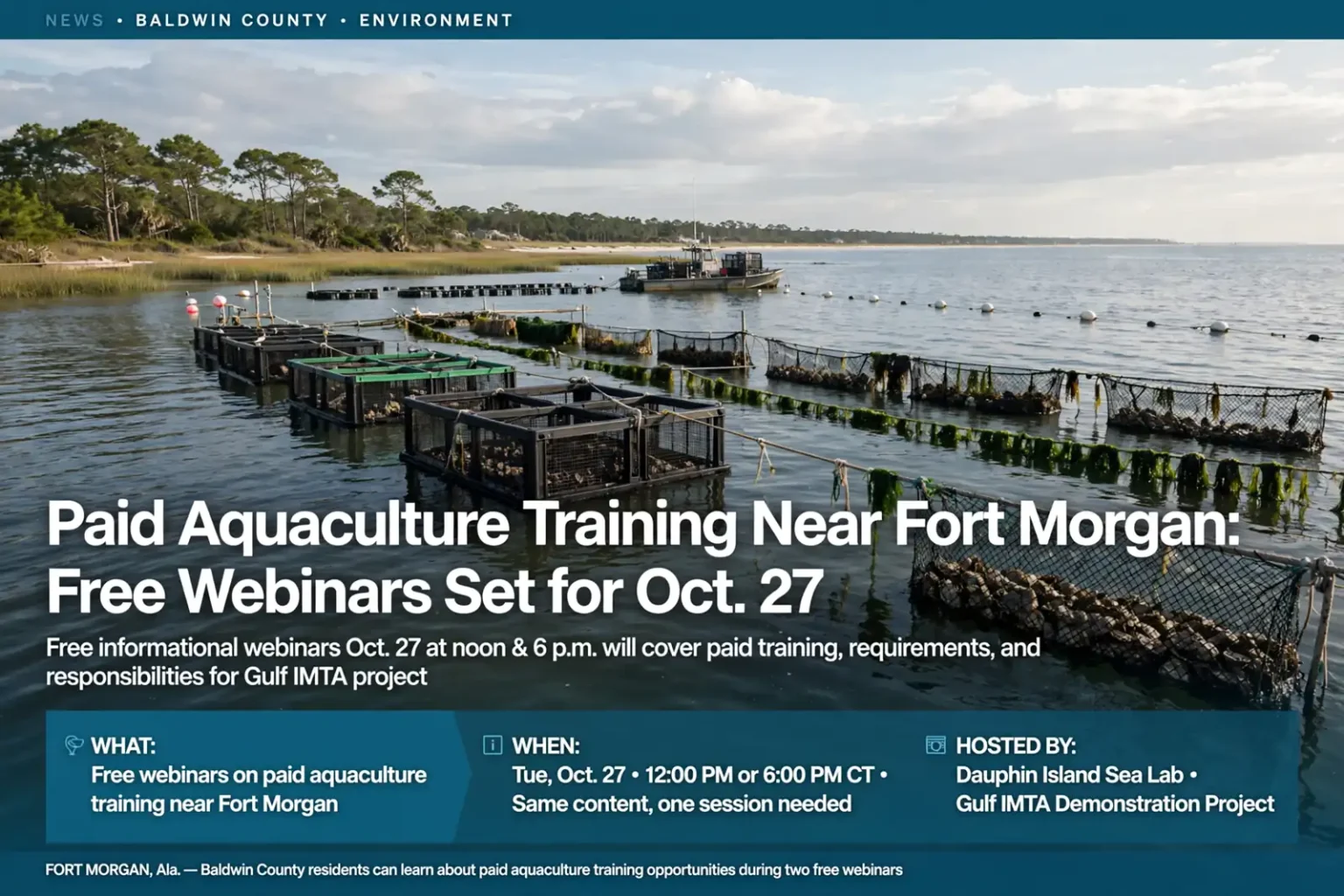
FORT MORGAN, Ala. — Baldwin County residents curious about a paid aquaculture training opportunity near Fort Morgan can learn more during free informational webinars on Tuesday, Oct. 27, at noon and 6 p.m. The sessions will explain the pay, requirements and responsibilities of the position, which may include feeding, monitoring and harvesting, according to the Dauphin Island Sea Lab.
The training opportunities are being offered by the Gulf Integrated Multi-Trophic Aquaculture (IMTA) Demonstration Project, a federally funded, state-led pilot designed to show that sustainable, nearshore aquaculture is achievable, scalable and environmentally responsible in the northern Gulf.
Both webinars will present the same information, so those interested only need to register for one time slot.
Webinar details
- What: Free informational webinars on paid aquaculture training near Fort Morgan
- When: Tuesday, Oct. 27, at noon or 6 p.m. (same content at both sessions)
- Who: Baldwin County residents interested in a paid aquaculture opportunity
- Topics: Pay, requirements and responsibilities, which may include feeding, monitoring and harvesting
- Information: Dauphin Island Sea Lab
What is aquaculture?
The National Oceanic and Atmospheric Administration defines aquaculture as the “breeding, rearing and harvesting of fish, shellfish, algae and all other organisms in all types of water environments.”
Unlike traditional fishing, which usually involves harvesting wild seafood, aquaculture involves raising and harvesting seafood in managed environments, including those close to the coast or in open waters. Along the Alabama coast, the best-known example is oyster farming, in which growers raise oysters in cages or bags suspended in the water until they reach market size.
What ‘multi-trophic’ means
Integrated multi-trophic aquaculture is an approach that raises different kinds of species together so that they complement one another. The word “trophic” refers to levels in a food web. In a typical IMTA system, species that are fed, such as fish, are grown alongside species that filter or absorb nutrients from the water, such as shellfish and seaweed. The filter feeders and plants can take up some of the extra nutrients and particles produced by the fed species, which can reduce environmental impacts while producing additional crops.
That is the idea the Gulf project is testing: whether such a system can work at a meaningful scale in nearshore waters of the northern Gulf while remaining environmentally responsible.
Why the project matters
According to project organizers, the demonstration addresses the growing domestic and global demand for seafood while supporting U.S. food production and security goals, coastal economies and workforce development.
The United States imports a large share of the seafood its residents eat, and federal agencies have promoted domestic aquaculture as one way to increase the country’s own supply. For coastal communities like those in south Baldwin County, aquaculture also offers the potential for jobs that build on a long tradition of working on the water.
The paid training positions are part of the workforce side of that effort, giving local residents hands-on experience with the daily work of an aquaculture operation.
About the Dauphin Island Sea Lab
The Dauphin Island Sea Lab is Alabama’s marine science research and education center, supported by a consortium of the state’s public universities. Located on Dauphin Island in Mobile County, it conducts research on coastal and marine environments, offers university courses and runs public education programs, including the Alabama Aquarium at the Sea Lab.
How to sign up
Those interested in learning more can register for either the noon or 6 p.m. webinar on Tuesday, Oct. 27, through the Dauphin Island Sea Lab. Because both sessions cover the same material, participants need to attend only one. The webinars are free.