DHR Childcare Subsidy Terminations Empty Prichard Daycare Classrooms as Agency Stays Silent
A Prichard daycare director says she lost about 20 children in a matter of weeks as the Alabama Department of Human Resources tightened its childcare subsidy rules, while the agency has not explained the scope of the changes.
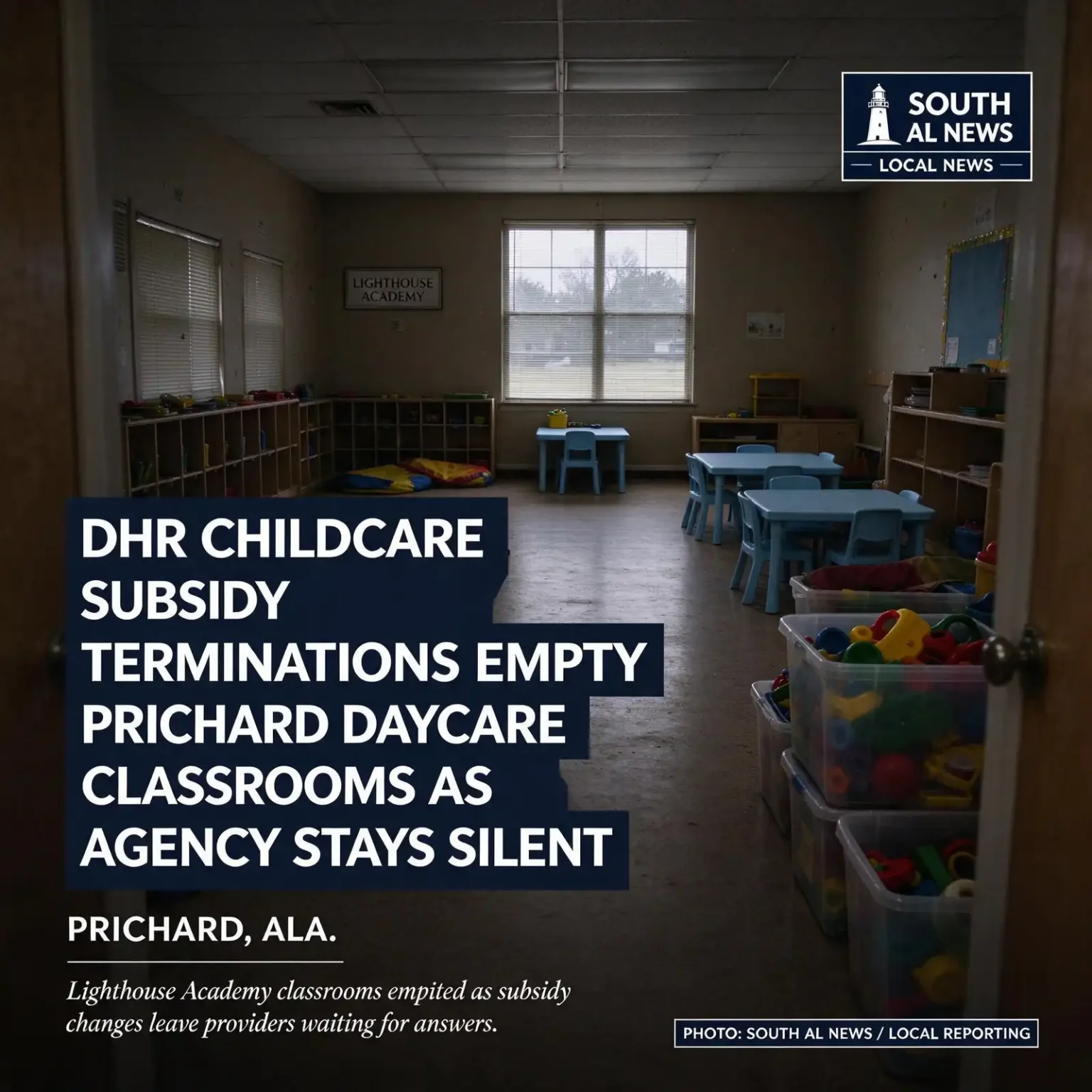
PRICHARD, Ala. — Two classrooms sit dark down the hall from Melody Patterson’s office at the Lighthouse Academy daycare in downtown Prichard. The toys have been packed into containers, the tables are bare and the doors stay closed. Just a few months ago, those rooms were full of infants and toddlers. Patterson says changes to the Alabama Department of Human Resources’ DHR childcare subsidy program are the reason they are empty now.
“In a matter of maybe two to three weeks, I lost probably about 20 kids,” Patterson said. “… I literally have three classes that are closed: the infant class that holds five, a toddler class that holds seven and another toddler class that holds seven.”
Patterson opens the center each morning and waits for dozens of children to arrive for a day of early learning while their parents go to work. In a city like Prichard, where options for early childcare can be scarce and some families cannot afford to miss work to stay home with young children, she sees the daycare as an essential community resource. Most of the children enrolled there rely on the state’s federally funded Childcare Assistance Program, which covers some or most of the cost of daycare for low-income working families.
She said she lost a few students earlier this year, but the largest share left in September. Her account, and those of other providers across south Alabama, point to a series of eligibility and enforcement changes that DHR has made with little public explanation. The agency has not disclosed the full extent of those changes, and it did not respond to several requests for comment for this story. A spokesperson did ask for a copy of correspondence describing the changes on Friday, Oct. 16.
South AL News reported on the subsidy changes earlier this month, when parents and providers in Mobile and Baldwin counties described being dropped from the program at renewal time. That earlier report detailed the income-limit reductions and the waiting list the agency put in place in May. New correspondence and provider accounts now suggest that the agency also ordered a large-scale removal of families in September.
A ‘mass statewide termination’
According to written correspondence from a childcare management agency, or CMA, one of the regional organizations that partner with DHR to run the program day to day, the state agency directed social workers to carry out a mass disenrollment of families from the program in September because of changes made earlier in the year.
The correspondence, an exchange in early October between a daycare provider and a CMA social worker about the enrollment of certain children, states that DHR ordered a “mass statewide termination” of families on the subsidy who were using more than one cellular device to sign a child in and out of daycare.
That termination stemmed from a change in who in a family may sign a child in. Families track attendance through an app that lets them scan a barcode at the daycare. Previously, only one family member had to register a specific phone with the family’s account. DHR now requires every family member who drops off or picks up a child to use a registered device.
Sam Charif, director of the Alabama Childcare Owners’ Association, said the change was made suddenly and caused some families to be removed from the program. Johnnie Frost, a Baldwin County childcare provider, said the move may have been intended to prevent potential fraud under the earlier attendance-tracking method. Some providers said the broader set of changes was aimed both at addressing the possibility of fraud and at further cutting costs so DHR can afford to keep running the program.
Around the same time, DHR reported problems with attendance recording that left parents and providers unsure whether children were being counted as present or absent. Patterson said families typically have 10 days of absences before they can be disenrolled from the subsidy.
“The state has just been made aware of a system error which has been corrected regarding notifications for absences,” read a notice posted Sept. 30. “Parents will need to resume scanning attendance beginning today. Failure to resume scanning attendance will result in your child being unenrolled from your provider.”
Patterson said she knows of several families who fell into that gap and may have been placed on the waiting list because of attendance issues.
Conflicting answers from the agencies that run the program
CMAs handle much of the program’s daily work. They help families apply and recertify, send notices about program changes, work with families on problems and process payments to providers for the government’s share of daycare tuition.
CMA directors who were contacted to explain the termination order or how many families had been removed did not respond. A CMA official in Tuscaloosa, who did not fully identify herself, said by phone that questions about CMAs should be directed to DHR. She said the email, which had been sent to a care provider from a different CMA office, was false, but that changes had been made to the program because of federal funding cuts. When asked to clarify, she hung up.
DHR has previously said it has seen no change in its federal funding. The agency has also said it does not track the number of families removed from the program.
As of September, DHR reported that 2,748 families were on a waiting list to enroll on a first-come, first-served basis, the first such waiting list in roughly eight years. That figure includes both new applicants and families already in the program who were required to reapply because of recertification problems. The written correspondence suggests the true number of affected families could be much higher. As of January 2026, roughly 29,000 families were using the subsidy.
“When I tell you it is massive attrition, it is massive,” Frost said. “The number of calls we’re getting is just mind-boggling.”
Providers in low-income areas hit hardest
Charif said providers saw an increase in removals in September and that the changes will most affect daycares in low-income areas that depend most heavily on the subsidy.
“The parent and provider communication we are receiving is that providers are being greatly impacted in minority areas. … It’s a known fact, and those facilities and centers are serving a large population of subsidized care families, and the families are getting booted off at renewal time either due to paperwork errors or due to income guidelines being changed without parents being notified,” Charif said.
“There was no planning, no progressive situation where they came out and said, ‘OK, you guys, you know, we’re doing this, and we’re going to cut you here.’ [Families] are just being cut off without warning at renewal time because they no longer meet the income guidelines.”
Charif said that although DHR has held several meetings with providers about subsidy payments, program changes, payment pauses for providers who make certain covered facility upgrades and new sign-in requirements, the agency has disclosed little to no information. Frost said she saw families leave the program at rates similar to Patterson’s around the same time.
The state plan changes
At least two significant changes appear in amendments DHR submitted to the federal government for its 2025-2027 state plan, the document that governs how Alabama runs the subsidy program, including how daycares are paid, whether payments are based on attendance or enrollment, and who is eligible. In practice, both changes will reduce the number of families using the program:
- Lower income limits: Eligibility dropped from between 180% and 200% of the federal poverty line in January, or $59,400 to $66,000 for a family of four, to between 150% and 170% in June, or $49,500 to $59,400 for a family of four.
- A narrower definition of “special needs”: The revised definition could reduce the number of children classified as having special needs from roughly 500 to about 200.
The amendments were submitted to the U.S. Department of Health and Human Services, which funds the program, but as of Oct. 1 neither had been approved by the federal government or publicly disclosed. Program rules allow DHR to put the changes into effect while awaiting approval, and HHS’s Office of Child Care was in the process of approving them as of October. DHR has not said how many families are expected to lose eligibility under the amendments. The only notice the agency appears to have given was replacing documents on its website, a step required under program guidelines.
Where did the money go?
DHR announced unexplained funding lapses in May and made the eligibility changes in response. It has not disclosed the exact source of the shortfall or whether more cuts are coming. The agency previously said it was reviewing current fiscal year finances to determine how many families could be moved off the waiting list.
State Rep. Ginny Shaver, R-Leesburg, who chairs the House Children and Senior Advocacy Committee, said the changes are likely the result of dwindling or exhausted COVID-19 pandemic-era federal funds. She said the income eligibility changes were going to happen unless more federal money was sent.
“There’s very little money with the general fund to bridge that gap. I mean, the general fund is really squeezed,” Shaver said.
During the pandemic, DHR received hundreds of millions of federal dollars to run key programs, including the childcare subsidy. By 2023, those funds allowed the agency to raise income eligibility thresholds and expand the number of families served, and helped it avoid a waiting list, something it had not used since 2018. As pandemic funds have expired nationwide, 22 other states and Washington, D.C., have begun using waiting lists or enrollment freezes in their own subsidy programs.
Federal and state figures, however, show funding increases. Nationally, the Child Care and Development Fund, which pays for the subsidy, grew from $8.747 billion in fiscal year 2025 to $8.831 billion in the current fiscal year, before DHR began its cost-saving measures in May. On the state side, the Legislature approved a roughly $5 million increase in General Fund money for DHR from fiscal 2025 to fiscal 2026, bringing it to $149.2 million.
Charif said DHR should explain the source of the shortfall and why providers were not told until May, roughly eight months into the funding cycle.
“I would like to know where the money is because it was allotted already through this year,” she said. “If they knew it was coming, you would be working on the next state plan year. So, I don’t see how it’s possible. That’s the age-old question: Where did the funding go that was already allotted and earmarked for this?”
Earlier this month, U.S. Sen. Katie Britt also questioned the agency’s explanation, saying the answers her office had received about a lack of funding were “inadequate” because Alabama’s Child Care and Development Fund allocation had increased. DHR said in a written statement at that time that “federal funding has remained fairly consistent” and that “no one was ‘kicked off’ the program,” adding that recertification is based on eligibility requirements that some families did not meet.
No hearings planned as closures loom
Shaver said her committee, which handles legislation involving DHR, likely will not hold hearings, ask the agency to explain the funding lapse or ask what other changes it plans to make to the program.
“This is normal business,” she said. “Things change, and programs change. You can’t keep funding at the higher levels. We knew it was going to drop back.”
Other state lawmakers who work on agency budgets did not respond to requests for comment.
More changes could still come. Earlier this year, HHS revised Child Care and Development Fund rules to allow states to pay providers based on daily attendance rather than enrollment and capacity. Charif and Patterson said that could, in theory, reduce payments to providers whenever a child is absent, even if the child remains enrolled.
Patterson said she hopes to avoid closing her Prichard center or merging it with another location in the Lighthouse Academy network, which has four other sites. But she said permanently closing is a possibility. At least two other providers in the Mobile County area have been identified as being at moderate to high risk of closing because of the current funding cuts.
“It’s not a good feeling, you know, and it’s because the community needs [daycares],” Patterson said.
What families can do
Families who have lost the subsidy, been placed on the waiting list or received a termination notice can take several steps:
- Contact the local childcare management agency or county DHR office to confirm their status and ask the specific reason for any termination.
- Make sure every adult who drops off or picks up a child has a device registered with the family’s attendance account, and keep scanning attendance daily.
- Keep copies of every document submitted for recertification, along with the dates, since waiting list placement is first-come, first-served.
- Ask their daycare provider about any payment options while they wait to re-enroll.
What happens next depends largely on DHR’s review of its finances for the new fiscal year, which began Oct. 1, and on the federal government’s decision on the pending state plan amendments. For now, providers such as Patterson are keeping the lights on in the rooms that remain open and waiting for answers.