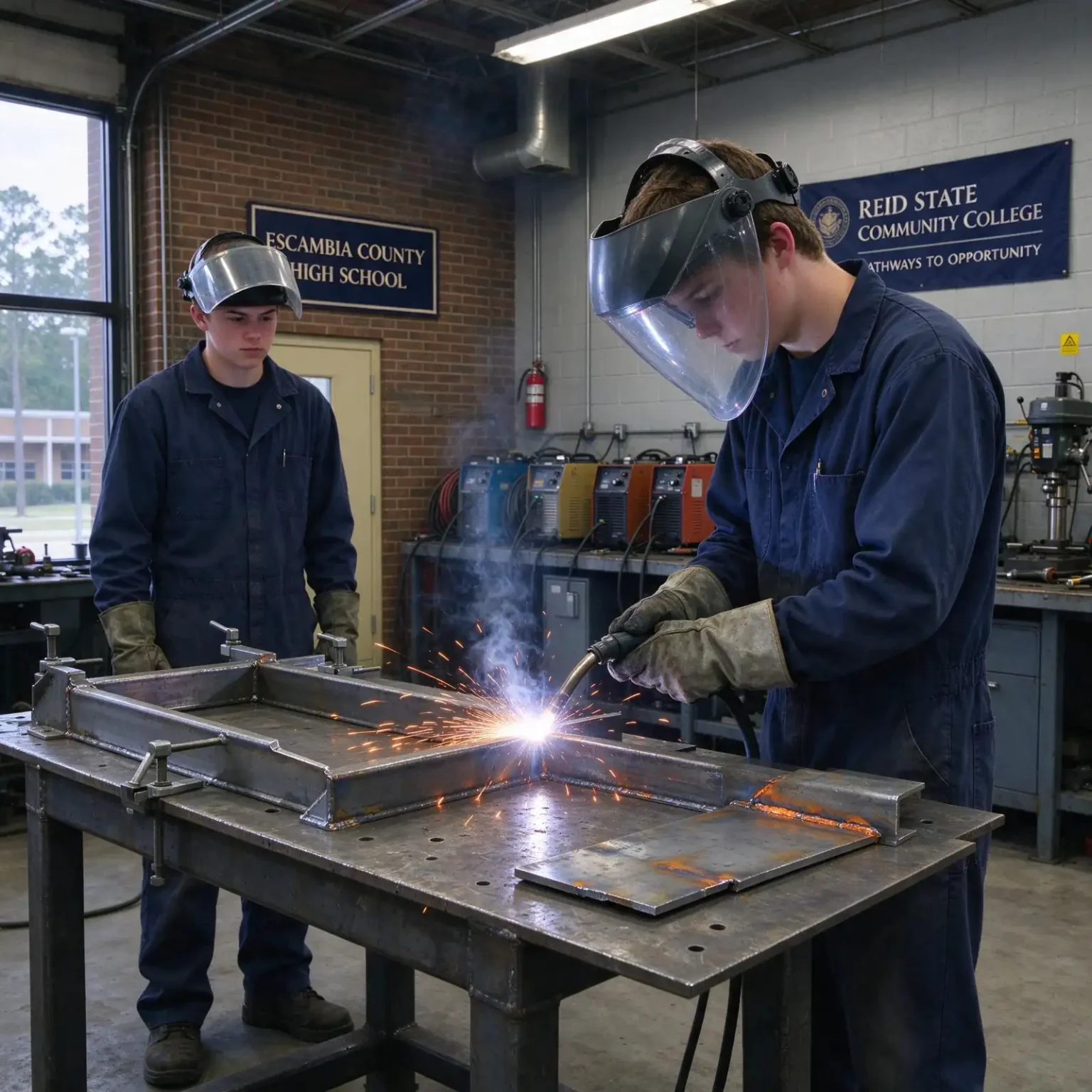
ATMORE, Ala. — The new Escambia County High welding program, housed in a newly renovated lab at the Atmore school, is giving students a head start on careers in the skilled trades, letting them take college-level welding courses through Reid State Community College and work toward a workforce credential before they finish high school.
By the time 16-year-old Zakaree Blair strikes his first arc of the day in the lab, he already knows what he wants his future to look like.
“I like working with my hands,” Blair said. “I want to learn something I can use after high school and start working.”
For school leaders and students, the program is about more than learning to weld. It is designed to create a direct path from high school to a credential, a job and a career, without requiring students to leave their community, or their high school, to get started.
A former masonry room becomes a welding lab
The program was developed through an Alabama Community College System (ACCS) workforce development grant awarded to Reid State last year. Escambia County Schools also invested in the project by renovating a former brick masonry space at the high school into a state-of-the-art welding lab.
That partnership means students can train in a modern shop on their own campus while earning college credit from Reid State, rather than traveling to a college campus for hands-on instruction.
“We wanted to give our students access to opportunities that connect what they are learning today with where they can go tomorrow,” said Dr. Latonya Gill, principal of Escambia County High School. “This program allows students to see a future for themselves while they are still in high school.”
Why welders are in demand
School and college officials point to strong demand for skilled workers. The U.S. Navy’s Submarine Industrial Base Program Office, in partnership with Reid State and the ACCS, projects a need for approximately 140,000 skilled workers over the next decade across submarine construction and sustainment.
Regional data also show about 517 annual job openings across pipefitters, steamfitters and plumbers, with a beginning salary of around $35,000. The median salary is around $54,000 a year, and some local jobs are advertising $30 to $40 per hour.
Welding skills are used across a wide range of industries, from shipbuilding and defense manufacturing to pipelines, construction, power generation and industrial maintenance. Pipefitting and steamfitting work, in particular, often requires welding pipe that carries water, steam, fuel or chemicals, which is why those trades are frequently linked to welding training. Industrial plants, paper mills and fabrication shops across south Alabama and northwest Florida all rely on these skills.
The submarine industrial base refers to the network of shipyards, suppliers and manufacturers that build and maintain the Navy’s submarine fleet. The Navy has worked with community colleges and workforce programs around the country to recruit and train welders, machinists, pipefitters and other trades workers to meet its long-term production goals.
How Reid State dual enrollment works
Reid State’s dual enrollment program allows eligible students to begin college-level academic or technical coursework as early as the summer after ninth grade.
Students who enter the Reid State welding pathway as 10th graders can build college credit and technical skills throughout high school, with the goal of earning a workforce credential by the summer after graduation.
Technical students may also qualify for state workforce scholarships that help cover tuition, books and supplies.
In practical terms, a student who starts in the 10th grade could spend three years of high school working through welding courses, then complete the credential the summer after graduation, ready to apply for jobs or continue training at a time when many classmates are just starting college or job searching.
What students learn in a welding program
Welding programs at Alabama community colleges typically begin with shop safety and the fundamentals of reading blueprints and welding symbols, then move into different welding processes, such as shielded metal arc welding (often called stick welding), gas metal arc welding (MIG), flux-cored arc welding and gas tungsten arc welding (TIG). Students also learn cutting processes and practice welds in different positions, from flat to overhead, which become more challenging as they progress.
Many welding programs prepare students to test for industry-recognized certifications, which employers use to verify that a welder can produce sound welds to a specific standard. Earning those credentials is often what opens the door to higher-paying positions.
Keeping talent close to home
For a rural county like Escambia, programs that let students train and earn credentials locally can make a difference in whether young people find good jobs without moving away. A credential earned in high school can lead directly to work, to an apprenticeship, or to further training in fields such as pipefitting or industrial maintenance.
For students like Blair, who says he wants to start working after high school, the program offers a clear route from the classroom to a paycheck.
About Reid State and Escambia County High School
Reid State Community College is based in Evergreen in neighboring Conecuh County and is part of the Alabama Community College System, which oversees the state’s public two-year colleges. The system’s colleges offer academic transfer programs, career and technical education and workforce training, and many partner with local high schools through dual enrollment.
Escambia County High School in Atmore is one of the high schools in the Escambia County Schools system. Families interested in the welding pathway or other dual enrollment options can contact the high school’s counseling office or Reid State Community College for eligibility requirements and scholarship information.